
The National Library of New Zealand catalogues A Return of the Freeholders of New Zealand, compiled from Property-Tax Department assessment rolls dated October 1882, as a volume published in Wellington in 1884. That distinction is essential. The year in the title refers to the assessment snapshot, while 1884 is the publication date of the book. Neither is a certificate that a named person owned the same land in every intervening year. Start your citation with both dates rather than silently standardizing them. Search by the printed title, the government department and the library catalogue description. If a search result is a modern database transcription or a later printed extract, trace it back to the actual volume and page. A name-only snippet loses the assessment context that makes the source historically interpretable.
Identify what the return was designed to report
The National Library title describes names, addresses and occupations of landowners, alongside area and assessed values for counties and values for boroughs and town districts. It was prepared from a tax-related assessment system rather than a genealogical census. Its purpose is property reporting; the administrative categories reflect that purpose and the rules under which the list was compiled.
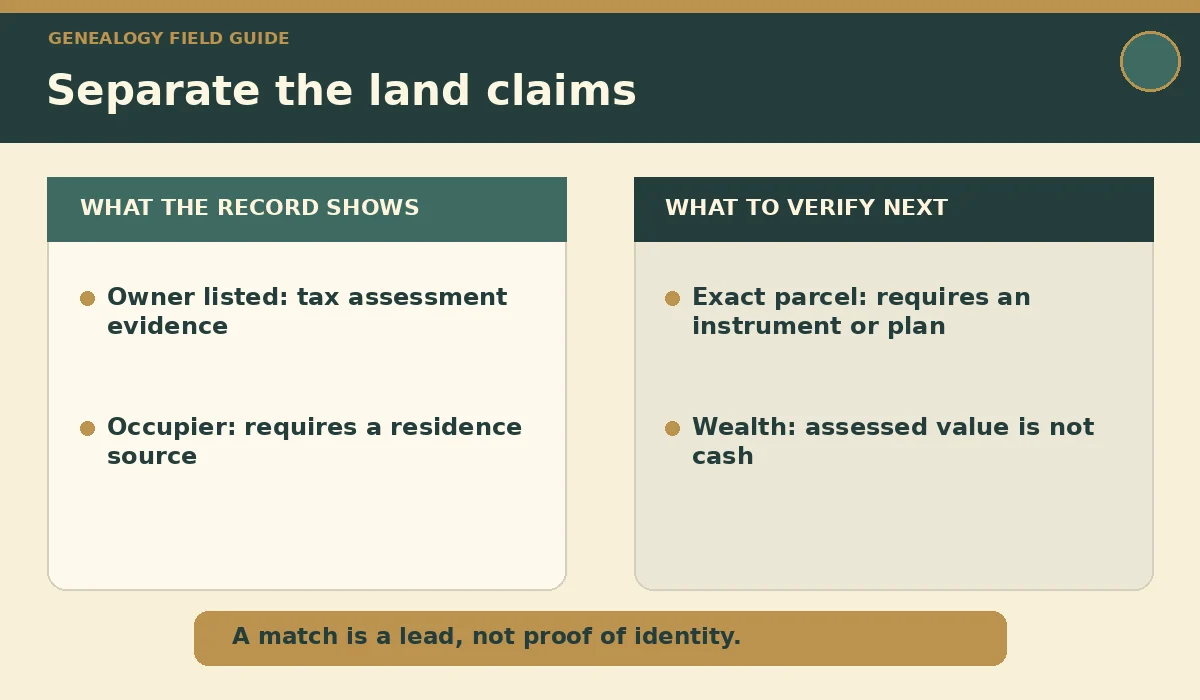
A listing can show that a named person or entity appeared in the assessment return, with the locality, acreage or value recorded there. It does not automatically prove residence at the land, uninterrupted ownership, the identity of an heir or the precise location of a modern cadastral parcel. Keep property assessed, person named and home address as separate evidence fields.
Search both surname and the historical place
When locating a candidate, capture all associated name forms, address, occupation, county or borough, stated area and value. A surname search can uncover several people with similar initials, especially when towns and farming districts are near one another. Use the administrative place classification in the original entry to narrow the match. Search a historical map and electoral or directory source for the same period.
If the book is not fully searchable online, use the National Library catalogue to determine whether a copy can be viewed or requested. Do not assume digitization solely because there is a catalogue record. Save an image or transcription of the relevant page when access rights permit, and record which part of the alphabetical publication was actually inspected.

Distinguish a taxpayer name from the person occupying land
A landowner’s address in the return may be a contact address rather than the physical residence on an assessed rural property. An owner could hold property outside the town where they lived. Equally, people working or renting on a farm may be absent from a freeholders’ list because it was not created to enumerate tenants or laborers.
Describe the person as “listed as a freeholder in the assessment” until a title instrument or other original establishes the legal estate. Avoid turning a tax valuation into a claim about net wealth or family prosperity. An assessed capital value is a measure from a particular administrative system, not cash held in a bank account or the proceeds of a later sale.
Move from the printed assessment to land instruments
To establish a chain of legal ownership, use the historic property description and date to find the relevant deeds, title registers, transfers or survey information held by the appropriate land custodian. Toitū Te Whenua LINZ describes a Land Record Search tool for titles, instruments and surveys; its present coverage and terminology should be checked before expecting an nineteenth-century document to be instantly searchable.
A good next-step question is specific: “Does a deed or title record establish that this assessed freeholder held this particular parcel?” A legal instrument may use a different name spelling, locality or plan reference, and those differences must be reconciled. Where Māori land tenure is involved, avoid forcing distinct customary and legal arrangements into a settler freehold framework; consult the proper records and community context.
| Research checkpoint | What to record | What it cannot establish |
|---|---|---|
| October 1882 | Exact source date and identifier | A surname hit alone is identity proof |
| 1884 | Original wording and relevant jurisdiction | An administrative step is a final event |
| Independent corroboration | Person, place and dated comparison | Shared names automatically mean kinship |
| Access or coverage gap | Series/item and precise search attempt | No hit proves absence |
Read 1884 newspaper commentary as context, not a name index
Papers Past includes a July 1884 Evening Star report discussing property-tax returns and the number of freeholders. That newspaper article helps explain how contemporaries described the figures, but it is not a substitute for the name-level return. Aggregate totals cannot verify that a particular ancestor was a freeholder, and newspaper summaries can contain printing or OCR errors.
Separate the government publication, later statistical commentary, and a modern property title in your citation log. Use the book for the individual assessment entry and the newspaper only to describe the public discussion at the time. If totals differ between sources, compare the cut-off dates and definitions before concluding that one is simply wrong.
A fictional case tests address against occupation
Imagine a fictional Ada Martin listed with a Wellington correspondence address and assessed rural holdings in another county. A descendant might assume she personally farmed the property or moved there in 1882. The return does not prove either proposition. Copy the listed occupation, place, acreage and value, then compare the name with a dated electoral roll, local directory and a land title or deed.
If the title belongs to another Ada Martin, preserve separate identity profiles. If an original transfer establishes the same person but a later tenant occupied the land, document the difference between ownership and residence. This is precisely the kind of clarification that prevents a family-history narrative from treating an administrative list as a residential census.

Write a citation that keeps the snapshot intact
Cite New Zealand Property-Tax Department, A Return of the Freeholders of New Zealand, assessment October 1882, Wellington government printing 1884, exact page or name entry, and the library holding or digital representation actually consulted. If relying on the National Library catalogue alone, say you reviewed its bibliographic description and that the individual page remains to be verified.
Close with a conservative claim: “The 1882 assessment return lists this name at this place with this declared category and value.” Then give the evidence for identifying the person, a deed search to test legal title, and any remaining uncertainty about who lived on the land. That three-part conclusion is more reliable than a confident but unsupported ownership story. For the same kind of choice in another place, see our guide “1828 NSW Census”.
How We Research New Zealand Freeholders
We reviewed the repository descriptions and historical finding aids cited below on October 22, 2026, and compared the intended question with prior GenHis article topics. The example names and situations in this guide are fictional and do not reproduce original named people’s private records. Administrative sources can be incomplete or affected by access restrictions; we describe each reported field and date as applicable to its specific series, not as a universal guarantee. Check the current item-level catalogue, rights, fees and restrictions before requesting or publishing information.
More Records and Archives Guides
Original catalogues and archive guides for New Zealand Freeholders
National Library of New Zealand: bibliographic record of the Return of Freeholders compiled from October 1882 property-tax rolls and printed in 1884 (natlib.govt.nz).
National Library Papers Past: 1884 contemporary report on property-tax assessments and published freeholder totals (paperspast.natlib.govt.nz).
Toitū Te Whenua LINZ: modern search for titles, instruments and survey records; separate from historic tax listings (www.linz.govt.nz).
Editorial and affiliate disclosure: This independent educational article is not sponsored by the repositories listed here, and it includes no paid partner links. Verify original documents and respect any restrictions affecting living individuals, historical allegations or medical information. Read the GenHis affiliate disclosure for the site-wide commercial-link policy.
It describes assessments as of October 1882 and was issued as a government-printed volume in 1884.
Its title describes owners’ names, addresses, occupations, areas and land values, with different detail for counties and towns.
No. A listed ownership interest and an address do not establish personal residence on a specific parcel.
The National Library of New Zealand catalogues the printed Return of Freeholders under its historical government publications.
Trace a matching historic property description to an appropriate deed, title instrument or survey record and confirm the person’s identity.