
The New Zealand Police Gazette is a historical police publication, not a list of everyone convicted of an offense. Issues beginning in 1877 contained varied official notices, including wanted or missing people, crimes, property, descriptions and, in some periods, photographs. Archives New Zealand has digitized tens of thousands of Gazette images, but access to more recent issues is restricted: its guidance treats Police Gazettes differently from other police files, with a 70-year restriction measured from closure. A genealogical result should therefore be described by its exact notice type, date and page—not as automatic proof of guilt, identity or a complete criminal history.
Choose the right publication and issue date
Start with the historical period, reported locality and approximate police event. The National Library identifies The New Zealand police gazette as beginning in 1877; holdings and digitized access can vary by issue and provider. A relative’s known residence in 1910 does not by itself indicate that their name appears in that year’s Gazette. Ask instead whether a specific notice can corroborate a dated event or description from another source.
Record the publication date separately from the date of an event described inside. A notice may be published after an incident or may repeat earlier information. Consult the front matter or issue header rather than borrowing a date from a search-result snippet. The issue date, page and notice heading are essential for a citation.
Locate issues through official collections
Archives New Zealand describes its digitization of over 39,000 Police Gazette images in a recent archival project and shows examples from 1909 and 1929. The National Library offers a catalogue route toward online historic issues through Papers Past. Confirm that you are using a Gazette issue rather than a general newspaper, a district police file or a modern web article quoting an old notice.
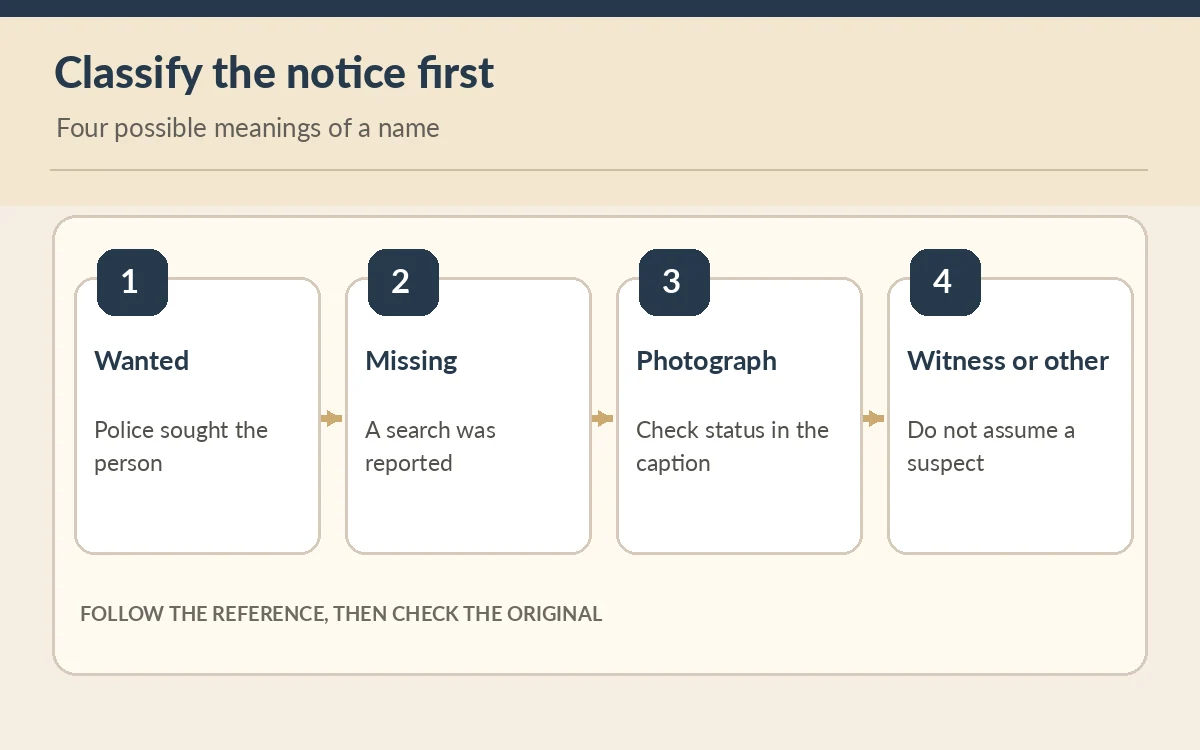
An indexed snippet can hide a name in a list of unrelated people. Open the original issue or page image when permitted. Identify the section heading and read surrounding lines to see whether the person was wanted, missing, sought as a witness, recorded after release or merely mentioned in correspondence. Do not treat a photographed page as an authoritative portrait identification without the printed caption and a second source.
Apply the correct access restriction before searching
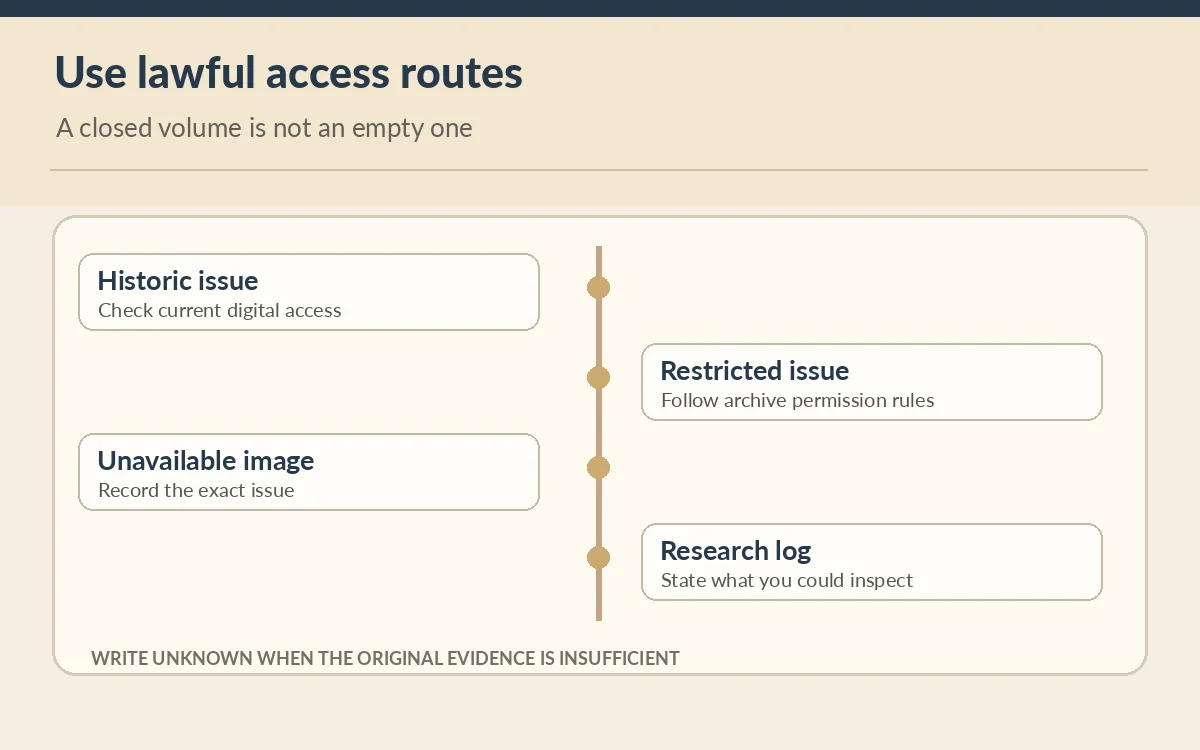
Archives New Zealand states that Police records are generally restricted for 100 years from closure while Police Gazettes are subject to a 70-year restriction. The New Zealand Police Museum also directs genealogical researchers to Archives New Zealand for government police records and confirms that different closure periods apply. These are access conditions, not a promise that every older issue will be online. Our guide “Queensland Government Gazettes, 1859–1900” goes into more detail.
When a desired issue is not viewable, consult the archive’s current access instructions. Do not suggest bypassing authentication, using illicit mirrors, or inventing a direct download link. Note the issue range you requested, your question and the repository response; a closed issue is not evidence that a person was never documented.
Classify the notice before interpreting a name
A wanted notice records an official inquiry at the time of publication. A missing-person notice describes a search. A description accompanying a property report may identify a witness or suspected party, while a photograph of a discharged prisoner records a different administrative status. These categories have very different implications for genealogy. Never infer a conviction from a wanted notice, or assume a named associate was present at the reported scene.
Transcribe the exact notice heading, person’s reported description and geographic clues. Historians should also note historical police terminology may be biased or dated. Use neutral language in your own analysis and place quoted words in context. For family relationships, prefer later civil records or directly identifying documents over labels in a Gazette paragraph. Our guide “Tasmania Police Gazettes, 1861–1933” goes into more detail.

Verify a photograph against independent identity evidence
Archives New Zealand’s photographic guide identifies Gazette photographs among historical police image series, as well as separate prisoner photograph collections. A photograph showing a name can be an important visual clue, but the caption may be short and the image alone cannot establish a family connection. Compare the printed identifying data—where given—with a birth year estimate, residence, occupation or another dated record.
Photographic similarity is subjective. Two images of people with similar facial features or clothing do not establish identity, and an apparent age may be misleading. If the documentary details conflict, retain the Gazette image as an unverified candidate rather than labeling it as an ancestor in a public family album.
| Source | Strongest use | Proof limit |
|---|---|---|
| Wanted notice | Person officially sought | Not proof of conviction |
| Missing-person entry | Search was reported | Not proof of death |
| Discharged-prisoner photo | Published administrative image | Identity needs corroboration |
| Closed issue | Access currently restricted | Not evidence of absence |
Try a fictional notice-to-person comparison
Imagine that a family letter mentions a railway worker called Samuel Lee in Wellington in 1911. A Gazette index contains a Samuel Lee in a property notice in a nearby district. The name and place create a candidate, but the notice may describe someone who made a report, someone sought by police, or a person whose property was missing. Read the actual heading and text before assigning a role.
Then compare a contemporary address or employment record. If the Gazette has no age or occupation, that absence should lower confidence, not invite invention. The Samuel Lee account is purely fictional. A reproducible result logs exact issue, page, category, wording and an independent record that supports or contradicts the identity.
Recover OCR misses and incomplete issue coverage
Historic printed text, columns and scans can cause incorrect OCR and name indexing. Search multiple variants, including initials and local place names; when the likely issue date is known, browse neighboring issues and headings rather than relying only on keyword hits. Log the search query, date range, source interface and any issues not available. A blank keyword result is not proof that no notice exists.
Photographs may appear in supplements or separately classified material. Do not assume every published description includes an image, or that all police photographs were published in the Gazette. If the record falls outside the open period, report the restriction and a legitimate archive enquiry route rather than fabricating a negative result. To go further, our guide “Victoria Police Gazettes, 1853–1971” shows how to find notices and check the evidence.
Cite with care for descendants and living people
A sufficient citation identifies the New Zealand Police Gazette, publication date, notice section, page or image identifier, repository/platform and access date. A separate citation should identify any civil record used for identity confirmation. Keep the original wording in a controlled research note while writing a balanced public summary of what the Gazette actually recorded. If that is your next decision, our guide “Queensland Police Gazettes, 1864–1945” explains how to find names and original issues.
The material may include accusations, details of vulnerable people and dated discriminatory language. Avoid speculative conclusions about character, motives, ethnicity or inherited traits. For publicly shared family stories, consider whether a name or photograph could affect living relatives, and do not turn an official historic notice into a modern allegation.
How We Research New Zealand Police Gazettes
We checked Archives New Zealand’s Gazette digitization and photographic guides against the National Library publication record and New Zealand Police Museum access instructions. These sources distinguish issue content, photos and restricted police files. We did not claim universal name indexing or open access to recent volumes. Samuel Lee is fictional; each real identification should be tied to an original page and independent document.
More Records and Archives Guides
Original Archive Guides and Finding Aids for New Zealand Police Gazettes
Archives New Zealand: Gazette images, contents and digitization project (www.archives.govt.nz).
Archives New Zealand: police photo series and 70-year Gazette restriction (www.archives.govt.nz).
National Library: New Zealand Police Gazette publication and Papers Past record (natlib.govt.nz).
New Zealand Police: 100-year police files and 70-year Police Gazette access guidance (www.police.govt.nz).
Editorial disclosure: This guide does not contain a paid placement or affiliate recommendation. Read the GenHis affiliate disclosure for our site-wide policy. Historical records may contain errors, unequal treatment or distressing descriptions; cite original context and avoid exposing private information about living people.
The National Library identifies its publication as beginning in 1877.
No. Holdings, digitization and the 70-year closure restriction affect access.
No. The notice records a search or inquiry, not a final verdict.
Some historic issues and supplements contain photographs; not every named person was pictured.
Compare issue, section, locality and identifying details against independent contemporary evidence.