
A Queensland Government Gazette is an official publication announcing government actions and legal notices. It can place a historical person in a specific administrative event, but rarely supplies a complete family narrative. The State Library of Queensland identifies notices concerning appointments, insolvency, land, naturalisation, police matters, registered occupations, wills and transmission of property. For genealogy, the strongest method is to find the exact notice and then pursue the original record created by the same office or court. Start by writing which administrative event you want to establish.
Use the correct historical run and access path
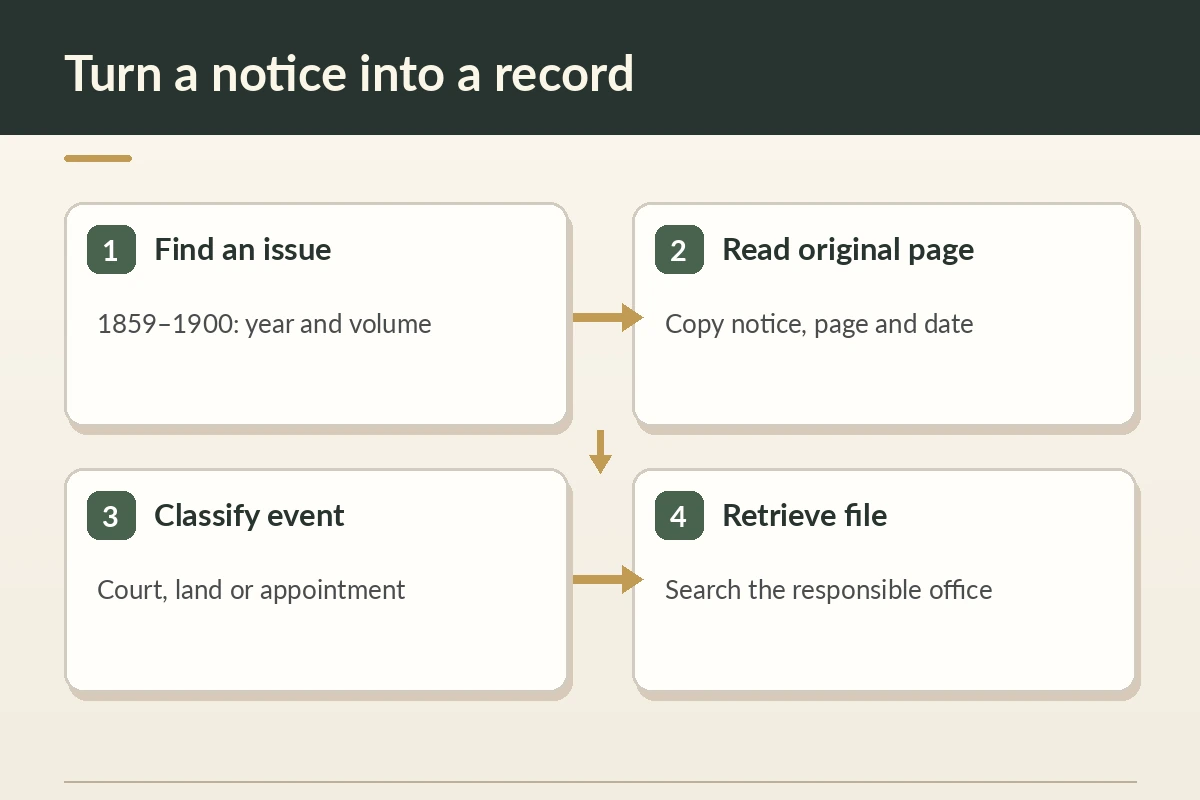
The National Library of Australia directs readers seeking historic Queensland Government Gazettes for 1859–1900 to the free Text Queensland collection. The State Library of Queensland describes access to this span in online, microfiche, microfilm and print formats. Those are collection descriptions, not a guarantee that every scanned page will OCR-search perfectly. Do not confuse the colonial Queensland Gazette with the Commonwealth of Australia Gazette, which began in 1901, or with an ordinary newspaper article reporting a government announcement.
Search first by the type of notice you need
Surname searches alone are unreliable for a publication with many pages, changing typography and historical spelling. Choose a category—land lease, public-service appointment, insolvency, probate, naturalisation or a relevant license—and identify a plausible date range before searching. Use associated place names, office titles, nearby land descriptions or an employer’s name. If a search service returns no matches, browse indexes and dated issues. A common surname plus a large date range can overwhelm the result list without increasing confidence about the person.
Capture the notice date, page and wording
Open the page image, not just an OCR snippet. Record the gazette’s exact publication date, issue or volume number, page, notice heading and the person’s name as printed. Keep adjoining paragraphs when they specify the office or legal action involved. A proclamation date and the date the notice was printed may differ. For instance, a court order mentioned in a Gazette is not necessarily an order issued on publication day. Preserve both dates in your chronology with labels describing what each one means.
Follow an estate notice to the court record
A notice about an intestate estate, administration or probate may identify an executor, estate or court step. It does not reproduce the deceased person’s complete file, inventory or will. The National Library’s court-records guide notes historical Queensland indexes of wills, intestacies and insolvency notices published in Gazette runs. Use the person’s name, notice date and relevant court or district to look for the corresponding archival case or grant. Do not infer inheritance amounts, beneficiaries or kinship from the existence of a notice unless those details appear in the actual source.
Follow a land notice to tenure and survey records
The State Library lists land orders, land sales and leases, land reserves, transfers and related administrative actions among Gazette notices. A person named in such a notice might be an applicant, lessee, neighboring party or public official; the heading and wording determine the role. Record the lot, run, parish, district or survey description and then locate original selection, title, survey or correspondence files. Publication of an offer or application does not itself prove completion of a purchase or long-term occupancy.
Follow an appointment to a personnel timeline
Government Gazettes can document public-service appointments, transfers, promotions, retirements and registrations of certain professions. If an ancestor is named, record the office, employing department and effective date exactly. Then compare directory entries, newspaper announcements and departmental or employment files for continuation. An appointment notice supports an official employment action at a point in time; it does not prove the employee held the post throughout an entire decade. Separate changes in appointment from subsequent service history.

Search naturalisation and police notices cautiously
The State Library’s law-collections guide includes naturalisations and police notices among Gazette subjects. The terminology and legal categories in historical notices reflect their time and can be biased. A printed list may refer to an administrative stage rather than the complete file, and a person’s name can be misspelled in a notice or digital transcription. Search the relevant administrative archive for a register, application or related record before declaring a legal status or attaching a stigmatizing event to an ancestor. Avoid republishing unnecessary information about living people.
Use an index when OCR misses the surname
The National Library identifies indexes issued with the Gazette and historical consolidated indexes, including a Queensland Gazette consolidation for 1859–1919 available through subscription-library access. A free search that fails can therefore be followed by index browsing or a library-based lookup, rather than forcing a conclusion that no notice exists. Narrow the search to a year, category and district, then inspect likely page ranges. Capture the entire scope of your unsuccessful search, including the indexes or issues examined.
Apply a fictional notice-to-file example
Imagine a fictional 1878 Gazette entry naming Clara Evans in a land-leasing notice near Ipswich. A later 1881 directory also lists a Clara Evans, but the directory does not show that the lessee and resident were the same woman. Transcribe the parcel identifier and notice date, find the land-selection or lease file, and then test address, occupation or associates in a third record. If the parcel and household evidence do not connect, record the candidates separately. The notice becomes a well-dated research lead, not automatic proof of ownership.
Design a citation that survives a broken search link
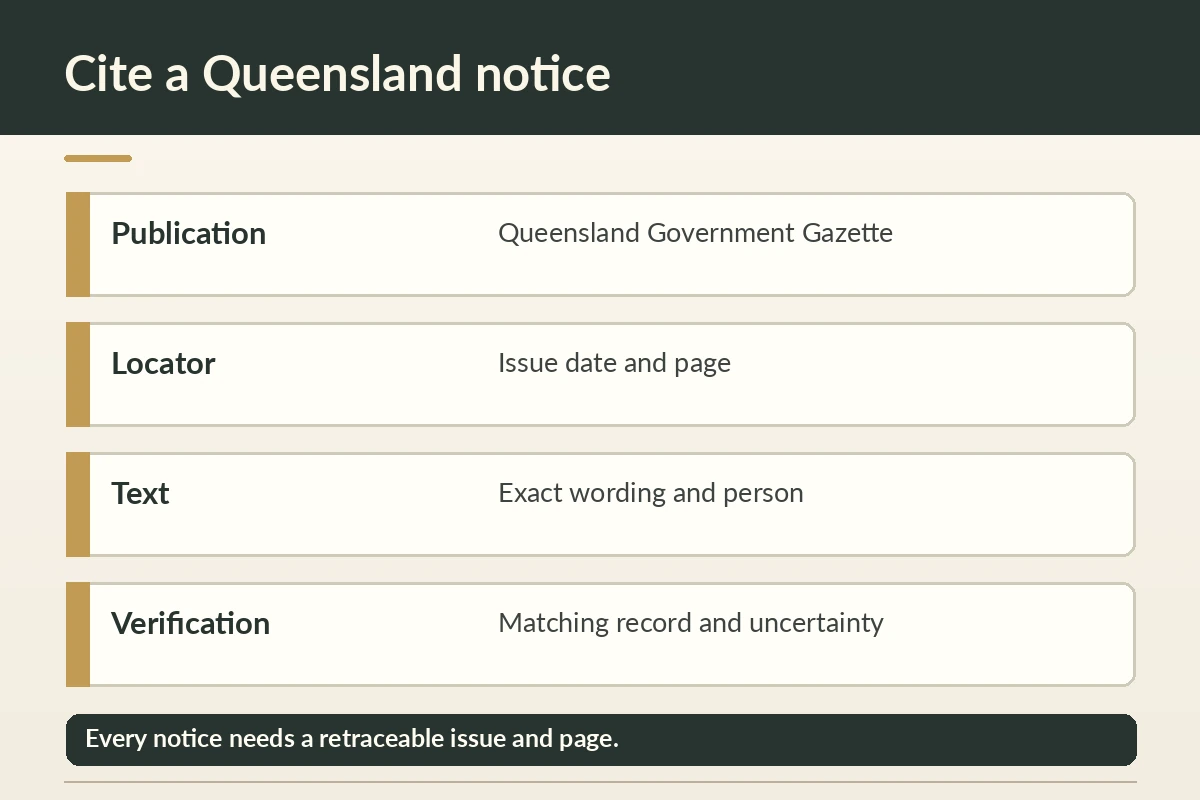
Cite the title Queensland Government Gazette, the issue date, page and notice heading, then identify where you viewed it, such as Text Queensland or a State Library holding. If the page has a persistent image link, save that alongside a local research-log entry. Do not cite only a transient list of search results. When you infer a connection between the notice and an archival file, provide separate citations for each and explain the basis for the link. That gives another reader enough information to locate and evaluate the same administrative action.
Know when a Gazette search cannot settle the claim
Not every civil or private event would trigger an official Gazette announcement. A missing notice cannot prove that a person was never married, never owned property or never worked for the government. Gazette coverage and text recognition introduce additional limitations, especially for damaged print. When the issue you need is missing or unreadable, check alternate library holdings and the underlying records directly. Express your conclusion narrowly: what the examined issues show, what remains unsearched and which repository could provide a stronger source.
| Gazette notice | Next original record | What not to assume |
|---|---|---|
| Estate or insolvency | Court file, grant or administration | Notice contains a complete estate |
| Land selection or lease | Application, title and survey | Applicant became an owner |
| Official appointment | Personnel and departmental file | Employment lasted indefinitely |
| Naturalisation notice | Naturalisation register or file | Notice proves every legal stage |
How We Research
This guide was written from the issuing archival institutions’ collection guidance and the National Library of Australia or another named primary custodian where appropriate. We checked the described record classes, stated years, search directions and limitations as of October 21, 2026. Illustrative people are fictional and are not presented as transcripts of authentic cases. The method separates an online index from an original image and a historical assertion from a proven family relationship. This article is educational and not legal, medical or genealogical certification advice.
More Records and Archives Guides
Queensland Gazette collections and indexes
State Library of Queensland guide listing kinds of Gazette notices and 1859–1900 holdings (www.slq.qld.gov.au).
National Library of Australia guide to government gazettes and historical Queensland access (www.library.gov.au).
National Library guide to Queensland wills and insolvency Gazette indexes (www.library.gov.au).
Editorial disclosure: GenHis is an independent educational family-history publication. No sponsorship or paid archival access is asserted in this article. Check current repository access terms and protect living people’s information. Read our affiliate disclosure before following any commercial links elsewhere on this site.
The National Library of Australia points to Text Queensland for digitized historical editions; the State Library lists other formats.
No. They are official government-notice publications, although newspapers sometimes reproduced or reported some announcements.
Not necessarily. It may announce an application, lease or administrative decision. Check the underlying tenure or title record.
Browse issue indexes, narrow by date and notice category, or consult consolidated indexes through relevant libraries.
Usually no. Use the notice to locate the relevant court or probate file and inspect that record separately.