
Start with the two Queensland State Archives indexes labeled Wills 1857–1940: one for digital material and one for nondigital material. Search both, capture the full will number, district, year and QSA item reference, and then inspect the original ecclesiastical file. An index entry is a route to an estate record, not proof that every deceased Queenslander left a surviving will. The key research task is identifying the correct court file and separating what it states from family relationships you still need to verify.
Why these indexes are not a universal list of deaths
The original entries derive from ecclesiastical estate files of the Supreme Court districts. A file exists because an estate required court handling, not because everyone who died was routinely listed. A will written privately might never have been probated. Conversely, a person with relevant estate proceedings could have died elsewhere. Begin with a death-place hypothesis but avoid filtering out every nonlocal candidate. A Queensland civil death registration, burial notice or contemporary address can establish which namesake you are seeking. These documents answer different questions; keep them separate in a source log rather than treating the probate index as a substitute death register.
Search digital and nondigital indexes independently
On Queensland State Archives Search the Indexes, choose Courts and find both Wills 1857–1940 resources. Search a surname with broad given-name variants, including initials and spelling changes; then refine by district and year where the interface permits. Repeat the same queries in the second index. Digital versus nondigital describes access pathways, not two different legal classes of wills. A missing result in one should never be described as an absent will until the other has been checked. Capture the date you searched, exact search terms, and any failed spelling variants so a later researcher can repeat your work without guessing.

Respect the changing court-district coverage
QSA currently describes coverage for all Supreme Court districts from 1857 through 1900, and its online Wills index description specifies Northern and Southern district files from 1901 through 1940. Do not take a Queensland-wide 1940 label to mean that every Central District proceeding is included in the displayed name indexes after 1900. If a person lived near Rockhampton or otherwise belongs in a potential gap, use the catalogue, relevant court series and QSA research assistance before drawing a negative conclusion. A date range on a landing page is a search limit, not a guarantee that all surviving items have been indexed or digitized. Our guide “Queensland Divorce Petitions, 1861–1894” goes into more detail.
Capture identifiers beyond the person’s name
The government data dictionary lists fields such as last and given names, will number, year, district, QSA reference, item ID, microfilm number and series ID. Some entries may omit values. Transcribe all populated identifiers exactly, including the court district and any note about the record. These data make an archival request reproducible and distinguish two residents called Mary Brown far more reliably than name alone. Save the stable item or catalogue URL if shown. A search-result screenshot without the numbered archival reference may become impossible to reconstruct after the interface changes. Treat a microfilm reference as a locator, not as a statement of content.
Read a complete surviving file before citing a relationship
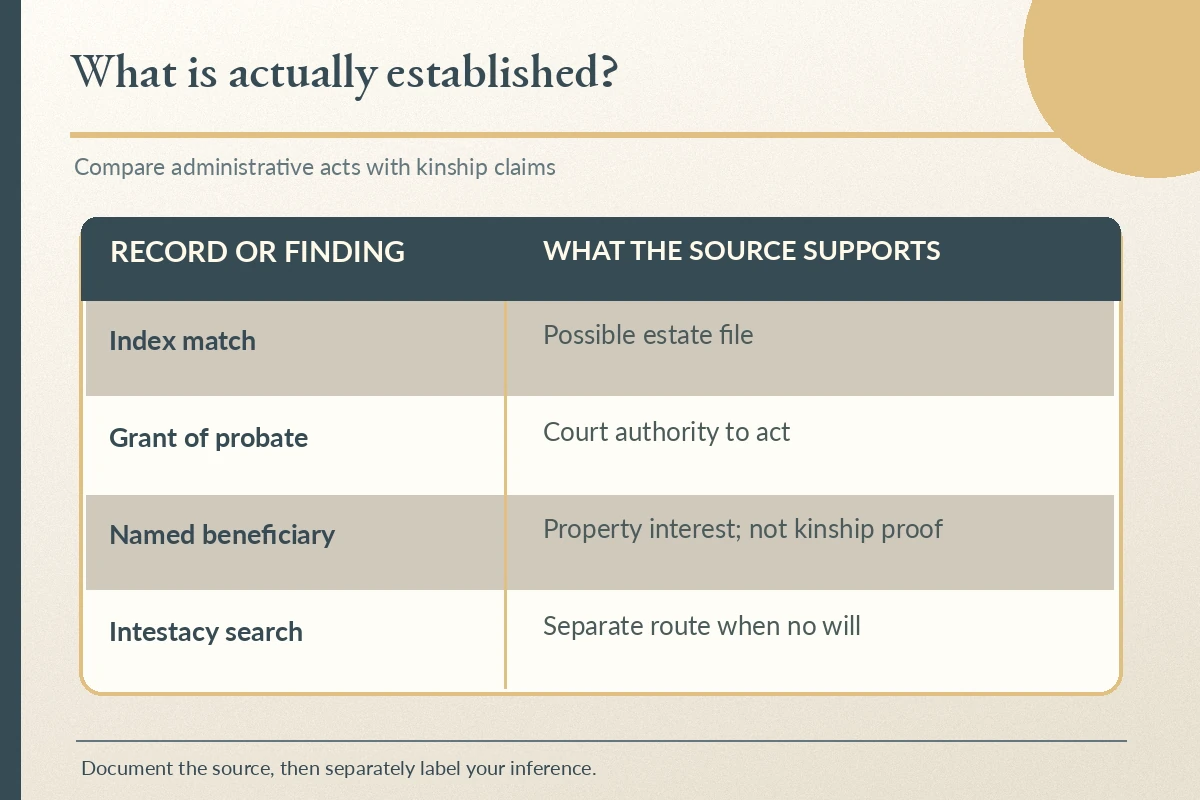
An ecclesiastical file may include a will, application, grant and supporting papers, but the exact combination varies by item. Read the whole accessible file, identify who wrote each document and distinguish the date of the will from the later date of probate. A beneficiary is not necessarily a child; an executor is appointed to administer an estate, and may be a relative, a friend or a professional. If the will uses “my niece,” cite the exact passage and seek a separate birth or marriage chain to establish the relationship. If the record contains only an index line, say so; do not describe unseen pages as though examined.
Use a fictional two-candidate identity test
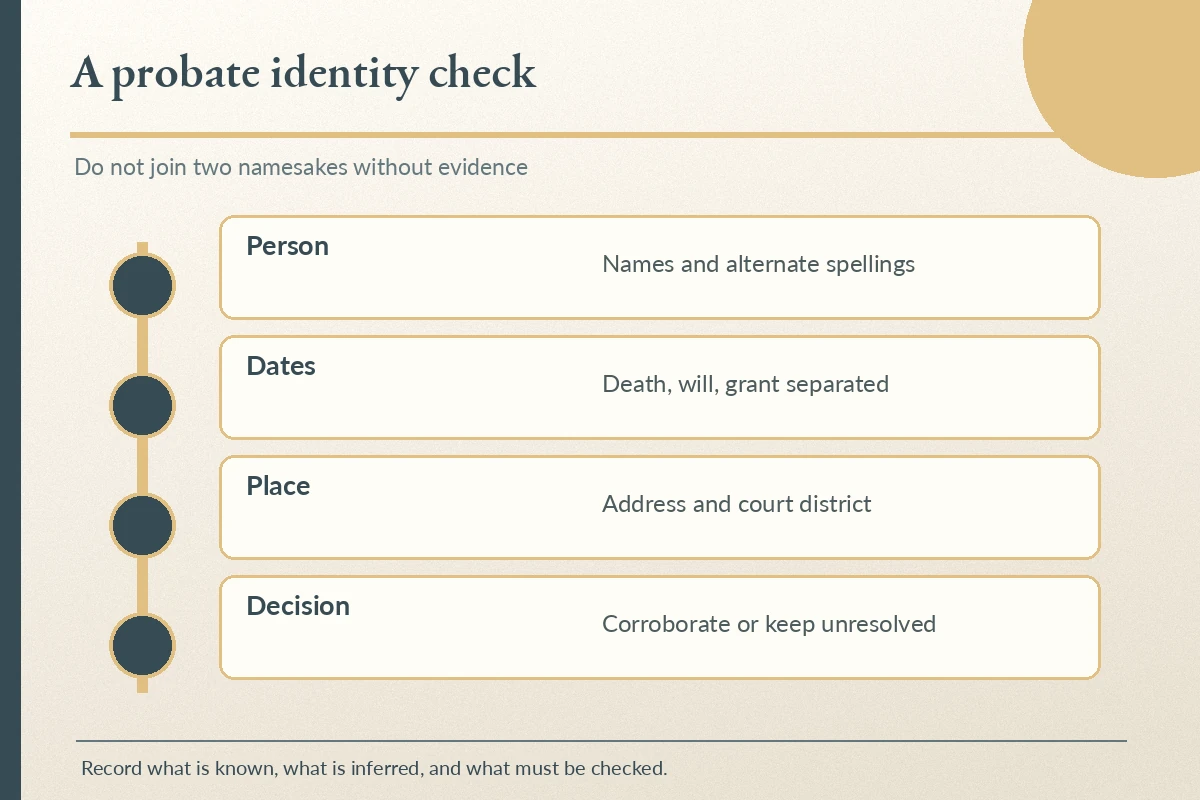
Suppose an index yields two similarly named men in neighboring districts in 1896 and 1898. The example is invented and does not describe real files. Make rows for name form, residence, death date, occupation, court district, will number and independently documented family members. A year alone is not enough: death, will signing and grant may differ. If one candidate has a verifiable residence matching a civil death registration, prioritize that original file, but keep the second as unresolved until excluded. Record disconfirming evidence rather than silently dropping it. The method prevents attractive beneficiaries from being attached to the wrong household.
When the will index is empty, consider intestacy
QSA distinguishes will files from intestacy and Public Curator holdings. An estate administered without a proved will may be recorded through an administrator or curator instead; that category is not a hidden page in the named wills index. Recheck the approximate death and residence using independent sources, then follow QSA guidance for intestacies, trustee files and court catalogue material. The existence of a family story about a written will does not establish that probate occurred. A responsible no-result statement gives both index names, ranges, search variants and why the second estate-record route remains plausible. Our guide “NSW Deceased Estate Files, 1880–1958” shows how to find property and death duty clues.
Create a claim-by-claim estate worksheet
Transcribe the estate document into a simple grid: quoted or summarized statement, document author, document date, relevant person, archival page and what remains uncertain. Separate “executor named” from “executor served,” “estate refers to land” from “this person occupied the land,” and “beneficiary was called son” from a proven birth link. Legal terminology changes through history; do not project current succession rules backward. Attach each conclusion to the page where it appears and mark any issue caused by illegible handwriting, missing attachments or restrictions. This makes later family-tree edits auditable and prevents one disputed sentence from supporting multiple unchecked claims.
| Question | Search or record | Do not infer |
|---|---|---|
| Was a file indexed? | Both QSA wills indexes | A complete will survives |
| Which proceeding? | Will number, district, item ID | Every district is equally covered |
| Was there a will? | Original probate papers | Every deceased person left one |
| Who was related? | Will wording plus independent BDM | Beneficiary means child |
Choose the next source based on the missing fact
For identity, compare a death entry and dated residence. For a stated kinship, trace civil or church registrations for both parties; for property, consult land or rate records; for probate completion, request the actual grant. Queensland Government Gazettes may provide notices and clues to court activity, but a notice is not itself the original probate file. If the record is nondigitized, consult the current QSA catalogue and access options rather than assuming an image is freely online. Write down a clear unanswered question before each new search and update your citations when an original document replaces an index hypothesis. Our guide “Queensland Inquest Records, 1859–1905” shows how to find files and verify death clues.
How We Research
We checked Queensland State Archives index descriptions, Queensland open-data records and the official field dictionary, and compared the intent with the existing GenHis probate and BDM guides. The sample identity case is explicitly fictional, and an index entry is not presented as a viewed court file.
More Records and Archives Guides
Official sources and archival guidance
Queensland State Archives names separate digital and nondigital Wills 1857–1940 indexes and summarizes their court coverage (www.qld.gov.au).
QSA places wills and trustee files among its court holdings and describes the search route (www.qld.gov.au).
Queensland Open Data documents provenance and update metadata for nondigitized will-index entries (www.data.qld.gov.au).
Queensland Open Data describes the distinct digital Wills 1857–1940 index (www.data.qld.gov.au).
Also, Queensland data dictionary specifies name, will number, district, year and QSA identifiers (www.data.qld.gov.au).
Independent genealogy information, not legal or probate advice. Availability, copying arrangements and restrictions can change; no paid service is recommended. See our GenHis affiliate disclosure.
Search both Queensland State Archives Wills 1857–1940 indexes under Courts, then identify the original item.
No. It describes the indexed access route; use the QSA item reference to locate open holdings or request a copy.
Do not assume so. The QSA description identifies district-specific coverage and a narrower post-1900 set in its displayed online indexes.
Not on its own. Check the exact document wording and independently documented civil or church connections.
Try variations and the court catalogue, then investigate intestacy and Public Curator records rather than concluding there was no estate.