
To locate a nineteenth-century Queensland inquest, search both the digitized and nondigitized Queensland State Archives inquest indexes for 1859–1905. Copy the complete file and archive identifiers, then determine whether the underlying papers are viewable or need to be requested. An inquest investigated the circumstances of a death; its existence does not automatically establish a crime, and a witness account is not necessarily an independently confirmed fact.
Understand what an inquest actually records
A coroner or magistrate investigated certain deaths to clarify identity, circumstances and possible cause. Queensland State Archives explains that relevant inquiries could also concern fires or missing people, while preliminary inquiries did not always proceed to a formal inquest. A death certificate, newspaper notice and coronial file are therefore different records, made for different purposes. Begin with a specific person and an approximate date of death, but do not require the inquest date to equal the death date. A hearing could follow later; archive dates may refer to administrative filing rather than the underlying event. The goal is to identify the investigation, not to fit every date into one column.
Search both official 1859–1905 indexes
QSA presents two separate name-search resources labeled Inquests 1859–1905: digital and non-digital. Search the suspected surname, then try given-name initials, spelling alternatives and a date window. Retain plausible results until the original file is inspected. The digital label describes the index group whose listed records were digitized; it does not make the nondigital group nonexistent. Also note that a 2025 QSA guidance document describes an older 1859–1902 online range, so the exact current index title and individual record coverage matter more than assuming one range describes every file. Log the interface used, query and search date.

Record all identifiers before leaving the index
The Queensland Government dataset’s published fields include last name, given names, year, file number, QSA reference, earlier and newer item identifiers, series ID and digital image ID. Not every entry has every field. Copy the fields that are actually populated, without interpreting an empty digital-image field as proof that a case never occurred. A file number and year can identify an investigation more reliably than a surname alone, especially when several unrelated people share initials. Save a stable catalogue link or a complete repository citation when available. This allows another researcher to recover the same archival item even if search screens change. Our guide “Queensland Wills, 1857–1940” goes into more detail.
Inspect the papers, not just the index summary
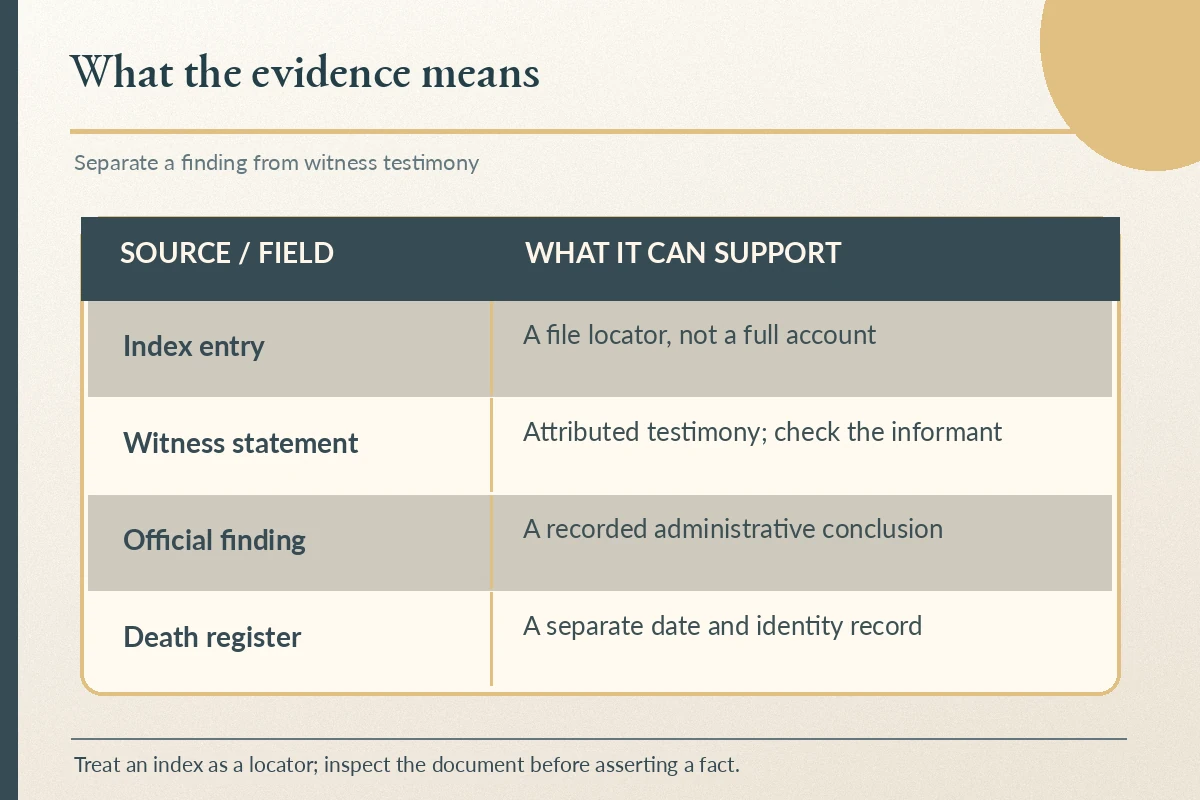
QSA describes inquest files as potentially containing place and date of the inquiry, the deceased’s identity and occupation, witness depositions and administrative action. The surviving document may be a full file, a register entry or a limited group of papers. Read the document’s heading, all leaves, the names of witnesses and the finding if preserved. Separate what a witness says they observed from what they heard from someone else, and from what the coroner formally recorded. Transcribe ambiguous wording and mark omissions. A sensational newspaper account should not silently replace the wording of the official investigation.
Build a two-date death and inquiry timeline
A useful worksheet carries distinct columns for death date, inquiry date, file year, registration date and newspaper-publication date. For a fictional 1891 death investigated in early 1892, a file dated 1892 may be correct even when the death register reports 1891. The example is invented; it is not an archival citation. Compare people’s names, location and circumstances before accepting this explanation. If the dates conflict, preserve both readings with their exact source and image reference. A difference may be an administrative delay, transcription error or evidence of two unrelated people. Do not choose the most convenient date without a documented reason.
Check whether the inquest established identity
Coronial investigations can include descriptions of a deceased person or third-party identifications. Ask who identified the person, how they knew that person, whether there were contradictions, and whether the deceased had a familiar name variant. A shared surname or a matching age may be weak where mining towns or ports had several people with similar identities. Compare the file with the civil death registration, an employer or residence record, and a dated family document. Record each source’s informant. A person named as a witness is not necessarily a relative, and a relationship stated by one witness may need a separate marriage or birth record to verify it.
Recover a result when the name search fails
Search a narrower place and date where the interface permits, then try alternate spellings and a broader range of inquiry years. Consult QSA’s court-record guidance for additional inquest or preliminary-enquiry series outside the name indexes. A historic locality may appear under another district, and an index may omit a file that exists in the catalogue. If the newspaper reports an inquest, record its issue date, town and exact wording; use those details as search leads rather than treating journalism as proof of archival survival. For a nondigitized holding, follow the repository’s current access or copying instructions and note any restriction. Our guide “South Australia Inquests, 1877–1930” goes into more detail.

Use a three-level claim test
Grade each assertion as (1) a documented administrative fact, such as a dated inquiry; (2) an attributed testimony, such as a witness’s description; or (3) a research inference, such as a proposed family relationship. These categories are not a judgment on a witness’s character. A witness deposition may be contemporaneous but mistaken about a birth date or name, and an official conclusion can reflect the inquiry’s limited evidence. If a file reports a possible accident, do not upgrade “possible” to “proved.” When you make a family-history claim, quote only the relevant wording in your own research notes, cite the file, and find independent evidence.
| Research question | Best first evidence | Required caution |
|---|---|---|
| Did an inquiry take place? | QSA index plus file reference | A listed inquiry is not a criminal verdict |
| When did death occur? | Civil death registration | File year can be later |
| Who identified the deceased? | Witness deposition | Check informant and namesake |
| What did investigators conclude? | Full surviving inquest papers | Finding differs from allegations |
Plan a responsible follow-up
Coronial material may contain distressing allegations and personal information about survivors. Read historic terminology in context and avoid turning tragedies into entertainment. Restrict any publication of information about potentially living descendants to what is necessary and appropriate, even if the older record is accessible. A practical next search might be a civil death entry, cemetery register, work accident record or adjacent newspaper issue. Choose the next record because it tests a named uncertainty—for example identity or place of death—not simply because another search engine exists. Record both a positive result and a careful, scope-limited negative search. For the fuller picture, see our guide “NSW Coroners’ Inquest Registers, 1834–1942”.
Cite the archival item so others can retrieve it
A reproducible note should include Queensland State Archives as repository, collection or series, file title or person, file and year, item or QSA reference, and the image or access link used. Store the exact wording of any contradictory date beside the citation. An index entry should have its own citation until the original file has been viewed; do not cite a full inquest as read when you saw only a dataset row. This distinction makes later revision easier when improved scans or further pages become available.
How We Research
We compared Queensland State Archives court and index guidance with the Queensland Government open-data description and data dictionary. Each step distinguishes metadata from a record image and a finding from witness testimony. We did not use a historical person to fabricate an example or assume that every index row contains a complete image.
More Records and Archives Guides
Official sources and archival guidance
Queensland State Archives lists separate digital and nondigital Inquests 1859–1905 indexes (www.qld.gov.au).
QSA explains inquests, preliminary inquiries and its court-record guide (www.qld.gov.au).
Queensland Government describes the provenance and limited coverage of the digitized inquest index (www.data.qld.gov.au).
Official data dictionary identifies file, year, QSA, item and digital-image identifiers (www.data.qld.gov.au).
This is independent educational guidance, not coronial, medical, or legal advice. Historical death investigations can contain sensitive testimony. This guide contains no affiliate links. See our GenHis affiliate disclosure.
No. QSA provides separate digital and nondigital index groups, and survival or image access must be checked for the particular item.
Not necessarily. The date can refer to the inquiry or administrative file, which may follow the death.
No. An inquiry assessed circumstances, and a charge is a separate outcome that must be documented.
Only if the statement establishes that claim and independent records support the relationship; merely being named as a witness does not prove kinship.
Keep the name as indexed, year, file number, QSA reference, item identifier, source URL and date searched.