
Most historical City Coroner inquest files for South Australia during 1877–1930 cannot be retrieved: State Records SA says they were authorized for pulping during World War II. For these years, search the surviving Police Reports to the Coroner instead, especially GRG1/44 (1879–1982), and investigate GRG1/39 and local police-station registers where appropriate. Begin with the deceased person, event location and date. A police report can document an investigation without proving that a full formal inquest occurred or that a particular account of the death was correct.
Begin with the archival loss, not a missing name
The State Records SA guide explicitly identifies a major historical loss: City Coroner inquest files for 1877–1930 were authorized for pulping during the Second World War. This is a series-level preservation problem and not evidence that a particular person was never investigated. An index to GRG1/27 may identify other periods, especially 1867/1869–1876 and 1931 onward, but it does not reverse the known loss in between. Set a coverage note at the top of your worksheet before doing name searches. Doing so prevents repeatedly requesting a file that cannot be produced and preserves time for surviving administrative alternatives. To go further, our guide “Queensland Inquest Records, 1859–1905” shows how to find files and verify death clues.
Understand what a police report can show
A report to the City Coroner was compiled by police and forwarded for a decision about whether an inquest was necessary. The official series description explains that this decision stage preceded any formal hearing. Such papers may contain reported identity, location, statements, circumstances and correspondence, but availability varies by file. A police report is not automatically the coroner’s finding; in some cases an inquest did not follow. When summarizing the evidence, attribute statements precisely: “the officer reported” or “the witness stated,” not “the investigation proved.” A civil death registration answers related but different questions and should be consulted independently.

Search GRG1/44 and note its geographic scope
State Records SA lists Police Reports to the City Coroner series GRG1/44 for 1879–1982, and notes that until the 1960s the main series related to Adelaide metropolitan matters. It also includes reports of deaths of patients at Parkside and Adelaide lunatic asylums. Do not call it a complete statewide database. The official guide flags gaps between 1884 and 1891, and yearly indexes from 1911 to 1966. Search with a date range broad enough for the reporting period, note the original spelling, and obtain the actual series or item reference. A no-result in an Adelaide series does not establish that nothing was investigated in a distant town.
Check GRG1/39 and local station evidence
The archives identifies another Police Reports to the Coroner series, GRG1/39, for 1884–1891. Some station archives also preserve local inquest registers. The official guide names Blinman, Carrieton, Jamestown, Waukuringa and Yongala examples, with distinct register ranges. A station register can note an inquiry without containing the detailed City Coroner case papers. Search the appropriate district and dates rather than assuming these registers were compiled statewide. If a regional newspaper describes the inquest, use its exact town and date to choose a station or catalogue query. Keep the newspaper account separate as published testimony, not an archive substitute for every missing legal document.

Use digitized guides without assuming all pages are online
State Records SA points to FamilySearch digitization of GRG1/44 and GRG1/39 and lists date intervals within those collections. Access through FamilySearch requires a free account according to the archive. Some archival items may not have online images; the archive advises requesting information or a copying quote using specific references. Verify what you actually saw: a dataset listing, film image, register page or complete report. A missing online image can represent nondigitization or an access condition rather than missing source material. Save exact reel, dates, digital item locator and any restriction information while the interface is open.
Reconstruct a cautious event timeline
For a fictional reported death in 1902, create five columns: reported death, police report, coroner decision, possible hearing, and newspaper publication. The example is invented and should not be cited as evidence about a real family. Some columns may remain blank because the 1877–1930 inquest files were lost; leaving them blank is an honest result. The date of a police report might follow the date of death, and a newspaper report might refer to a proceeding days later. Do not fill the missing hearing date from assumptions, or convert a death-certificate cause into a verdict without checking what the surviving documents actually say.
Distinguish a missing file from missing evidence
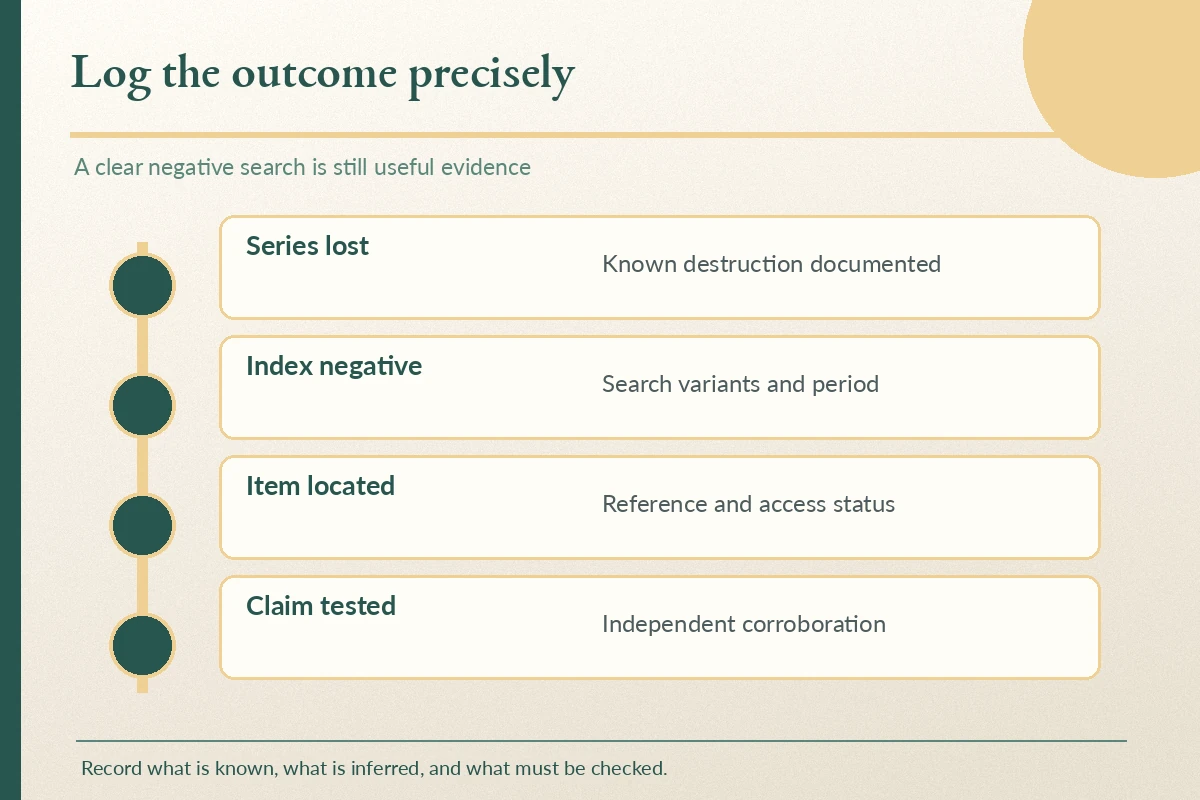
Three conditions often look similar in a search screen: the GRG1/27 inquest series was destroyed for the target era; a particular GRG1/44 police file is not indexed or digitized; or the person may not have been a case for the City Coroner at all. Treat each separately. In a research log label loss confirmed by the repository, coverage uncertain, index negative or original file examined. Other records—death registrations, cemetery administration, historical newspapers or local station material—may test a person’s identity and circumstances. Their combined agreement can support a conclusion but does not magically recreate the exact wording of a destroyed inquest finding.
Handle testimony and distressing material respectfully
Coronial and police records can contain graphic allegations, mental-health descriptions, violent death accounts or sensitive references to surviving family members. The repository warns that some twentieth-century material contains graphic photographs and that copying graphic media may be prohibited. Its access rules generally distinguish police material available after 50 or 60 years from coroner material after 60 years, subject to item conditions. Follow current access guidance rather than circumventing restrictions. Preserve historical wording accurately when essential, but avoid unnecessary sensational detail. An accusation made in testimony does not automatically establish guilt, and a reported relationship should be corroborated through independent sources. Our guide “Western Australia Historical Inquests” goes into more detail.
| Record group | Relevant years | What it can tell you |
|---|---|---|
| GRG1/27 inquest files | 1877–1930 lost | Do not request presumed surviving files |
| GRG1/44 police reports | 1879–1982 | Officer reports; decision leads |
| GRG1/39 police reports | 1884–1891 | Additional police-report route |
| GRG5 station registers | Local ranges | Some regional inquiry entries |
Write a useful negative search and request
A strong archival citation identifies State Records of South Australia, series GRG1/44 or GRG1/39, item details, document date, viewed page and access route. An honest negative conclusion states that GRG1/27 inquest files for the target era were destroyed, which alternative series were searched, and whether the local station has a suitable register. If the original is nondigitized, ask the repository about the specific identified item rather than requesting “all inquests” for a common surname. Next choose a source that addresses an outstanding question: identity, residence, date, or the existence of a later formal finding. Avoid declaring criminal or family conclusions from incomplete papers.
How We Research
We checked State Records SA’s official coronial guide and both GRG1/27 and GRG1/44 catalogue descriptions. The key loss warning is a repository statement, not a deduction from empty search results. Timelines and names used as examples are fictional.
More Records and Archives Guides
Official sources and archival guidance
State Records SA explains original inquest-file loss, surviving police reports, early series and regional registers (www.archives.sa.gov.au).
Series GRG1/27 official description confirms pulping inquest files for 1877–1930 and documents their record scope (catalogue.archives.sa.gov.au).
Official series GRG1/44 covers Police Reports to the City Coroner, 1879–1982, and identifies its administrative purpose (catalogue.archives.sa.gov.au).
State Records SA records digitized access routes to coronial police reports (www.archives.sa.gov.au).
State Records SA explains index and access restrictions for court archives (www.archives.sa.gov.au).
Archival research guidance only; not medical, criminal or legal advice. Material may be distressing or subject to access and copying restrictions. No affiliate products are promoted. See our GenHis affiliate disclosure.
State Records SA says GRG1/27 City Coroner inquest files for those years were authorized for pulping during World War II.
Start with Police Reports to the Coroner GRG1/44, then assess GRG1/39 and relevant police station registers.
No. Reports could be forwarded so the Coroner could decide whether a formal inquest was needed.
The main series chiefly concerned Adelaide metropolitan deaths until the 1960s; search relevant regional holdings separately.
Some are digitized through FamilySearch, but access, completeness and item restrictions vary; check the archives guidance.