
Western Australian coronial records are scattered and often incomplete. The State Records Office expressly cautions that relatively few old inquest files have survived. The State Library’s Dead Reckoning guide explains that prior to 1976 inquests were routinely destroyed after ten years, although reports and references can survive in other record classes. A death mentioned in a newspaper may therefore have generated an inquest whose original case papers no longer exist. The first job is to identify a likely locality and date, then discover which record stream for that district survived.
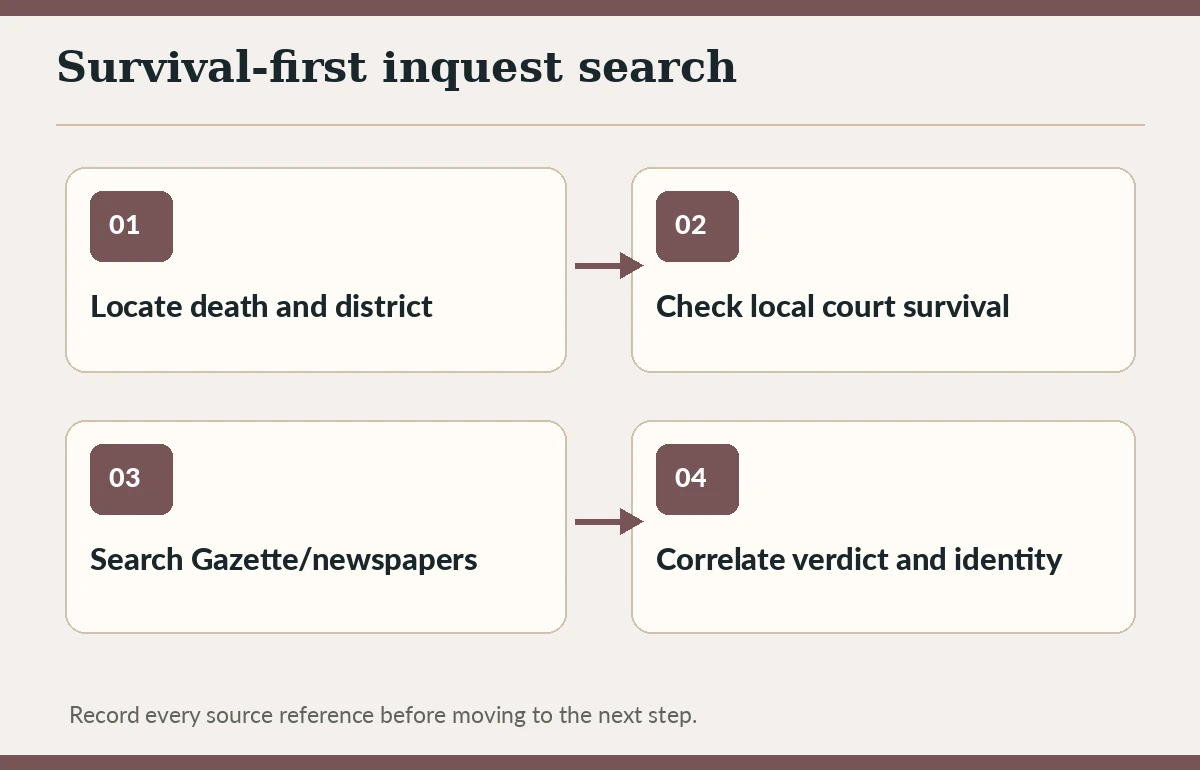
Start with survival, not a statewide name search
The practical research question is not merely “Was there an inquest?” but “Which surviving contemporary source documents the event and what conclusion does it actually report?” Create a dated event sheet recording death, inquiry, report publication and burial as separate dates. A death registration and a coroner’s inquiry may supply different facts. Do not use one to infer missing names, testimony or legal findings in the other.
Route the case to a courthouse or police station
The State Records Office advises that early coronial material is most usefully pursued through records of the local courthouse or police station. Its published examples include Albany reports before a magistrate, 1864–1875, Series 1646 Consignment 348, Boulder Police Station inquest books for 1911–1924 and 1932–1937, and a Yalgoo Coroner’s Court inquiry book for 1897–1948. These are examples of local holdings, not proof that every named case appears in each range.
Start with the place of death or where the inquiry was held, not today’s nearest metropolitan court. Search the archival catalogue for the historical courthouse, police station, magistrate or district, and inspect the series description for gaps, date span and access limits. Record a series number and consignment or item reference. A local register entry may summarize a verdict, whereas the report itself may contain witness evidence. Do not claim to have read the testimony if you have only a register.
Use the Police Gazette and newspaper indexes carefully
The State Library of Western Australia notes that an index of inquests reported in the Western Australian Police Gazette for 1876–1903 can lead to historical cases. The State Records Office says verdicts sometimes appeared in Police Gazettes and in newspapers, particularly for country districts. When a case falls in this period, search a given spelling and variations against the date of death, then browse the relevant original Gazette issue or newspaper page to verify the notice rather than relying on a copied surname list. For the fuller picture, see our guide “South Australia Inquests, 1877–1930”.
The Police Gazette is not the complete register of every Western Australian inquest. A printed notice can summarize an outcome, omit a witness, misreport a name or appear days after the inquiry. Newspapers can add social context but are not neutral summaries of medical or legal facts. Identify whether the item is a contemporary report, an official notice, or a later retrospective account, and cite the issue, page and exact passage.
Check Colonial Secretary, Supreme Court and medical series
The State Records Office notes that references to pre-1900 inquiries can appear among Colonial Secretary’s Office records. It also lists a Supreme Court of Western Australia index to inquests for 1904–1911 as Series 161, Consignment 3587, Item 1. A name in that index is only a locator. Other examples include a Carnarvon Resident Medical Officer post-mortem book and locally held court registers for later years. Their different creators reflect different procedures; they are not interchangeable versions of a complete statewide database.
If a local case file is missing, search each plausible secondary stream separately, recording which repository holds the item and whether any image or transcription was actually examined. Do not assume a doctor’s post-mortem note establishes the jury or magistrate’s final determination. If a Colonial Secretary file records a request for information, that request may be unrelated to a final decision. Keep agency, type of document and role of the named person visible in your notes.
Extract the verdict without overstating cause or fault
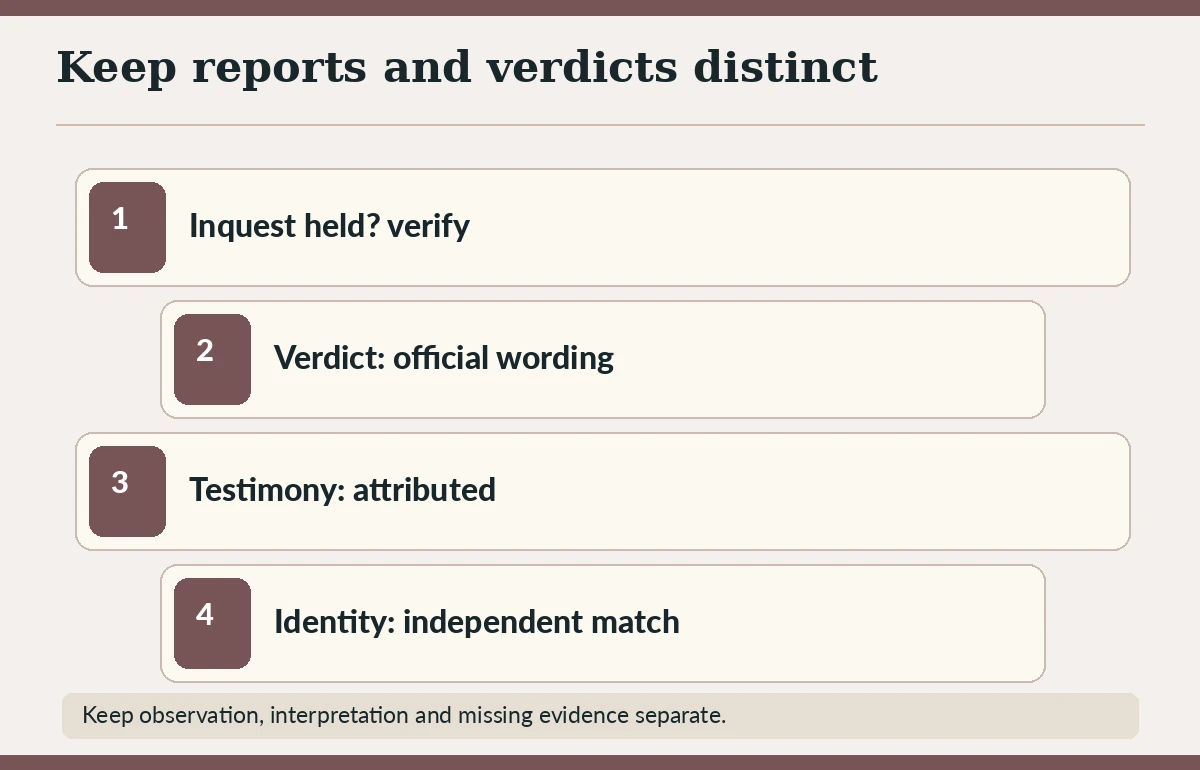
An inquest is a legal inquiry into a death, not a modern clinical diagnostic workup. A register may contain a brief verdict; a fuller report may summarize witness statements that disagree. Label a witness account as testimony, a coroner’s finding as the recorded legal outcome, and any later family interpretation as an inference. Claims about another person’s responsibility require particular care. An allegation in evidence is not proof of guilt, and archaic medical wording should not be converted to a precise modern diagnosis.
Make a comparison with the independent death registration and burial source if available. If their dates differ, determine whether one is date of death, registration, inquiry or publication. If a notice says “body found” on a particular day, that does not necessarily fix the moment of death. Maintain uncertainty as a date range when the surviving documents cannot narrow it further.
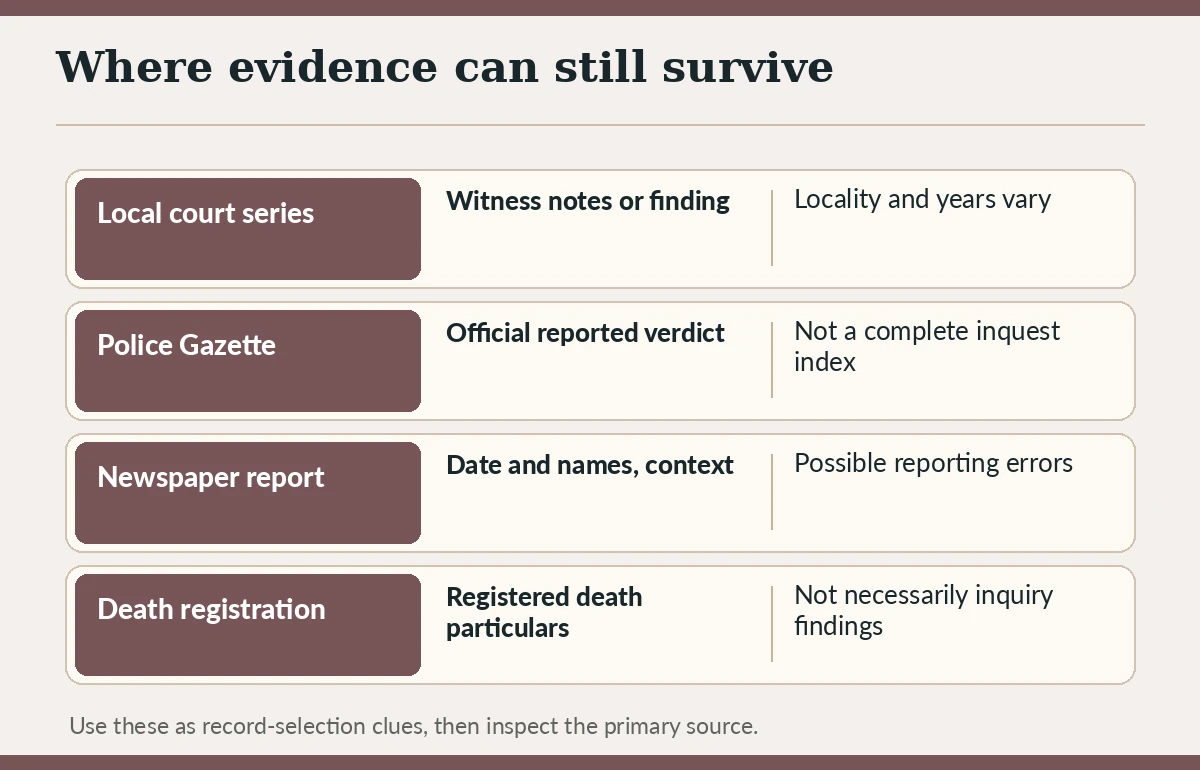
| Finding aid | What may survive | Caution |
|---|---|---|
| Local court series | Witness notes or finding | Locality and years vary |
| Police Gazette | Official reported verdict | Not a complete inquest index |
| Newspaper report | Date and names, context | Possible reporting errors |
| Death registration | Registered death particulars | Not necessarily inquiry findings |
Follow a fictional regional inquiry
Imagine a family account saying that an ancestor named Ellen Harris died near Albany in 1870 and was the subject of an inquiry. This is a fictional example, not an archival discovery. The locality and date direct you first to the Albany magistrate reports listed for 1864–1875, Series 1646, Consignment 348. Search the catalogue and determine if the relevant unit can be consulted. Compare any entry with a dated local newspaper and the independent death or burial record.
If the surviving court report identifies a person of that name but lacks age and family relationships, do not declare a match solely because the timeline aligns. A spouse, occupation, address or burial locality may supply another independent control. If the item is absent despite checking the correct unit, record the specific coverage and consider whether a Police Gazette or Colonial Secretary reference might survive. The research conclusion may legitimately remain unresolved.
Recognize the limits of modern access routes
The present Coroner’s Court of Western Australia explains that older cases do not form a complete centralized online collection, and that access rules differ for contemporary records. Do not follow a modern application form as though it guarantees a nineteenth-century case file or try to access private information about living relatives. For historical material, the State Records Office and State Library collection guides are more useful starting points than assuming a modern court portal preserves all past findings. To go further, our guide “Western Australia Naturalisation Records, 1841–1903” shows how to find certificates.
Use an evidence ladder: identifiable surviving original report first; a contemporary official register or Gazette notice second; a clearly attributed newspaper report as another source; and family recollection kept separately. A negative result can describe the archive series searched and its documented survival limits, but should not become the universal assertion that no inquest was ever held.
How We Research Western Australian Inquest Records
Our Western Australian inquest workflow reconciles the State Records Office’s examples of surviving courthouse and police holdings with the State Library’s warning about historic destruction and the current Coroner’s Court’s access limitations. We retained local series identifiers only where they are named by the archives, and we explicitly separated witness testimony, reported findings and independent death evidence. Ellen Harris is a fictional teaching example; the example makes no assertion that a named person died at Albany. Each record’s survival and permissions must be verified before attributing conclusions to an actual family.
More Records and Archives Guides
Official Finding Aids and Original Collection Descriptions for Western Australian Inquest Records
State Records Office guidance on surviving local inquest series and other historical sources (www.wa.gov.au).
State Library Dead Reckoning guide describing historic destruction and Gazette alternatives (slwa.wa.gov.au).
Modern Coroner’s Court explanation of access and the noncentralized historic record system (www.coronerscourt.wa.gov.au).
Editorial disclosure: No commercial partner influenced this Western Australia inquest guide, which has no affiliate purchase suggestions. Our affiliate disclosure explains general GenHis policies. Treat allegations, bereavement and living-person information with particular discretion.
No. The archives reports substantial loss and decentralized local records. Do not assume an online name search is exhaustive.
The State Library notes a practice of destruction after ten years, although some separate records and references survived.
Begin with the locally listed Albany magistrate inquest reports for 1864–1875, Series 1646 Consignment 348.
It records the inquiry and any finding available, while individual testimony must still be attributed and assessed.
They may provide a surviving clue or a contemporary account, but distinguish reporting from an official original.