
To research a historical South Australian police officer, first establish a service period and distinguish employee records from police notices about the public. State Records of South Australia explains that its Police Department holdings include high-level staff registers and individual employee sheets as well as separate correspondence, conduct material and Police Gazettes. Each answers a different question. A service sheet may help document an appointment or change in employment, while a Gazette reference may be an unrelated published notice. Access is also limited: personal, financial or disciplinary employee material is generally subject to longer closure periods, so a catalogue result does not automatically mean a complete personnel file is publicly available.
Start with a dated officer identity, not a badge story
Gather a full or partial name, likely station, approximate service years and any documented rank or occupation from a family certificate, obituary, electoral roll or period directory. A brass badge kept in the family may support a tradition of police service but does not independently identify its bearer or years of employment. Form a question such as whether one named person held an appointment near Port Adelaide around 1910.
Note name variants and relatives with similar occupations. Historical police departments had different organizational structures over time; do not assume a modern rank title was used for an nineteenth-century officer. If the only evidence is an unsourced family tree, search for a dated contemporary reference before requesting multiple departmental files.
Choose a staff register or employee sheet first
State Records SA identifies both higher-level staff registers and records described as employee sheets for individual service research. Check the current finding aid for the exact series and the dates covered, then determine whether the item is indexed by employee name, date or station. The archive does not present a guaranteed complete, digitized card for every former officer. Capture the item’s agency and series reference before drawing conclusions.
Where a register names an officer on a particular date, it establishes a limited employment clue. An individual service sheet may be richer, but its available fields and openness depend on the specific series. Do not state that every sheet provides birth dates, next of kin, promotions or discipline outcomes. Inspect the item and transcribe only fields actually present.
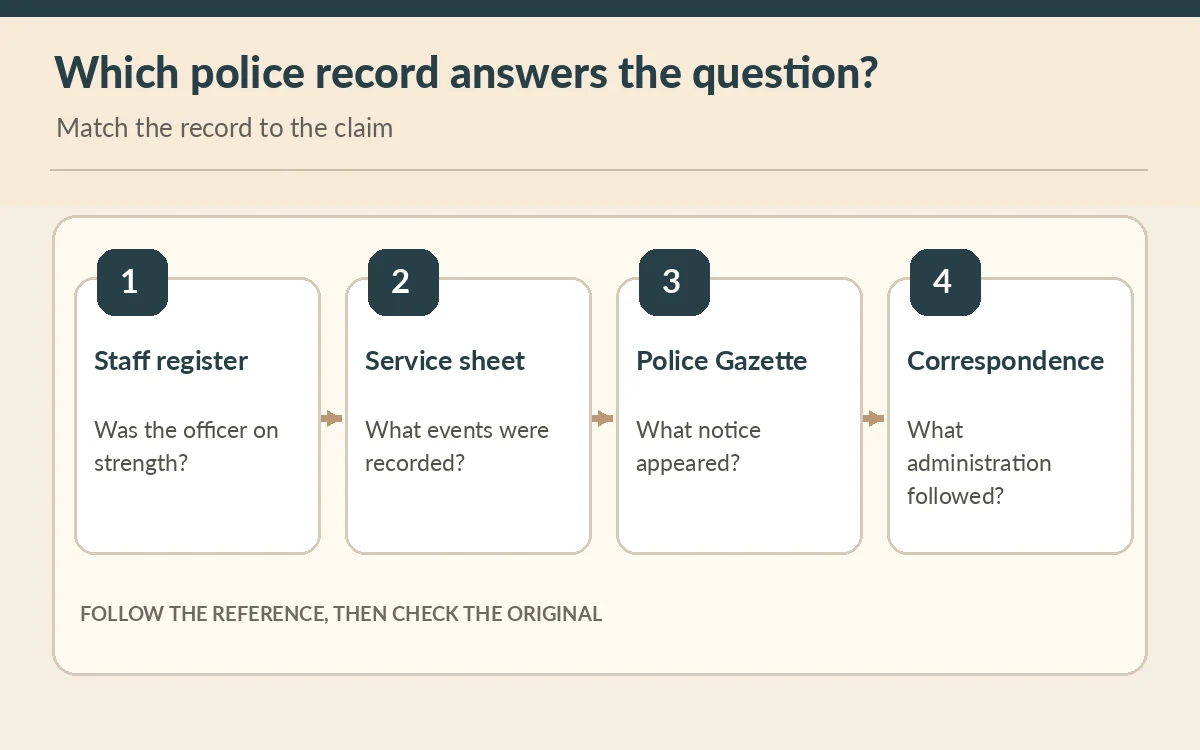
Use the Police Gazette for a separate question
The State Records SA police guide describes the Police Gazettes for 1861–1973 as GRG5/50. These periodicals were administrative publications with multiple kinds of notices; they are not identical to confidential personnel dossiers. A name appearing in a Gazette might belong to an officer, a suspect, a witness or someone in an unrelated notice. Determine the heading, issue, page and role before linking it to a member of your family.
Search a tight date range around a documented promotion, transfer or incident if the relevant issue can be lawfully accessed. A line in a Gazette may help build a chronology, but for a formal service claim cross-check with staff registers or other employment records. Avoid converting a notice of alleged misconduct or an official inquiry into a finding against the officer. Our guide “Victoria Police Employment Records, 1853–1973” covers a related question.
Distinguish the conduct and correspondence collections
The same archive guidance lists Police Commissioner’s Office miscellaneous papers, GRG5/4, among surviving records, alongside separate conduct material. Those collections were created for administrative purposes that differ from staff registers. They may involve several correspondents, officers or agencies. Do not assume that a file mentioning a police officer is a personnel file about that person. To go further, our guide “South Australian Railway Employee Records” shows how to find the right personnel file.
A later Police Commissioner’s Office series index, GRS/18682, illustrates that institutional records may be organized by author and subject and only partially open. Its documented 1950–1999 coverage should not be imported into an earlier century without checking the agency history. Use the actual date and series finding aid to select the right custodial path.

Apply privacy and closure rules before asking for copies
State Records SA says its Police Department records are typically available for general public access after 50 or 60 years, with some sensitive records open only after 100 years. Personal, financial or disciplinary employee records are typically publicly available after 60 years, while less detailed information may open sooner. These statements are general guidance; individual access determinations can differ by series or item.
Before requesting an image, inspect the record’s current access status and the archive’s restricted-record process. A record may require permission or a formal application even when a summary is catalogued. Do not calculate a blanket “public since” date from a broad series title, and do not advise circumvention. For recent people or living family members, share only information you are entitled to use.
| Source | Strongest use | Proof limit |
|---|---|---|
| Staff register | Officer in a named period | May omit full career |
| Employee sheet | Individual service evidence | Access and fields vary |
| Police Gazette · GRG5/50 | Official published notice | Role depends on heading |
| Commissioner’s files | Administrative correspondence | Not automatically personnel files |
Make a fictional service-history comparison
Imagine that two people named Patrick O’Neill appear in South Australian records: one named in a coastal station directory in 1908 and another in a city Police Gazette notice several years later. A hypothetical family photo caption says “Constable Pat.” It would be premature to combine the entries into one service career. Begin with the dated station record, then seek a staff register line or employee sheet for that particular Patrick O’Neill. Our guide “South Australia Railway Employee Records” adds more detail on this.
If a Gazette issue names “P. O’Neill” without a station or full forename, mark it as uncertain until a second identifier appears. Do not infer a promotion merely because a later source uses a different title. The names and records in this example are invented solely to demonstrate the comparison method.
Handle gaps and negative searches precisely
Not finding an employee by a web search may mean the person served before the surviving records, that a sheet remains restricted, that a series is not name-indexed or that the family tradition refers to a different colonial occupation. Write down the series, years searched, surname forms, access status and whether original items were actually examined. “No open result found” is an accurate research note; “he never served” is usually not.
If needed, use period directories, newspapers, departmental reports, pay information or electoral listings to document a residence or an occupational description. Compare each with the archive’s personnel evidence. A job title in a household census substitute is supporting context, not necessarily proof of a police appointment or a rank.
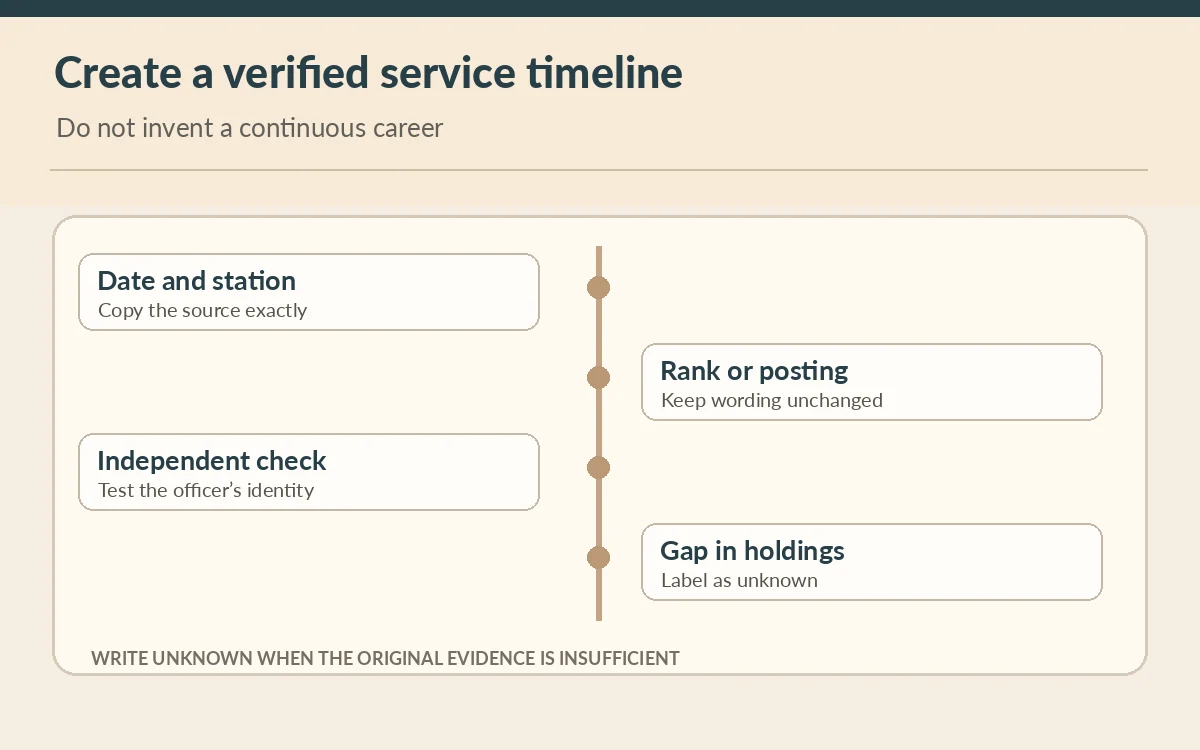
Build a service timeline with source-level confidence
A useful service worksheet holds date, reported event, source type, literal wording, identity confidence and a next verification step. Keep separate lines for entry into service, posting, transfer, leave, promotion and cessation, recording only events actually supported. The absence of a gap-filling employee sheet may prevent a continuous employment timeline; acknowledging that is better than constructing an unsupported career story.
For citations, name the State Records of South Australia repository, the producing police office, GRG or GRS series, item and page, relevant date, and access method. For a Gazette notice also record issue date and section. Treat personnel privacy, historical accusations and other people named in correspondence carefully when preparing anything for public circulation. If that is your next decision, our guide “South Australia Teacher History Sheets” explains how to find service Records, 1915–1965.
How We Research South Australian Police Service
We checked the current South Australian State Records police guide for record classes and the stated 50-, 60- and 100-year access differences, then reviewed its restricted-record guidance and later Commissioner’s Office index structure. We did not invent a complete police personnel database or claim current access to any named officer’s file. Patrick O’Neill is fictional. A real service chronology requires series-level checks and original records.
More Records and Archives Guides
Original Archive Guides and Finding Aids for South Australian Police Employment
State Records SA: personnel registers and sheets, other series and access conditions (www.archives.sa.gov.au).
State Records SA: restricted-record procedures and police information conditions (archives.sa.gov.au).
ArchivesSearch: Police Commissioner’s Office index series as an example of later partial access and agency record structure (catalogue.archives.sa.gov.au).
Editorial disclosure: This guide does not contain a paid placement or affiliate recommendation. Read the GenHis affiliate disclosure for our site-wide policy. Historical records may contain errors, unequal treatment or distressing descriptions; cite original context and avoid exposing private information about living people.
State Records SA lists individual employee-sheet records, but date coverage and access must be checked for each series.
No. It is a separate published record and usually only supplies individual dated notices.
The archive gives a typical 60-year threshold for sensitive employee information, but individual determinations may vary.
A badge is a lead. Identify its owner and service with contemporary personnel records.
Check name variants, station and period, series indexes, privacy restrictions and alternate contemporary sources.