
To trace a historical Victoria Police officer, begin with an approximate service year and search Public Record Office Victoria’s police employment collections. The archive does not hold one consolidated personnel file for every officer: reconstruct a timeline from muster rolls, appointments, salary records, and departures, recording each source separately.
Begin with a service window, not only a surname
Public Record Office Victoria (PROV) lists Victorian police employment material from 1853 to 1973, including VPRS 55, 2071, 1775, 1776, and 1785. Victoria Police became a unified force in 1853, but the state archives describe their holdings as a small and uneven selection of records rather than a complete central service register. Collect a likely start and end year, possible station, officer number, district, and any documented rank before opening the catalogue.
If a family story says an ancestor was a constable “before Federation,” search a realistic span rather than treating 1901 as a precise employment date. Establish the oldest firm clue first from a city directory, probate document, household record, or contemporary newspaper. A firm date narrows a series organized by year more effectively than surname searching alone. Our guide “Scottish Lightkeeper Registers, 1837–1921” covers a related question.
Choose the police record by the question it can answer
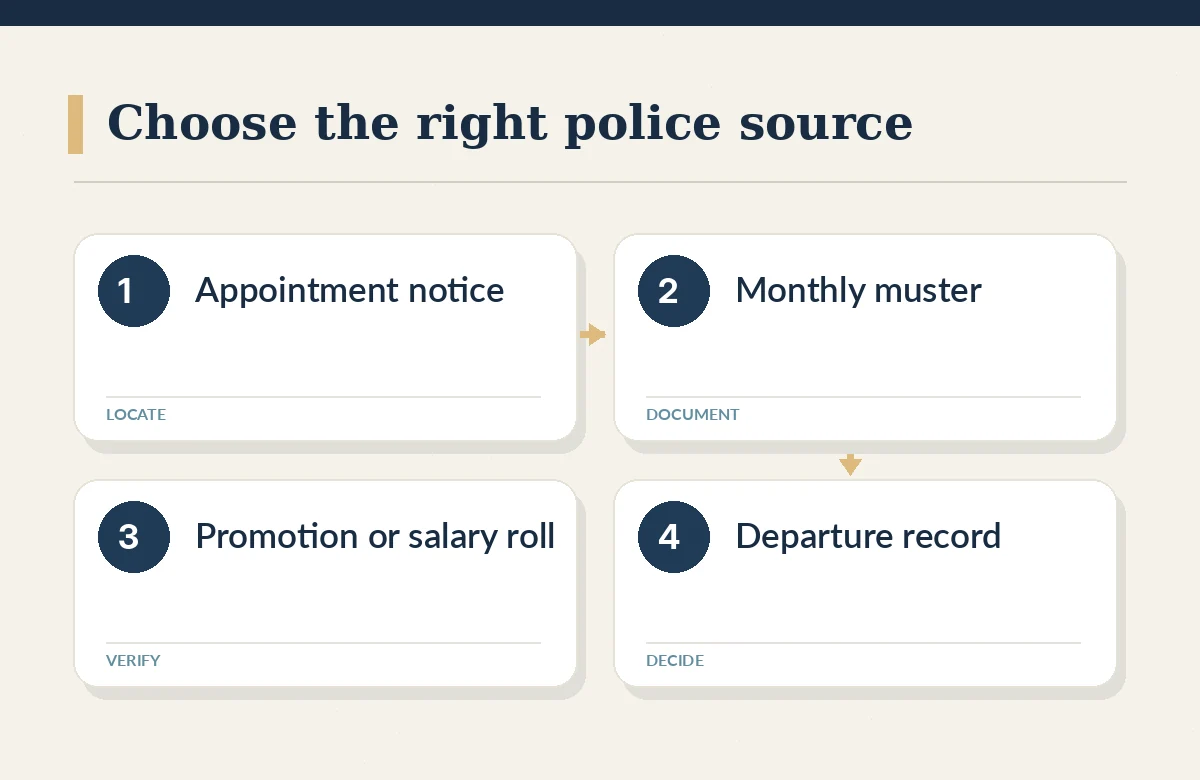
Muster rolls can show officers on duty or assigned to a district during a particular period. Appointment and promotion entries may address changes in rank; resignation, retirement, and salary documentation addresses different career events. PROV says many records were compiled monthly, annually, or at another regular interval. This is why one indexed name or pay line is neither a complete job history nor a guarantee of uninterrupted service.
Create a source-choice column in your notes. For “Where was she or he posted in July?”, prioritize a dated muster if it survives. For “When did service end?”, seek retirement or resignation material rather than assume the last appearance in an annual roll is the exit date. Remember that some employees recorded were not sworn officers.
Search PROV by employment years and archival series
Use the official Victoria Police employment page, entering the known or estimated year range into its catalogue search tools. Review the agency and VPRS description before ordering a file; multiple series are named because they document different administrative processes. Save the series number, unit or item reference, date limits and any available digitization or reading-room indicator.
PROV instructs researchers to order relevant materials and view them at its North Melbourne Reading Room when they are not online. Avoid assuming that a visible catalogue description means the records inside have been indexed person by person. Where a record is arranged by year, district, or station, inspect the sequence and surrounding entries.
Follow the officer number and station
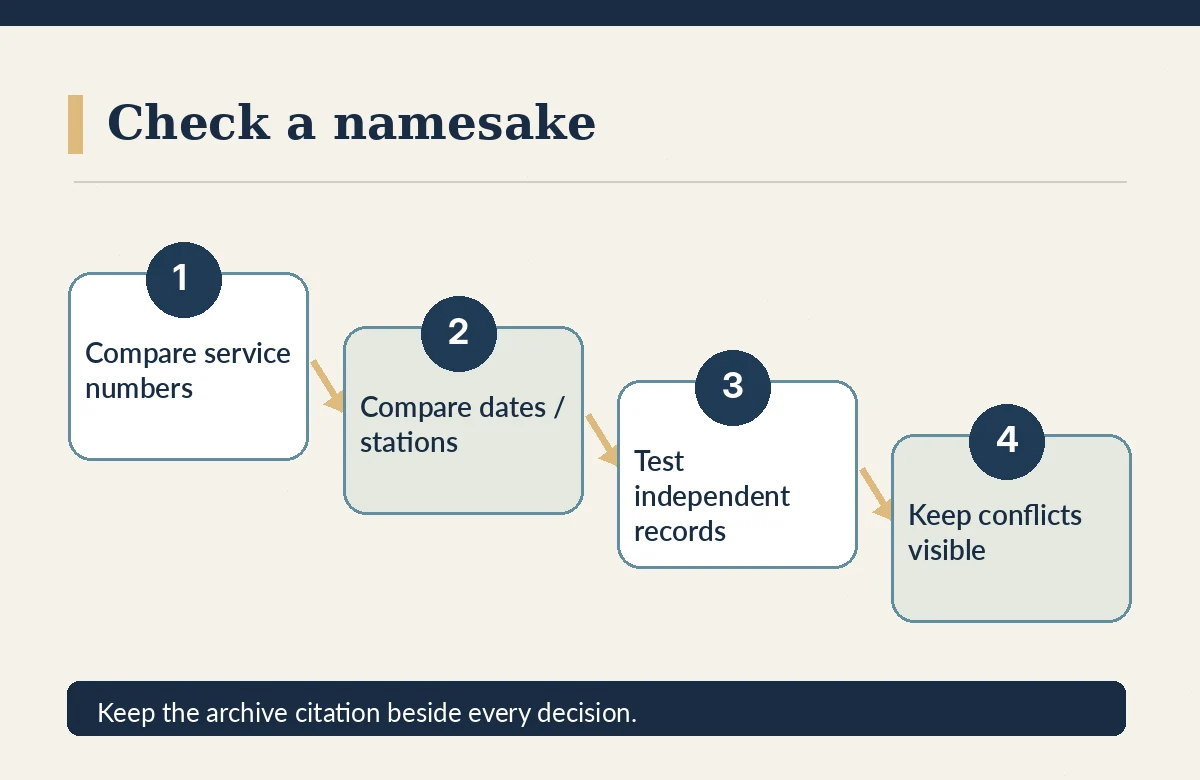
A number and a station are useful anchors, but treat them as dated observations. Record exactly where the number appears and which office or district the source names. If the person moves between stations, check that the rank, initials, approximate age, and chronology remain plausible before merging entries into one career.
A station’s existence does not prove an officer worked there throughout the relevant period. Conversely, an entry in a different district can reflect a temporary assignment, a transfer, or another similarly named officer. Let dated appointment and muster evidence settle the question rather than adjusting the timeline to fit a family anecdote.

Build a career ledger with explicit gaps
For each original source, enter the date covered, officer’s recorded name, service number when supplied, station or district, rank, duty or salary notation, source reference and a short quotation. Label each line “recorded,” “inferred,” or “unresolved.” A dated promotion followed by a salary change supports an administrative sequence, but it does not show daily duties or explain personal motivation.
Pay attention to timing. A salary roll’s period may differ from an appointment announcement’s effective date, and an annual muster might contain changes made partway through a year. If two records disagree, preserve both dates and ask whether one refers to approval and another to implementation. Do not overwrite conflicting evidence with a guessed compromise.
Keep service proof separate from conduct allegations
A newspaper court report or Police Gazette notice can identify a potentially relevant officer, but it is a different source class from an employment appointment record. The story may omit rank, initials or station, and namesake officers may be present. Use the personnel series to establish official service, and the original report to investigate a particular event only if the identities independently match.
Do not infer misconduct, dismissal, or cause of death from a disappearance in the surviving employment rolls. PROV expressly describes partial archival holdings. A person can be missing because a list, year, office, or record class did not survive or was not indexed.
| Record or checkpoint | What it supports | What it cannot prove alone |
|---|---|---|
| Annual or monthly muster | Presence, assignment or duty at a date | Entire career without gaps |
| Appointment or promotion | Administrative change with stated date | Daily presence at a station |
| Salary roll | Recorded rate or payment period | Reason for later career changes |
| Retirement or resignation | Recorded end-of-service action | Unrecorded personal circumstances |
Work through a fictional officer timeline
Imagine a family letter mentioning “Constable A. Miller” at a Victorian station in the 1890s. A yearly roll lists A. Miller in one district; a later appointment notice names an Alfred Miller elsewhere. That is a testable lead, not yet an identification. Compare service numbers, rank, dates, and station movements before deciding whether the two entries refer to the same officer.
If service numbers differ or both men appear simultaneously in different locations, keep separate candidate records. If one notice matches the number and transfer date from a muster, state precisely what the matching administrative facts support. These fictional names are illustrative and are not copied from archival case files.
Document access limits and ethical handling
PROV’s coverage is selective and many records require in-person reading-room consultation. Some modern personnel information may be governed by separate access conditions; confirm the item status before requesting it. Photograph or transcribe historic material only under repository rules and preserve the context of administrative language.
An employment record is not a complete biography. Establish family relationships from independent BDM, church, probate, or other contemporary family documents. When discussing living relatives, do not reveal unverified employment or disciplinary claims.
How We Research Victoria Police Employment Records
This guide was researched using the repository’s published collection descriptions and official finding aids. We compared the specific date spans, item and index identifiers, access directions, and what each type of entry can establish. A catalogue description is not a transcription of every surviving page; verify the individual record against its headings and the archive’s current access conditions before relying on a family conclusion.
The scenarios are illustrative research exercises, not claims about identified historical individuals. We do not insert fictitious names or “sample” historical facts into genuine source transcriptions. Review the citations and any conflicting original evidence before adding a relationship to a public tree.
More Records and Archives Guides
PROV police employment guides and catalogues
PROV dedicated police employment guide, 1853–1973, record types, series and reading-room workflow (prov.vic.gov.au).
Also, PROV professions and employment overview explaining varying employee record scope (prov.vic.gov.au).
PROV official resource hub, distinct online and reading-room access paths (prov.vic.gov.au).
Editorial disclosure: This guide contains no paid placement or approved affiliate recommendation. Read the GenHis affiliate disclosure. Archived records can contain offensive historical language, allegations, and information about people or families. Quote accurately, protect living people, and never turn an unverified administrative label into a current medical, legal, or personal judgment.
No. PROV says its police employment holdings are partial and spread across multiple record types.
It describes holdings for police employment from 1853 to 1973, with varying coverage by series.
No. Many records are arranged by date, agency, station, or other administrative units.
Not by itself. Look for a dated resignation or retirement entry and investigate gaps.
Record the officer number where available, station, date, VPRS series, item, and page.