
Scottish lighthouse-keeper research has an unusually precise route: Scotland’s People provides both a lightkeeper name index and a separate lighthouse-station index for historic Northern Lighthouse Board employment registers. Their online series NLC4/1 covers 1837–1921. The official record guide explains that person pages can describe service, postings and career progression, while station pages list people serving at a light. Use both sides to test a career rather than assuming anyone with a familiar surname at a lighthouse was the same person or a relative.
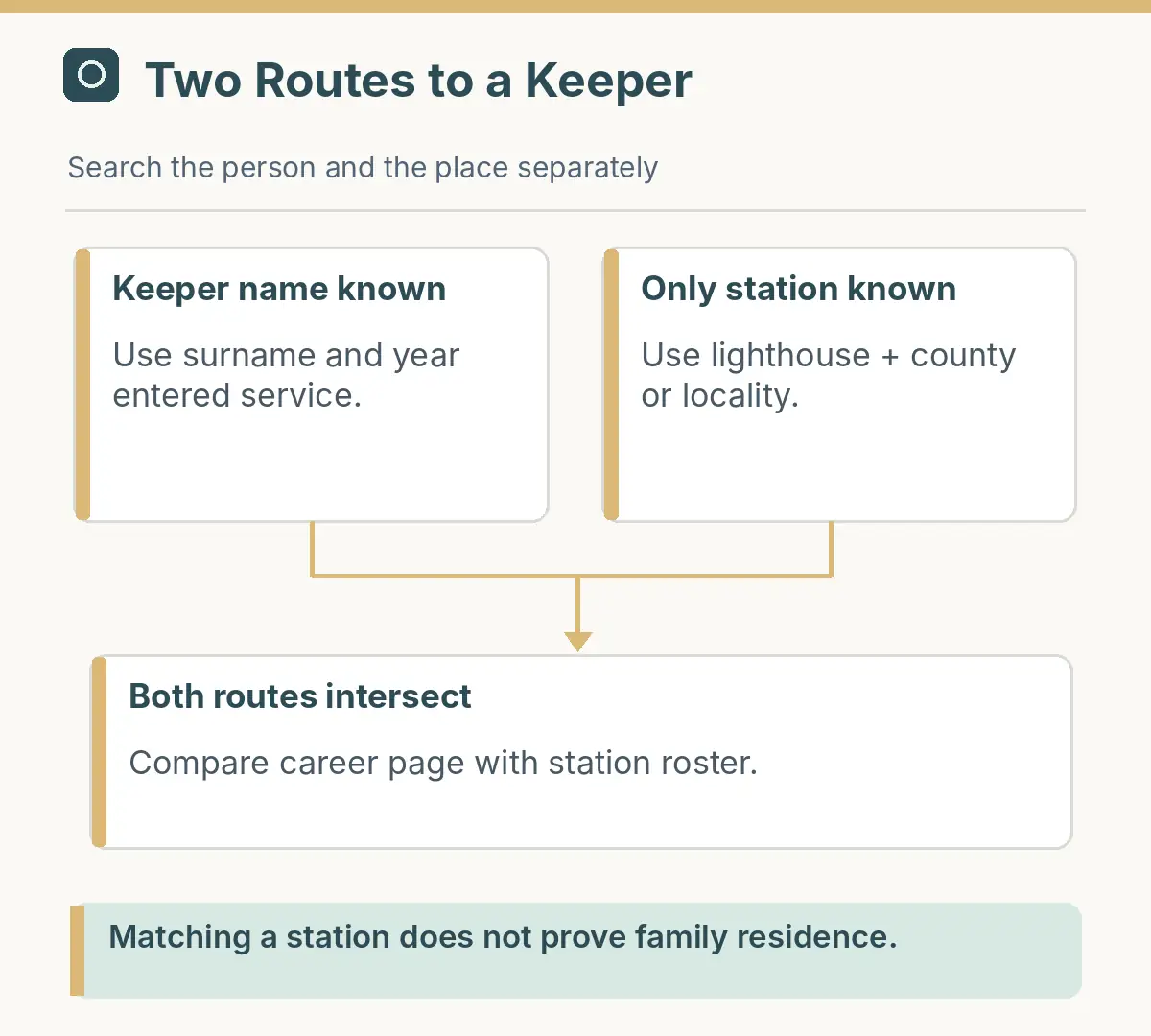
Use the person search when you have a candidate keeper
Search Scotland’s People Lightkeeper Registers by surname, forename, age when entering service, or year first employed. The archive says its person index draws from four registers with 1,363 individual entries; someone may appear separately in multiple volumes. That means one index hit is not necessarily the person’s entire career, and apparent duplicates should not be deleted. Record every volume and page, then compare the sequence of postings, reported age and later dates. A person with the same name listed in a distant lighthouse may be a namesake or an employee transferred between stations; the evidence needed differs. Preserve the register’s spelling of lighthouse names as well as the modern location, since the archive acknowledges some alternate station names. Write a dated employment timeline and distinguish first entry into Board service from the first date a person appears in one scanned volume.
Search the lighthouse index when only a place is known
If family correspondence names a particular lighthouse but not a full name, switch to the lighthouse search. The guide says the station search accepts lighthouse name, county and locality and draws from separate station pages in the same four historical books. Known alternate lighthouse names may also be indexed. Search the location and list every individual keeper recorded in the relevant date span, rather than choosing one because an ancestor lived on the coast. A lighthouse’s register can include several successive officers and assistants; a name’s presence supports employment at that station but not ownership of the land or permanent residence of a keeper’s spouse. Copy the exact lighthouse heading and the period noted on each scanned page.
Know the four NLC4/1 volume boundaries
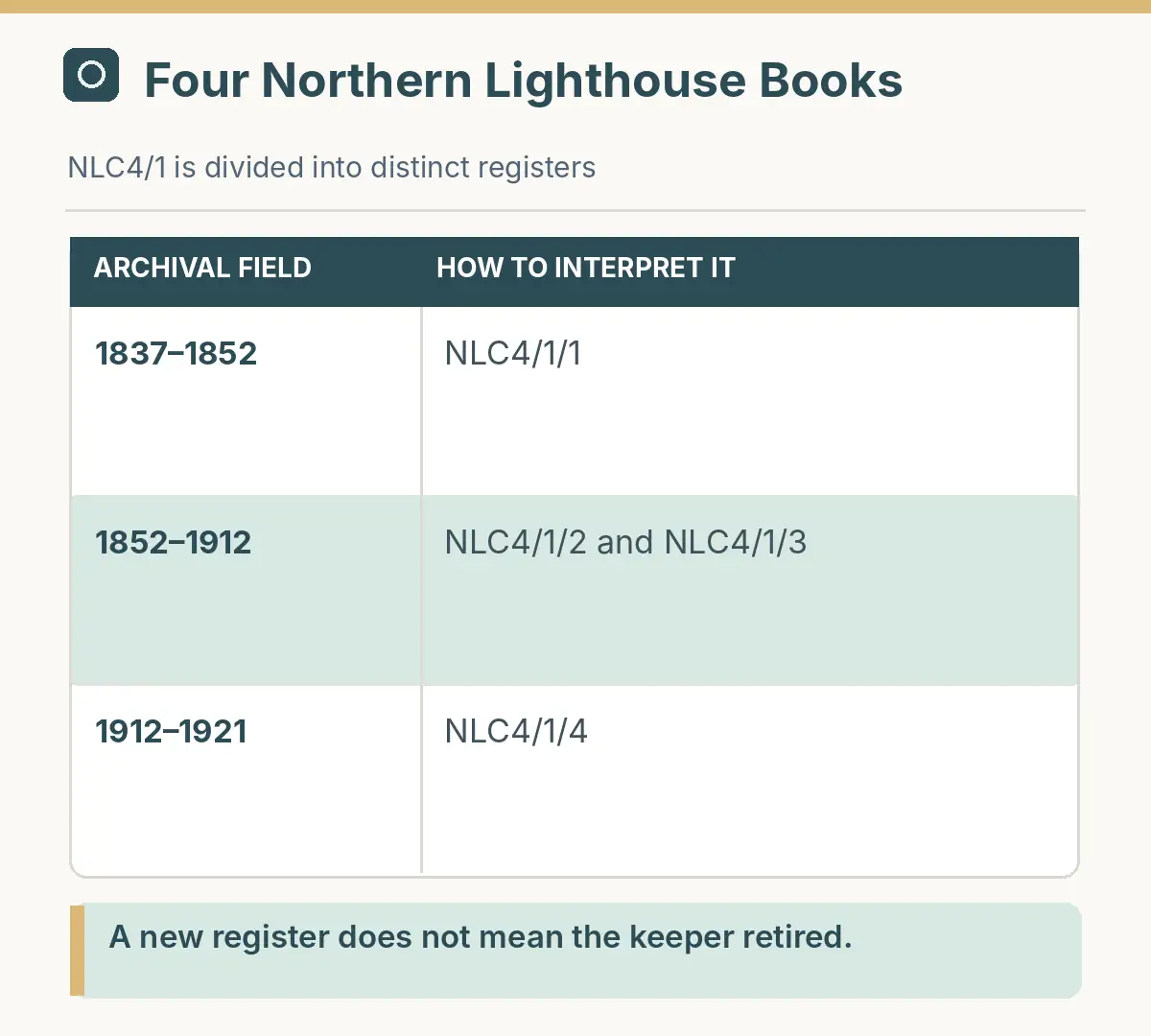
The official guide identifies NLC4/1/1 (1837–1852), NLC4/1/2 (1852–1869), NLC4/1/3 (1869–1912) and NLC4/1/4 (1912–1921). In the earlier volumes, principal and assistant lightkeepers generally have separate person sections, followed by pages for the lighthouses; the last volume rearranges them into two parts. This structure explains why a person-focused name lookup and a place-focused lighthouse lookup can expose different angles of a career. The same keeper may carry forward into a subsequent volume with a changed service history. Do not interpret the end of one volume in 1869 as a retirement without checking the next. Record the exact book and page cited in the digital viewer, not just ‘Northern Lighthouse Board records.’
Interpret transfers, promotion and retirement narrowly
Keeper registers can record the names of stations served, promotion, demotion, retirement and in later volumes sometimes birth date, according to the National Records of Scotland guide. A named station and period suggest employment there, but do not automatically prove that a wife, children or parents lived at the same light. Some keepers rotated between rock stations and shore duties. The archive’s account describes multiple lightkeepers taking shifts at remote stations; workforce arrangements complicate simplistic residence assumptions. Place the service dates beside independent census returns, marriages or children’s births before inferring a family’s location. When different registers conflict on a birth year, retain the discrepancy. A date supplied many years after an event may not be as reliable as a contemporaneous entry.
Use station changes to disambiguate similar surnames
Suppose two historical James McDonalds appear in the first name index. One might serve at a west-coast light and another at an east-coast station during overlapping years. Make a person-by-station matrix for dates, stated age at appointment, rank, and later service movements. A matching surname and job title does not justify merging them. Search the reverse lighthouse index to see whether their employment histories intersect at all. If one register references a later volume or a retirement date, follow that trail before attributing a transfer. Compare with an independent census only if the household’s occupation and residence align on the correct date. Record a clear confidence level and a question for the next source, rather than turning two incomplete employment entries into a finished family biography.
Distinguish lighthouse employment records from other archives
The Northern Lighthouse Board’s personnel registers are not a complete archive of every engineer, builder or mariner associated with a lighthouse. The official guide notes that architectural drawings may be held at Historic Environment Scotland, Stevenson family engineering material at the National Library of Scotland and Clyde Lighthouses Trust material at Glasgow City Archives. Route an architectural question to construction drawings, a service career to NLC4/1 and a genealogy question to records naming the person, rather than treating any lighthouse document as an employee census. If your ancestor maintained a fog signal as a laborer but does not appear among indexed lightkeepers, an absence from this limited personnel set is inconclusive. Search contemporary directories, census entries or other Board files according to the actual research question.

More Records and Archives Guides
How We Research Scottish Lighthouse Careers
We rely on the official Lightkeeper Registers guide for the four NLC4/1 volumes, available search fields, station lists and service details, then verify the person and station routes on Scotland’s People. We do not infer permanent residence, ownership or family relationships from a keeper’s posting alone. Readers can assess external paid image access according to the repository’s terms; our affiliate disclosure documents the site’s commercial policy without implying an archive partnership.
The NLC4/1 volumes available on Scotland’s People cover 1837–1921.
Yes. A second index searches lighthouse name, county or locality.
The same keeper may be entered separately in consecutive historical register volumes.
No. The employment record does not by itself establish a spouse’s or child’s residence.
No. These are a specified set of historic lightkeeper registers, not all personnel or building records.