
To search the historic Virginia Free Registers, begin in Virginia Untold with a person and a likely county or town. Open the digitized register page behind any name result, record the volume and registration number, and test the written age, physical description and emancipation references against independent evidence. The Library of Virginia announced completion of digitization of 99 surviving register volumes on October 15, 2026; that does not mean every surviving person was recorded or every spelling is searchable.
Why the 2026 Completion Matters for Family Search
In October 2026 the Library of Virginia reported that all 99 surviving Free Register volumes had been digitized for Virginia Untold. The work began with 39 volumes from seventeen localities held by the Library and expanded through cooperation with circuit court clerks.
The announcement concerns surviving books, not a complete statewide list of free Black Virginians. New digital access changes how the researcher can compare scattered counties, but the creation of digital pages does not correct historical exclusions or establish a family tree automatically. Record the date of your online search because the volunteer-derived index can be updated independently of the images.
Choose the Historical County Before Searching a Surname
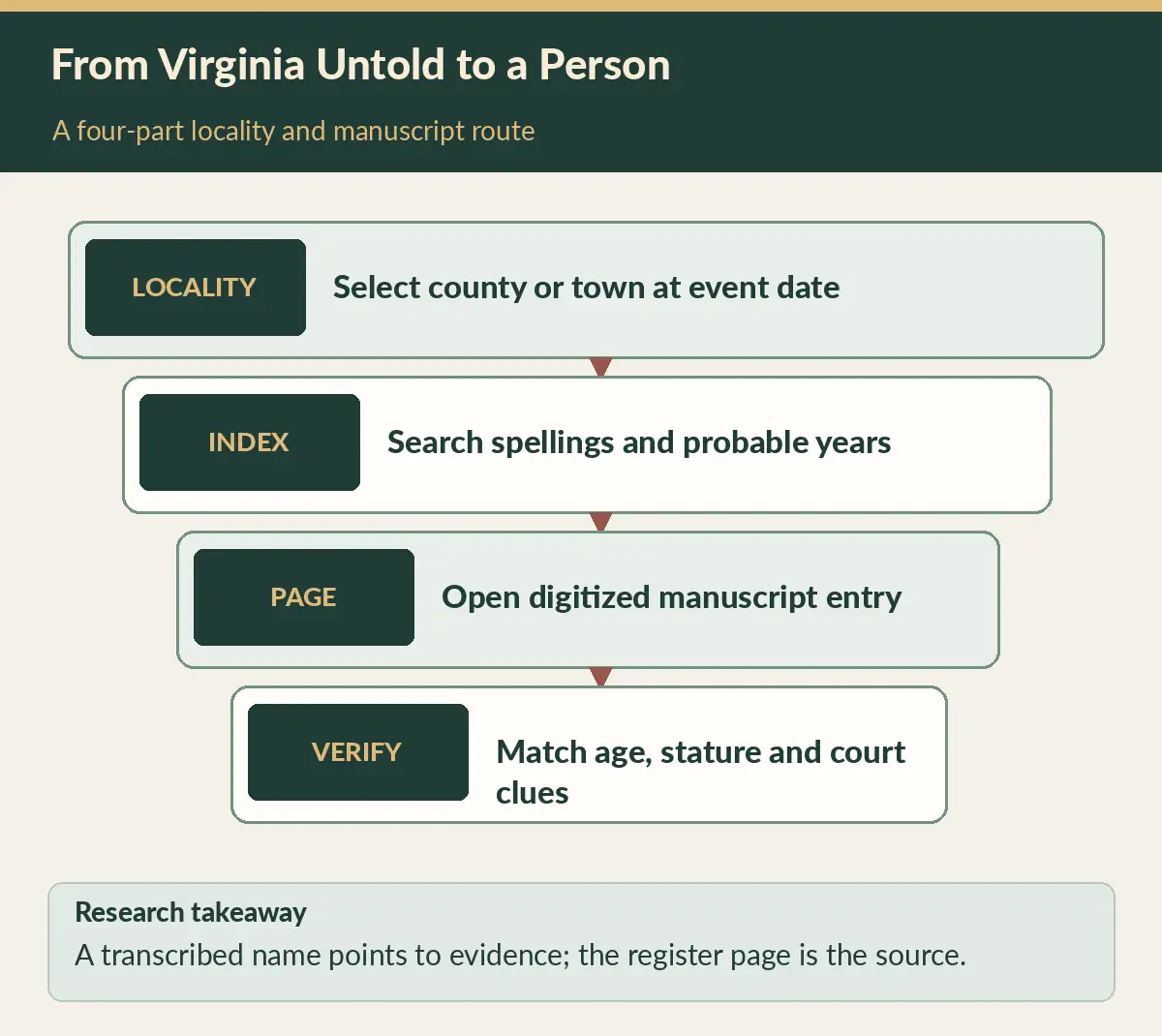
Start with the locality where the person is documented at a particular date, not the county where descendants later settled. Locate the period courthouse, town and any changed county boundary. Some register volumes include decades of entries while others span only a short period; county names can change and registrants could move.
Build a small locality timeline from tax lists, deeds, petitions, census enumerations and emancipation documents. Then query the likely register and one adjacent locality. A negative name search against a mismatched county is not evidence that the person lacked freedom, lived elsewhere or never registered.
Move from the Volunteer Transcription to the Manuscript Image
Virginia Untold incorporates data produced through the From the Page transcription workflow. That searchable text is a finding aid, not a replacement for the clerk’s manuscript. Open the source image and check whether the name is abbreviated, crossed through, amended or repeated.
Recreate the whole entry, including marginal notes, registry number, book title, page and date; retain a record of uncertainties rather than quietly modernizing spelling. If a cropped image omits the clerk’s column headings, read neighboring pages to understand the original form. A missing index hit may reflect transcription choices even when a page image exists.
Read Age, Stature, Complexion and Registration Number
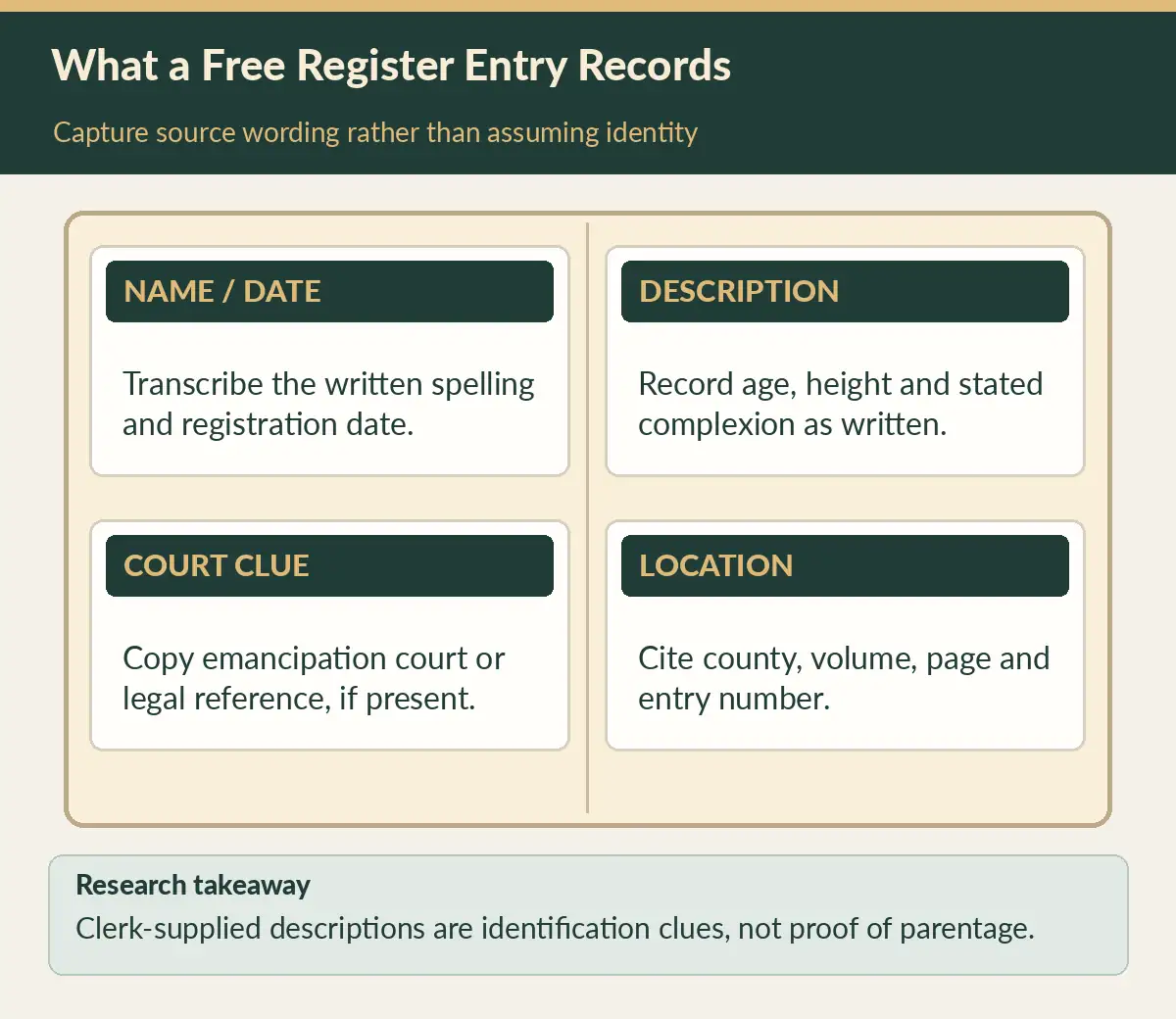
Virginia’s 1793 law called for details including name, age, color, stature and emancipation information. Later local books vary in practice. Use physical descriptions as historical identifiers only in conjunction with date, locality and other records: a stated age may be approximate, and descriptions reflect a registrar’s perspective and categories rather than a person’s self-description.
Enter every attribute as written alongside a carefully separated modern interpretation. Two same-named registrants may differ in age and height; one person may appear multiple times. The number identifies an entry in that register and should not be mistaken for a permanent statewide identifier.
Read Emancipation References Without Inventing Relationships
A register may indicate whether someone was born free or emancipated, or identify a court and person connected with emancipation. These clues are routes into legal records, not necessarily verified parentage or evidence about all members of a household.
The person named as emancipator is not automatically a parent, guardian or the same person as a later employer. Search the applicable court order, manumission deed or probate paper and transcribe its exact roles. If the underlying court record is missing, retain the reported emancipation reference without converting it into a proven event date or family tie.
Understand the Historical Purpose and Harm of Registration
These books were created within a system of racialized surveillance and restrictions on free Black residents. Use historical catalog terminology to locate documents but avoid adopting official status categories as neutral descriptions of identity. A person’s appearance in the book records an administrative act, not voluntary participation.
Equally, an absent entry can reflect a lost page, selective enforcement, relocation, spelling variation or records kept by another clerk. When sharing research, center the named individual and document the power imbalance evident in the source. This improves both ethical presentation and evidentiary accuracy.
Resolve Two People with the Same Given and Last Name
Suppose two registrations name Mary Johnson in nearby counties. Create two separate profiles with entry date, stated age, stature, county, registry number, emancipation notation and manuscript page. Compare each with an independently dated tax list or household record and follow the associates named in deeds or court files.
A twenty-year age difference may favor one candidate, but ages can shift across records; do not discard alternatives on a single numerical inconsistency. Keep a conflict column noting every mismatch and your explanation, if any. Never merge the records simply because the surname matches a descendant’s family tradition.
Record Both a Positive Finding and a Thorough Negative Search
For every promising result save the image, precise locality, date, register title, folio or page, entry number and search spelling. Also record what was searched when nothing appeared: the catalog item, years actually browsed, index variants and adjacent counties checked.
Missing a digital search result is not a tested absence from all 99 volumes. If you browse only indexed pages, state that limitation. When a page is damaged or difficult to read, preserve the image and note which characters are uncertain instead of creating an authoritative-looking transcription from guesswork.

How We Research a Virginia Free Register Identity
We first establish a probable county and date from evidence external to the register, then check the Library of Virginia’s project notes and locate the relevant digitized volume. We transcribe the entry with its historical terminology, compare any volunteer transcription with the manuscript, and test age, physical description and emancipation references against independently held records. We document alternative same-name candidates and do not treat the official category as a family relationship. Our affiliate disclosure explains site relationships without affecting this record assessment.
Write an Exact Citation and a Limited Conclusion
Cite the county or city, Free Register title and covered years, clerk or originating court where named, register page, entry number, image location and the Library of Virginia digital collection. Separately cite any transcription or dataset row used to locate it.
A cautious finding might state that a clerk registered a person of a recorded age and stature in a named locality on a particular date. It should not claim birth year precision, a specific ancestry, uninterrupted residence or emancipation by a certain person unless that conclusion survives independent tests. Note conflicting evidence directly in the narrative.
More Records and Archives Guides
Use the Digitization Milestone to Plan the Next Record
The 99-volume milestone makes cross-locality browsing more practical, but it is a starting point for a paper trail. After locating a registration, investigate its court reference, nearby deed records, local taxes, probate records and pre- or post-emancipation documents within the correct jurisdiction.
If the register provides a distinctive height or age, check whether another entry for the same person was issued later, then examine why the descriptions differ. Prioritize the record most likely to resolve an identity conflict. A chain of explicit documents carries more weight than any single name match or a modern online tree.
The Library of Virginia announced completion of digitizing the 99 surviving register volumes in October 2026; search indexing and original historical coverage are different questions.
No. Check the original page, locality, date, description and independent records before identifying a person.
No. Record the local volume and page because a number is meaningful within its particular registration context.
Check variants, neighboring counties, unindexed pages and survival limits before interpreting the absence.
No. It may suggest a legal record to examine, but the relationship requires independent evidence.