
For a West Virginia birth before statewide recording, identify the county and exact event year first. County registers begin in the mid-nineteenth century, but books and digitized images are not uniformly complete. West Virginia did not become a state until 1863, so some early registers originated in Virginia counties that later became part of West Virginia. The West Virginia Culture Center county availability table is the starting point, followed by the original page—not a statewide search result alone. A late-issued certificate can be useful but is not automatically contemporary evidence of birth.
Choose the Birth Event Date and Historical County
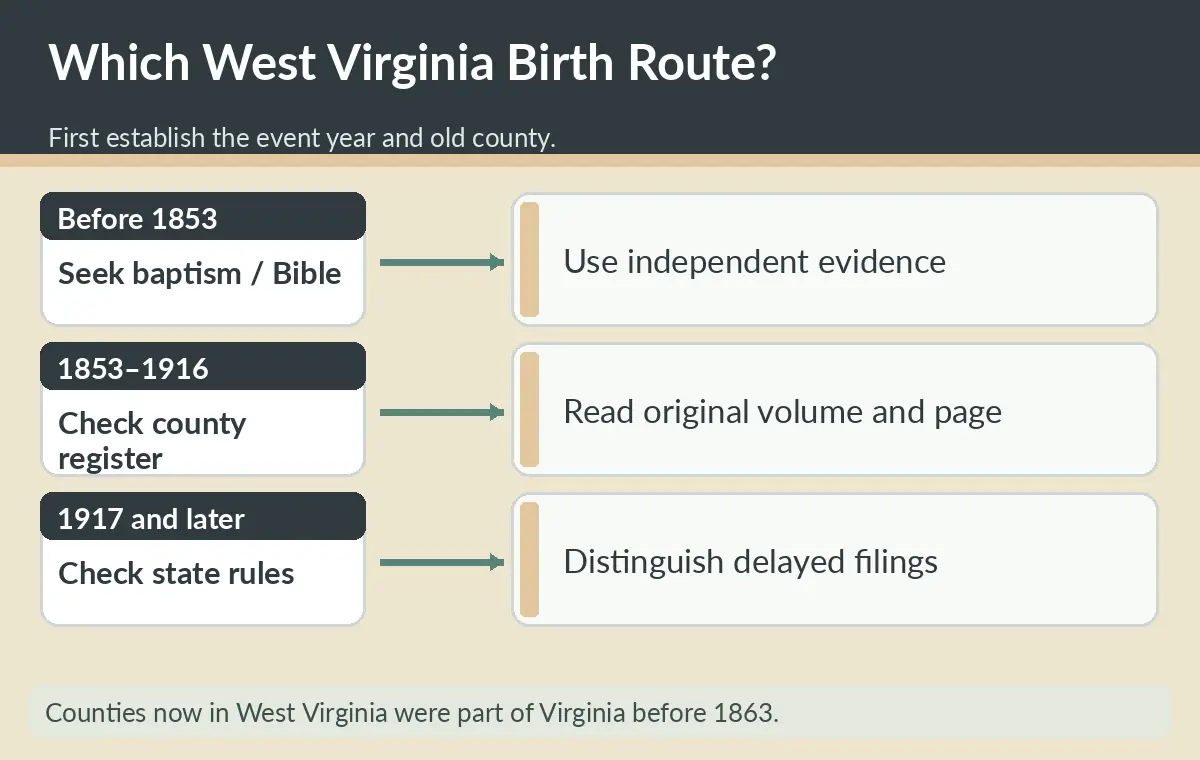
For a claimed birth in 1840, there was generally no required county civil birth register in the region. Church books, family Bibles, guardianship files and later accounts may supply indirect evidence. The West Virginia and Regional History Center explains that before 1853 official birth and death entries are virtually nonexistent, though older substitutes sometimes survive. Do not invent a county birth certificate for that era. First determine what county administered the location when the event took place, then look for sources actually created in that jurisdiction at the relevant date.
Between 1853 and the Civil War era, many relevant counties were still part of Virginia. The Library of Virginia lists some original birth, marriage and death registers from 1853–1862 for future West Virginia counties, with uneven survival and damaged originals. County divisions and name changes can alter which clerk now holds records. Establish the historic county from a contemporary map and place description, then check its specific surviving volumes. A modern state boundary alone does not supply the archival custodian.

Read Each County’s Available Years, Not a Statewide Date Claim
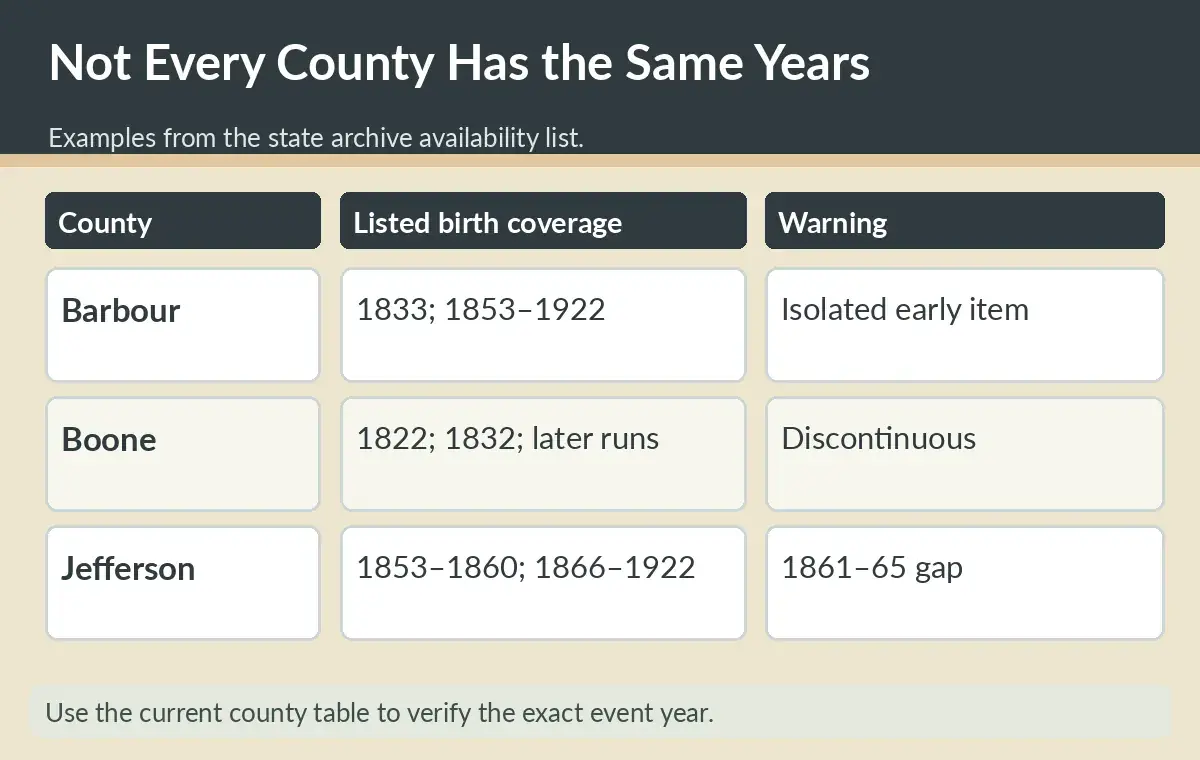
The Culture Center’s availability page lists different year spans for different counties. Some begin around 1853; others have intermittent or isolated earlier entries. Barbour, for example, lists 1833 and then 1853–1922, while Boone lists selected early years and a discontinuous run. A global claim that all West Virginia births from 1853 onward are searchable would be inaccurate. Note your county, precise year and the digitized interval before interpreting a missing result.
Search neighboring years because historical birth entries might have been entered late, arranged nonchronologically, or confused with a registration date. Check whether the database image belongs to a register, an index or a later transcript. A table saying the county has records through a particular year does not promise that every event survives or every handwritten page is indexed. Mark gaps explicitly: missing year, missing page, uncertain handwriting and no result after a complete browse are different outcomes. A reliable negative conclusion requires a defined surviving source.
Distinguish County Records From State Vital Registration
The West Virginia Vital Registration Office states that it maintains state-level birth records from 1917 onward, along with some delayed filings for older births. Earlier county registrations were kept by county officials, though archives and microfilm projects now provide access to many historic images. The event date and the filing date can differ. Do not imply that a child born in 1890 necessarily has a 1917-era original state certificate. If a delayed birth registration was made for later identification purposes, determine what documents and informants supported it.
The state vital records genealogy guidance refers researchers to Archives and History for much historic genealogical work. Modern certified copies and publicly available historic digitizations have different access routes. Never suggest bypassing current privacy or eligibility rules to view information about living people. For research on a deceased historical subject, retain the exact register volume and page, and seek independent baptism, marriage or death records to test the reported parents and date.
Interpret Parent Names, Locations and Handwriting Conservatively
A county birth register may identify a child, parents, residence and a date, but the precise field names can vary by period and county. Look at the headings in the original volume before deciding a number is a registration date or a birth date. Read the neighboring entries to understand the clerk’s abbreviations and local place spellings. A birth name indexed incorrectly can vanish from a database search while remaining legible in the register. Preserve a literal transcription and a separate standardized interpretation with any uncertainty recorded.
For a fictional pair of infants named Sarah Morgan in adjacent counties, do not choose one merely because a later marriage record shows the same first name. Compare the parents, birthplace or township, dates and surrounding family records. A common name can recur in a family after an earlier child died; a surviving infant record cannot be assigned to an adult without evidence of life continuity. If an informant was not the mother or attending physician, consider how the entry was produced. Distinguish what the clerk wrote from what a modern database indexed.
Recover Missing Matches Through Repositories and Other Sources
When an online search fails, first inspect county coverage, then try initials, name variants, the relevant township and adjacent dates. Where browsing is possible, read original volume pages in order. Check the date when the county was created and whether an earlier county retained the record. The Library of Virginia holds some older material from counties now in West Virginia; the West Virginia and Regional History Center documents additional county public records and substitutes. Use repository descriptions to locate the actual books rather than treating all digitized sources as the same collection.
If the county volume truly does not cover the event, build a substitute evidence plan: a baptism near the supposed birth year, 1850 or 1860 household entries where chronologically appropriate, estate guardianship proceedings, a later marriage, cemetery memorial and any family Bible entry with independently established writing date. These sources vary in directness and reliability. An absent civil record does not prove the person never existed or that an online family tree’s date is correct. Note when a date is only an estimate inferred from age reports.
Cite the Volume and State What Is Still Unknown
A sound citation includes the historic county, book or register title, page or entry, child’s name, record date, repository and the specific digital collection or microfilm consulted. If two platforms reproduce the same historic register, they provide different access paths to one original source, not two independent confirmations. Identify which information came from an original inscription and which came from an indexing interface. If the page is damaged or a surname ambiguous, keep the uncertain reading visible. Do not copy a standardized database name as if it were written by the clerk.
Finish with a precise next test such as: ‘Does the 1860 county register naming a fictional Elizabeth Harper connect with the person listed in the 1870 household?’ Note ages, parents, county boundaries and competing namesakes. Cite the clerk’s entry separately from the 1870 enumerator’s statement. The affiliate disclosure provides general transparency about this site’s relationships; none is needed to access the official archive guides listed here.
More Records and Archives Guides
How We Research This Collection
We checked the current county-by-county Culture Center digitization coverage, the West Virginia state registrar’s historical date guidance, Library of Virginia holdings for pre-statehood counties and West Virginia University’s public-record summary. We distinguish event date, registration date, county survival and digital indexing, without promising comprehensive records.
County systems generally began in 1853, but original survival and online coverage vary by county.
West Virginia formed in 1863; older events may belong to counties once administered by Virginia.
West Virginia’s Vital Registration Office lists state-held births from 1917 onward, with some older delayed registrations.
Check the county availability list, historical jurisdiction, alternative spellings, surviving pages and other custodians.
No. A delayed filing has a different creation date and its supporting evidence must be evaluated.