
To find a Sicilian birth in the nineteenth century, begin with the comune (municipality), an estimated year and the archive that preserves its civil-status books. Search Portale Antenati for a named act when indexed, then browse the appropriate birth register (nati) and its annual or decennial index. A missing name result does not mean the original act is absent: indexing and digitization are separate. The central task is to connect a numbered original record to an independently documented family, not to accept a same-surname hit.
Identify the Sicilian comune before searching for an ancestor
A U.S. passenger list or naturalization petition may say only “Sicily,” while the records were written by individual municipalities. Recover the exact comune from a marriage document, obituary, birthplace statement or another immigrant relative. Record spelling variants and the modern province without assuming they match nineteenth-century jurisdiction. The town may share a name with a hamlet or the family may have lived in a neighboring comune at the birth. When all you have is a province, make a shortlist of places supported by documents rather than searching every register indiscriminately. An exact locality is far more valuable than a guessed birth date.
Find the right Antenati collection and surviving years
Use “Cerca nei registri” to select a place, date and type of record, then inspect the collection hierarchy. An archive may distinguish stato civile della Restaurazione from later stato civile italiano or other series. Palermo State Archives describes Restoration civil status from 1820 through 1865 for Palermo province, but warns of gaps, and the local holdings must be checked town by town. Do not transfer this Palermo range to every Sicilian province. Antenati made substantial Palermo Restoration material available in 2026, yet its archive explicitly states that additional units remain undigitized. Finding a collection description is not the same as finding your exact year.
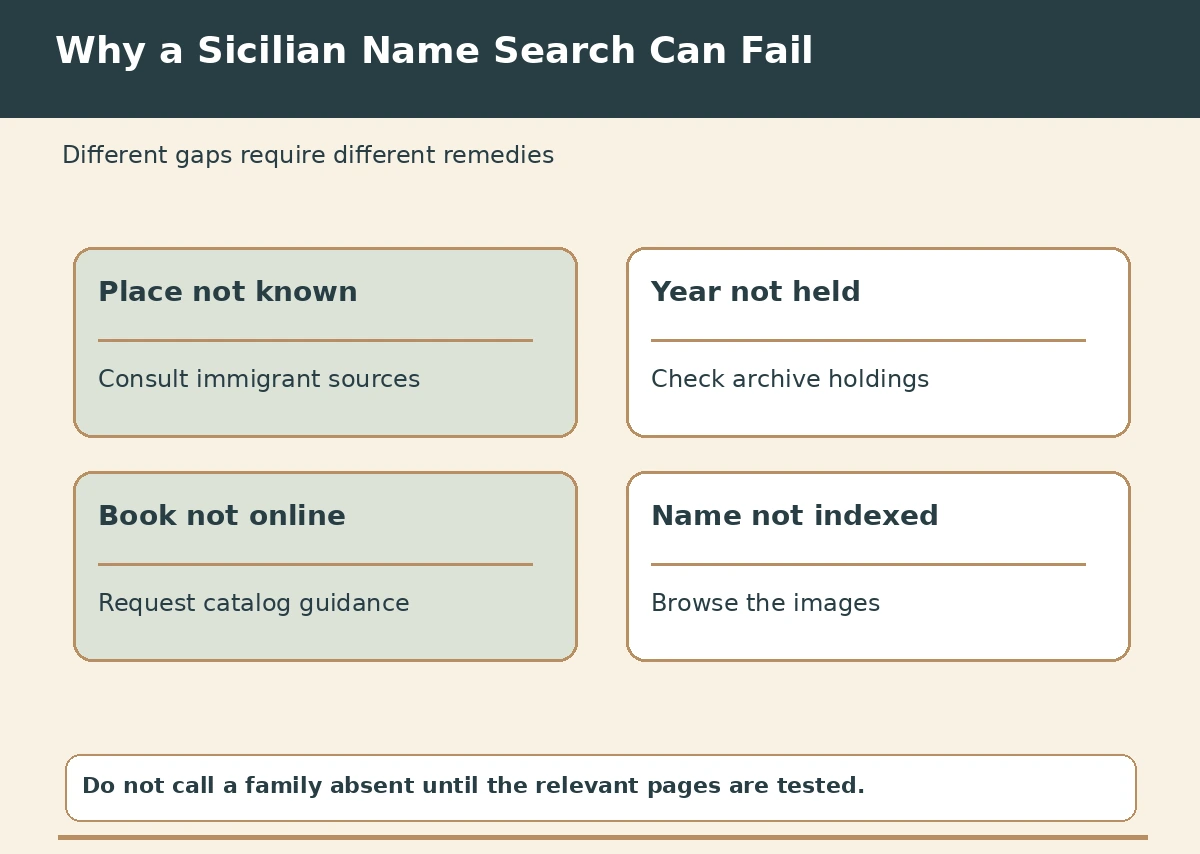
Browse annual indexes when the name search finds nothing
Antenati supports a name search only where names have been indexed. In an unindexed register, open the relevant year and look for indice annuale, an alphabetical list near the front or back, or an adjacent index volume. Surname order and the location of given names vary; verify the key supplied by that book instead of assuming a standardized layout. Copy the act number, then turn to the numbered entries and inspect the original page. If the index has no obvious match, page through the volume for variant surnames or a boundary-year event. Record which volume and pages were actually checked.

Transcribe what the act says rather than treating it as a birth certificate
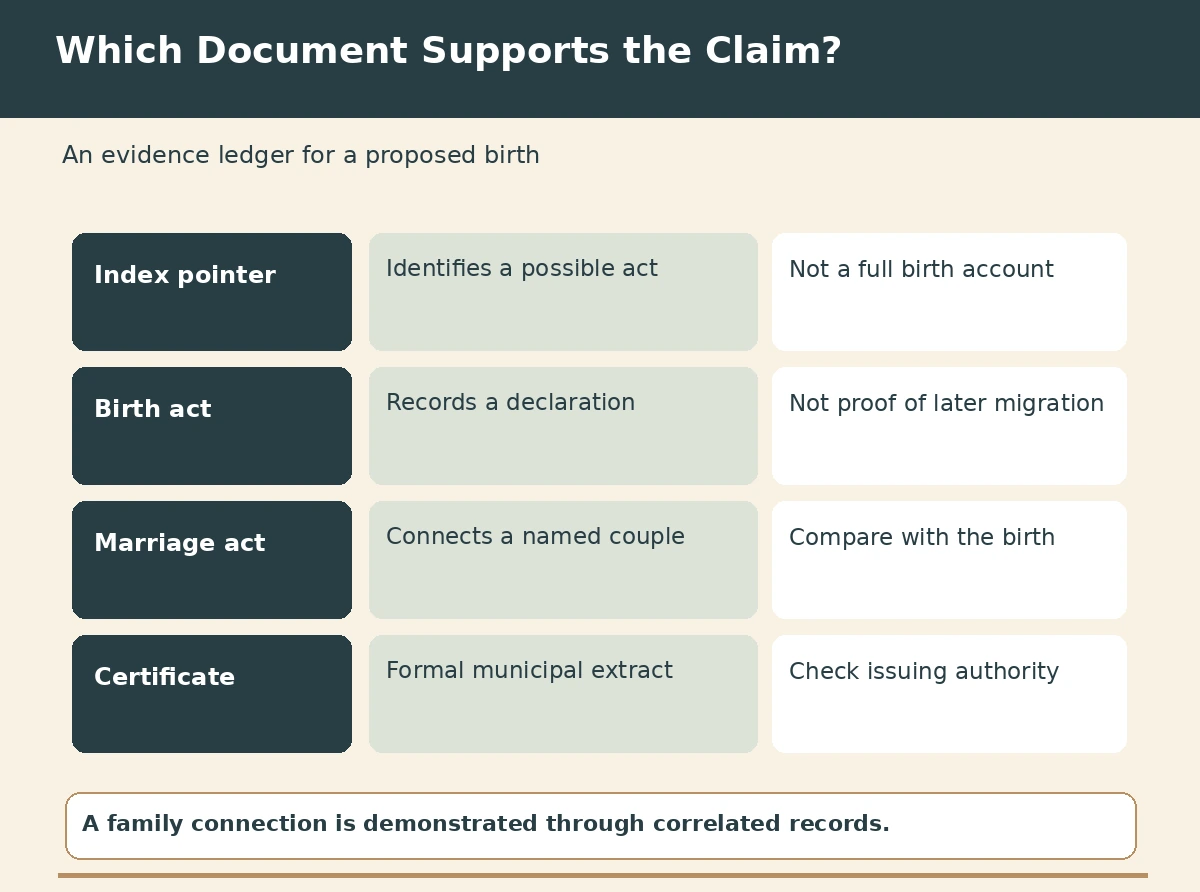
An Italian civil birth act may contain an act number, declaration date, child’s name and parents or declarants, with phrasing that distinguishes an event from the date the official wrote it down. The fields differ by period and locality. Write separate lines for birth date, registration date, house or street when present, father, mother, declarant and witnesses. A witness is not automatically a relative; a person named as the reporter need not be a parent. Translate formulaic phrases cautiously and preserve uncertain letters in a literal transcription. An annual index is only a pointer, and its abbreviated entry does not replace the act.
Compare a candidate child with independent Sicilian evidence
A common surname and plausible year make a candidate, not a proved ancestor. Compare both parents, a marriage act, siblings’ registrations and any marginal annotation against an immigrant’s records. Names such as Giuseppe, Maria and Salvatore can recur within extended families and across neighboring towns. Build an evidence grid that separates “stated on the act,” “reported in a later document” and “still unknown.” If the expected mother differs, do not quietly substitute a more convenient child. A negative search should specify town, series, date span and name variants before a researcher considers another comune.
| Evidence layer | What you obtain | Next confirmation |
|---|---|---|
| Antenati name hit | Possible child and indexed locality | Open numbered act |
| Annual name index | Act number within a year | Read the original page |
| Civil birth act | Recorded declaration and family details | Compare a marriage or sibling |
| Comune certificate | Official extract when issued | Follow authority requirements |
Use marginal notes and related marriage papers without overstating them
Some birth acts carry later marginal annotations pointing to marriages, deaths or corrections. Check whether a note was written contemporaneously or added years after the initial declaration, and follow the cited event where possible. Not every archive has linked images for each mentioned record. An annotation can be an excellent route to a separate act, but it should not become an assumed family relationship until its reference is verified. A marriage record may identify parents or spouses, while the birth act records the birth declaration. Keep those acts separate in your source log rather than counting repeated facts as independent confirmations. For a related choice, see our guide “Polish Birth Records”.
Distinguish historical images from an official certificate request
A digitized image from a state archive can support family-history research, but it is not necessarily a certificate acceptable for citizenship or another legal application. The Palermo archive explicitly states that the relevant comune civil-status office issues current certificates and extracts. The archive does not take over the municipality’s civil-registration function. For a formal copy, follow the current comune procedure; for research, cite the archive, series, locality, register, year, act number and image. Never promise an online printout will satisfy a consulate or use a paid certificate service without first identifying the legal requirement.
Record precisely why an apparent blank result is inconclusive
There are several distinct failures: a place has not yet been identified, the record series does not cover the year, the relevant volume survives but is not digitized, a digital image exists but the person is not indexed, or the act was checked and no matching entry found. Each implies a different next step. Write down the archive and register title, years, index pages, attempted spellings and images viewed. This audit protects future research from repeatedly querying the same incomplete name index. When relevant volumes do not appear online, consult the holding archive catalog or ask the municipality about custody. Our guide “Dutch Marriage Supplements” covers a related question.
Cite the birth entry so another researcher can retrieve it
A useful citation names the holding state archive, civil-status series, comune, type and year of book, act number, page or image, and the Antenati access route and consultation date. Preserve your transcription beside the image reference, not in place of it. Add a note describing whether you examined the manuscript, a copied register or only an index. If you are choosing among multiple similarly named infants, document each disqualifying difference rather than deleting the alternate candidate. Your final conclusion should say exactly which birth event the act records, and which connection to your immigrant ancestor still relies on other evidence. Our walkthrough on how to find Italian parish records beyond civil indexes sets out each step.
More Records and Archives Guides
How We Research Sicilian Birth Records
We compared the Italian Central Institute for Archives description of Antenati with Palermo State Archives guidance on Restoration holdings, 2026 publication changes and municipal certificates. The search example is a workflow, not a claim that any named family’s complete file was recovered. An act number is a locator; the parental relationship to an immigrant still requires independent corroboration.
Official references checked on October 24, 2026: primary archive; secondary archival guide; collection description; research resource. Collection pages describe archive scope; they do not mean we examined or verified every individual historical manuscript. This page contains no paid product recommendation. For the site-wide policy consult affiliate disclosure.
No. Antenati offers name searches only for indexed material; many surviving registers require browsing by town and year.
Historical series and preservation vary; verify the local archive collection rather than applying a Palermo date range to every comune.
It identifies a birth-record series or book; inspect the actual entry rather than treating the category label as proof of a particular birth.
Not necessarily. The Palermo archive directs official certificate and extract requests to the municipality’s civil-status office.
Record the archive, comune, register year, act number and image locator, together with the repository and access date.