
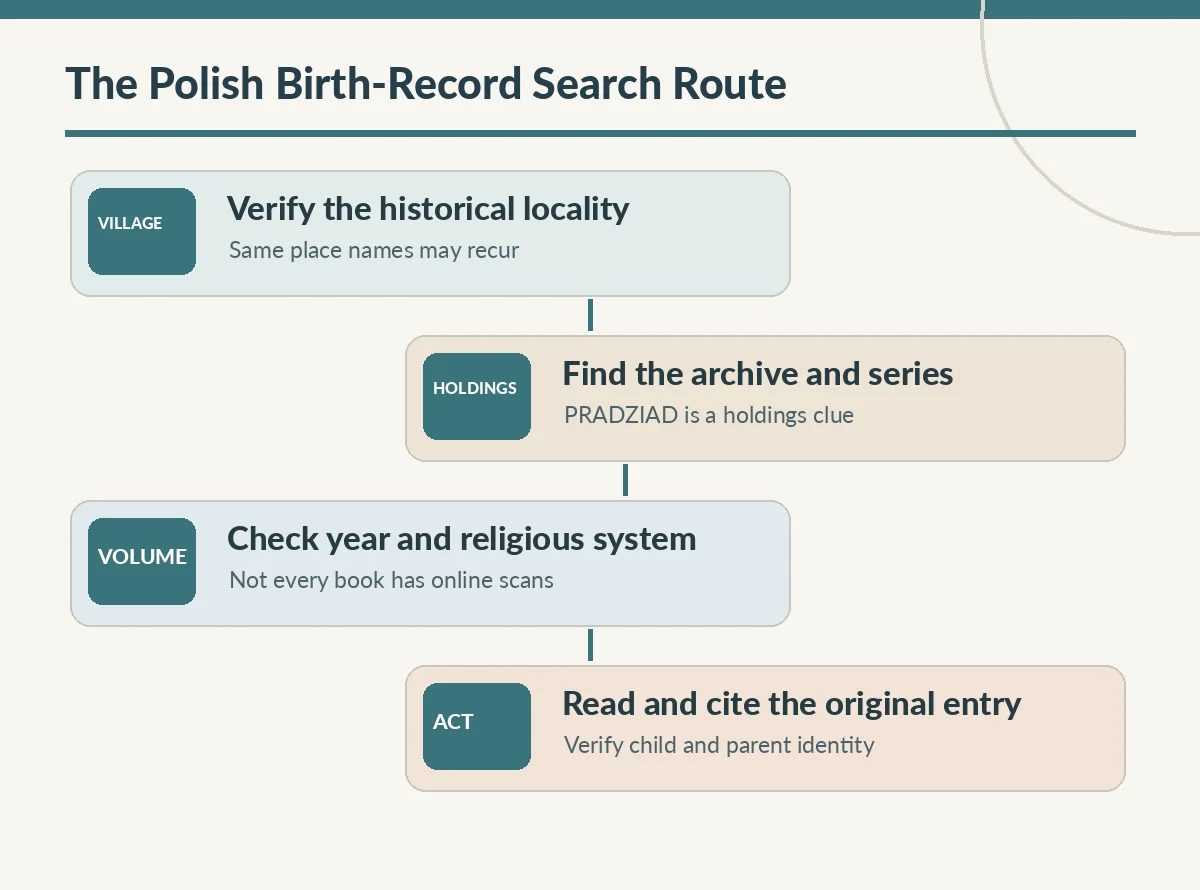
To find a historical Polish birth record, identify the place and religious or civil jurisdiction before trying another surname website. Poland’s Szukaj w Archiwach service contains state-archive descriptions and scans, including holdings data from PRADZIAD. A collection description is not a searchable birth entry, and a scan collection does not guarantee a name index. The strongest method moves from the historical village to the register’s archive and volume, and finally to the act itself, while checking privacy restrictions on younger birth registers.
Anchor the historical locality before searching for a Polish surname
Start with a documented town or village from an arrival record, marriage, death certificate or preserved family paper. Record the name as written, the approximate birth year, religion if evidenced and the province or district at the relevant date. The same village name can exist in several areas; nearby parishes, county and historical administrative boundaries matter. Modern spelling may not match German, Russian or Latin-language historical records. Make a short list of candidate localities rather than asserting a single modern map pin from a family tradition.
Before searching an archive, decide whether the question is ‘Where was this person born?’ or ‘Which existing volume contains births in this parish?’ The first is a person-identification question; the second is a holdings question. A modern state archive may hold records from a political jurisdiction that no longer exists. A Protestant baptism, Jewish register or civil birth entry may be kept under a different creator from a Catholic parish book. Use a settlement’s historical administrative profile to choose the creator, not just an online surname hit.
Read Szukaj w Archiwach holdings before expecting named acts
The Polish National Digital Archives explains that Szukaj w Archiwach displays finding-aid descriptions and digitized images of archival materials. Its descriptions also incorporate PRADZIAD, which records information on parish and civil-registration holdings. Search by locality and source creator, then note the archive, fond or collection, series, volume years and whether scans are present. An inventory result can establish that a volume exists without proving your ancestor appears in it.
Record the archive’s own reference and the years covered by each volume. Open the image set only when available; if a scan is not shown, check whether the volume must be consulted in a reading room or remains at a registry office or church archive. The Ministry of Culture describes parish and civil registers as a prominent genealogical use of the service, not a promise that every surviving volume is online. Never invent a stable record-level link from a series-level catalog page.

| Search result | What it establishes | What it does not |
|---|---|---|
| PRADZIAD holdings | A record type and custodian | Named child found |
| Collection description | Series or volume exists | Every page is digitized |
| Scanned act | Words on a specific page | That it is your ancestor |
| Index transcription | Potential matching person | Exact original wording |
Distinguish a civil birth act from a baptism register
A civil birth act is recorded within the appropriate civil-status system. A baptism entry documents a religious event and may contain a separate reported birth date. Depending on period and region, religious institutions could also be involved in official registration, so do not impose one countrywide transition date on all of historical Poland. The State Archives’ genealogy guidance describes records of births, marriages and deaths and the people named, but fields and language can vary greatly by locality and register. Our guide “Polish American Genealogy” adds more detail on this.
Transcribe the act number, date of recording, reported date of birth, locality, child’s name, parents, occupations and witnesses only when legible. A statement by the registrar may report a birth supplied by a declarant rather than direct observation. Translate or interpret difficult phrases in a second column. Use an independently dated marriage, census or later birth act of a sibling to compare parent names and residence. Two identical child names in the same parish may belong to different households.

Apply the register-closure rule before looking for recent births
The National Archives in Krakow states that civil birth records become normally available in state archives after 100 years from the closure of the register; the analogous guide gives 80 years for marriage and death registers. This is not simply ‘the child was born 100 years ago.’ A volume containing several years may remain closed based on its final entry, and special legal access rules may apply. Check the actual custodian and current procedure rather than promising every 1920s register is publicly visible.
For a more recent birth, an archive catalog search may reasonably show no page even though the registration exists. Determine whether the civil registry office (Urząd Stanu Cywilnego) or a different authority still holds it and respect eligibility for obtaining copies. Do not suggest circumventing legal restrictions or searching records about living people without a legitimate basis. For historical material, an archival scan may be openly viewable, while a physical original can still be restricted for preservation. Our guide “Sicilian Birth Records” covers a related question.
Reconcile scripts and shifting surname forms without guesswork
Polish records may be in Polish, Latin, German or Russian, depending on locality and date. A surname transliterated from Cyrillic may have several plausible Roman-letter forms, and a woman’s recorded surname can change at marriage. Record original script or a careful transliteration and mark interpretation separately. Search names by given-name equivalents as well as surnames, but never silently substitute a new spelling into your citation. A small difference in a letter can matter when sorting two namesakes. Our guide “LitvakSIG All Lithuania Database” covers a related question.
Create a three-anchor table: locality and house or parish, parents or spouse, and date or age. A single agreement is not enough. If the record names parents with common given names, compare another child’s birth or a marriage entry from the same locality. If there are conflicting spellings or ages, cite both and state why one interpretation is stronger. Keep a rejected candidate rather than deleting it; it prevents a future researcher from repeating a false match.
Document scans, missing volumes and an archive request
For a scanned entry, record the repository, fond or collection number, register title, year span, act number and the specific page or image reference. Save the viewing URL when supplied and note that an image counter may differ from original pagination. For an undigitized volume, write to the current holding archive with place, event type, approximate date, series reference and a narrow research question. Ask about consultation or copy policies without assuming an archive performs full-family research on request.
A negative result means only that no act was located in the sources actually examined. A missing volume, wrong parish, untranscribed index, access limit or jurisdictional change may explain it. List those possibilities in a reproducible log. Do not claim no birth occurred in a place solely because a global search returned zero hits. Conversely, do not treat a PRADZIAD finding-aid listing as a certified document. A documented page or lawful official extract is needed for the underlying act.
More Records and Archives Guides
How We Research Polish Birth and Parish Collections
We verified the State Archives’ own account of Szukaj w Archiwach and PRADZIAD, the Ministry of Culture’s description of genealogical records, and the Krakow archive’s 100-year register-closure rule. The tables classify search outputs by evidentiary status; they do not reproduce a real birth certificate. Locality and language examples are generalized workflows because the history of civil and parish registration differs across Polish regions and periods.
A record-backed family connection requires a specific act and independent corroboration, not a presumed national index. This guide makes no paid-provider recommendation or commission claim. Our affiliate disclosure explains the general policy. Always check the holding repository’s current conditions for access, reproduction and living-person information.
No. It includes archival descriptions and some scans; name-level indexing depends on the particular collection.
A program recording information about parish and civil-status records held in the archives, not a universal register of named people.
Not necessarily. The archive describes a 100-year period counted from the register’s closure, subject to access law.
Use it as a source with its own wording; transcribe any stated birth date separately from the baptism date and corroborate.
Historical locality and jurisdiction, approximate date, event type, likely collection and a precise question or known reference.