
The LitvakSIG All Lithuania Database (ALD) is a free searchable gateway to many kinds of records about Jewish communities connected with historical Lithuania. It is not a single continuous birth-register collection. Search by a documented town and flexible name spelling, identify the source category, then follow the result’s archival citation to an image or repository. The core distinction is between a translated or indexed database row and the underlying original created for a specific administrative purpose. A shared surname cannot by itself establish that two entries belong to one family.
Locate the historical shtetl and its later place name
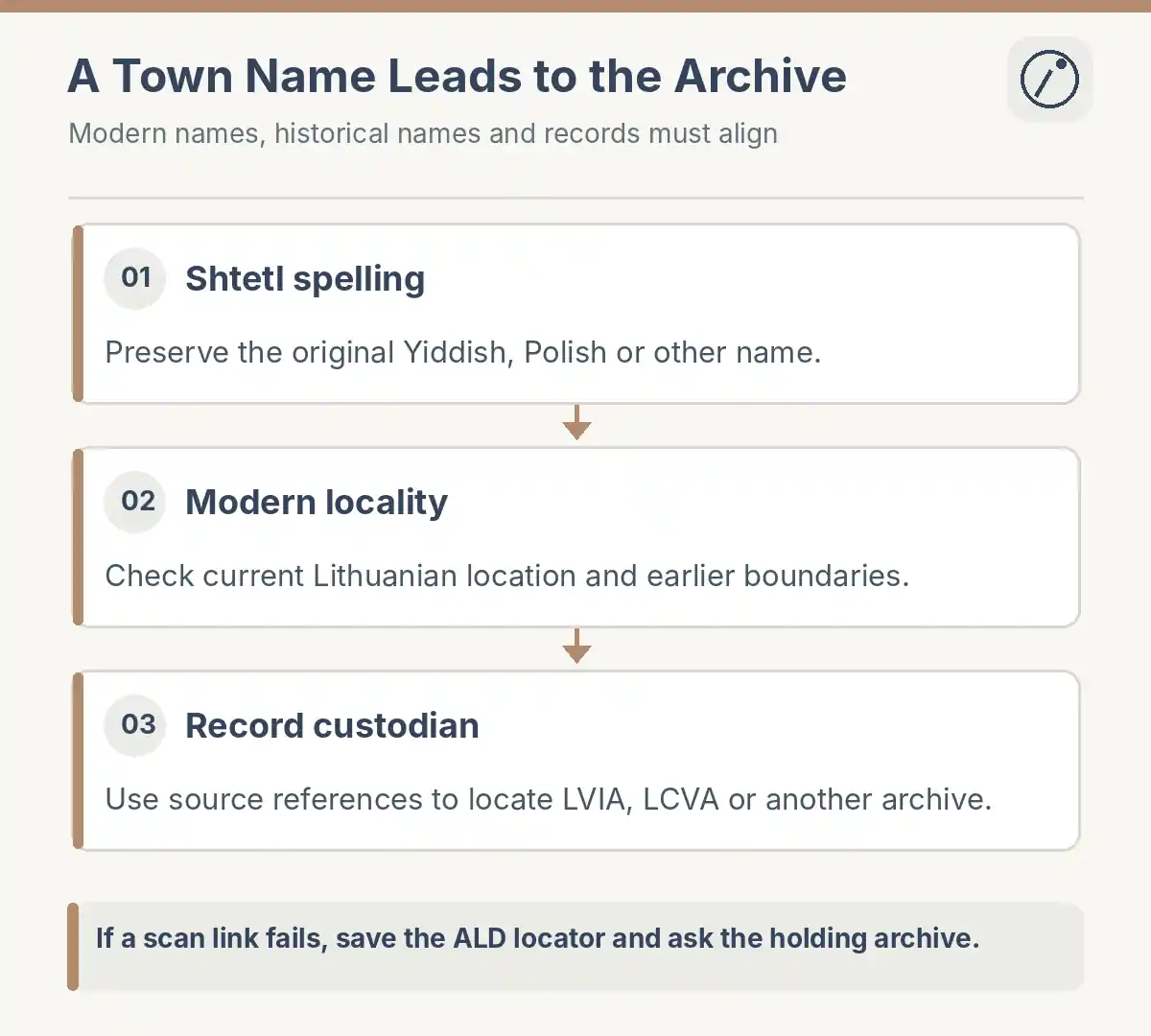
Begin with a town named in a passenger manifest, family letter, religious record or residence document. Write the spelling exactly as found, the source date and a candidate modern location. LitvakSIG normally standardizes geographic names to their contemporary spellings for indexing, while a remembered Yiddish or Polish form may look quite different. Borders and regional jurisdictions changed substantially between the Russian Empire, interwar states and the present day. Before searching the same surname across the entire database, try alternate town forms and compare the neighboring settlements. This reduces the false confidence created by finding a familiar surname somewhere in a very large territory. A town match itself still needs corroboration from a dated person-level record. The ALD guidance explains why modern geographic names and variant person names appear together.
Choose the original record class from the result
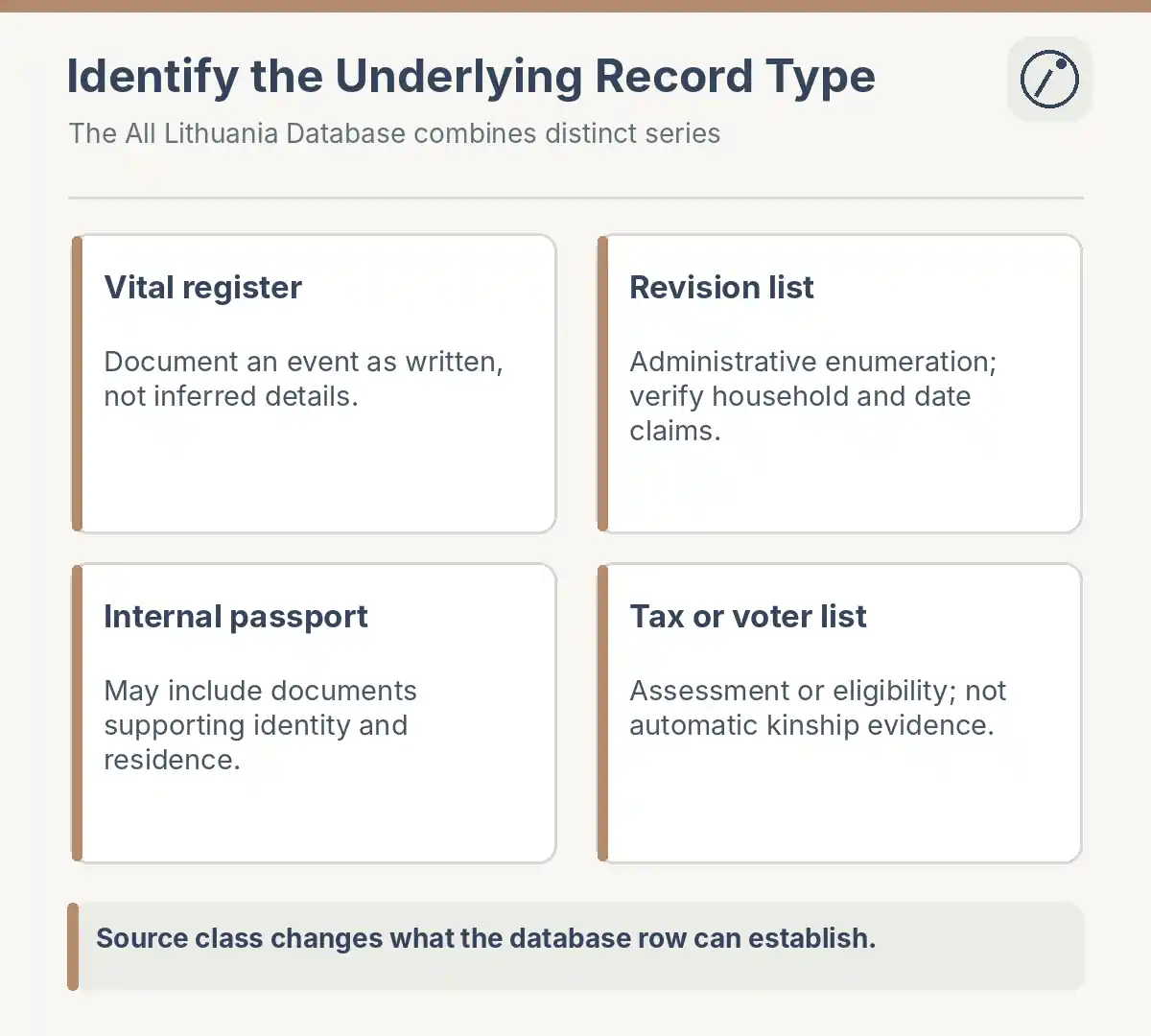
An ALD search can return vital records, revision and tax lists, voter lists, internal-passport files, directories, cemetery data and other material. These collections answer different historical questions. A birth register may report a birth; a revision list can enumerate persons for taxation or administrative control, not necessarily prove they lived together throughout the year. A tax list concerns an assessment, while a voter record has eligibility rules; an internal passport file may have valuable accompanying documents but coverage depends on survival. Record the exact class and year before extracting names. Do not put an index entry in a family tree as a birth certificate when it actually comes from a later administrative list. LitvakSIG’s record-type inventory helps classify the evidence.
Search variants without inventing a lineage
Older records may be written in Old Cyrillic, Russian, Hebrew, Yiddish, Lithuanian, Polish or German, and the translation is mediated by the choices of both clerk and indexer. Test first and last names in several plausible forms; avoid treating the modern spelling as fixed. Some Lithuanian surnames also have grammatical endings that differ by sex or marital status. Preserve the entry’s exact translated name and a separate field for the spelling by which you found it. For every likely hit, transcribe the stated town, date, names, relationships if explicitly given, source class and indexed reference. Compare candidates against the timing of migration or a documented residence. Two people with the same patronymic and surname may still be unrelated; build an evidence table rather than merging them. A transcription with no locality should rank below one that agrees independently on a place and dates.
Follow the record number to an archival custodian
The ALD is an access point, not the institution that created each original. Check its source and holding archive. Historic vital materials may be held at the Lithuanian State Historical Archives, while interwar school, internal-passport and other administrative records can involve the Lithuanian Central State Archives. Collections and repositories vary by district and record class. If a result includes a scan link, match the original handwriting and numbered entry or page rather than assuming the first image is correct. If only an indexed row survives online, preserve the archival references shown and ask the indicated archive about the original. LitvakSIG’s LVIA guidance describes how a screenshot of the ALD result can support a copy request.
Handle temporarily inaccessible FamilySearch images
LitvakSIG currently warns that many linked FamilySearch images show as locked or unavailable because of a technical access issue. This should not be reported as proof that the Lithuanian original was destroyed or restricted by the archive. Save the ALD row, original reference, image-link address and the access error, with a date. Next check the named repository’s request instructions rather than buying an unrelated record product. Access can differ from one record group to another, and the status may change. An archival copy request should contain the full indexed locator, district, document type, relevant year and a concise purpose; do not send speculative biographies. If a record is inaccessible, distinguish what the translated index reports from what you have not verified in the original handwriting.
Build a claim-by-claim citation for a Litvak family
Imagine an indexed revision-list row names a father and son but does not include a birth event. It may support that the list enumerated two named people in stated roles; it does not automatically document their birth dates, marriages or later migration. Track one claim per row: the reported relationship, date and place; source type; indexed transcription; original citation; availability; independent corroboration; remaining uncertainty. If a passenger document and an ALD row appear consistent, compare age, former home, trade and other persons before merging. Cite the archive and collection identifier when present, the indexed entry and the image consulted if any. Keep a note of all spelling variants so another researcher can reproduce the result and evaluate the same conflicts. Respect sensitive Holocaust-era records and do not expose information about living people.

A practical request worksheet has seven columns: modern town name, earlier place spelling, archival institution, document class, book or file number, indexed person details, and original-image status. The last field is especially important when scans do not open. List what the index actually states, then the exact missing evidence, such as the full relationship wording or the source’s date of compilation. A request is more likely to be useful when it identifies the indexed archive locator than when it asks an archive to reconstruct an entire family from a surname alone.
More Records and Archives Guides
How We Research LitvakSIG Source Chains
We distinguish the ALD search guidance from the archive’s holdings, and check the LCVA description when an interwar record is concerned. Dates such as 1795–1940 describe major historical collection efforts, not full coverage in every place and record series. The illustrative family comparisons in this guide are not actual database discoveries. Any commercial relationships are set out in our affiliate disclosure.
Yes. LitvakSIG describes the ALD as a free database; viewing results through JewishGen may require a free account. Additional projects can have separate contributor benefits.
Not necessarily. ALD indexes many different kinds of records. Identify the original document class and locate the source image before claiming primary evidence.
Records and indexes may use current Lithuanian spellings, earlier Yiddish or Polish names, or spellings from other languages and changing jurisdictions.
No. LitvakSIG reports an image-access issue for many links and directs researchers to the holding Lithuanian archive to request records.
No. Compare explicit relationships, locality, dates and independently documented evidence before connecting people.