
To locate a grave or memorial at Mount Gravatt Cemetery and Crematorium in Brisbane, use the Brisbane City Council grave and memorial location search and filter the result to the correct site. The cemetery opened in 1918; the crematorium opened in 1999, so a claimed earlier cremation at this specific facility needs immediate correction. Record the location precisely, then check whether the result identifies a burial, a cremation facility or a commemorative memorial. An online location is useful for navigation but does not by itself establish a family relationship or even that a visible headstone exists.
Select Mt Gravatt instead of a different Brisbane cemetery
The Council operates multiple cemeteries and crematoria, and a general surname search can return people buried across Brisbane. Open the Council search guide and proceed to its linked location tool. Search a given name or surname, then choose Mount Gravatt Cemetery from the site list where the interface allows. Note that Mount Gravatt Crematorium and Chapel may appear as a separate filter: this is not automatically the same proposition as burial in a plot. Keep the displayed location and event wording together with the selected site. Repeat with initials, alternative spellings and approximate dates if your first search is empty. An incorrectly selected cemetery can produce a compelling but irrelevant namesake; preserve all plausible candidate rows rather than accepting the first exact name.
Use opening dates as a first plausibility check
The official cemetery page dates the opening of Mount Gravatt Cemetery to 1918 and its crematorium to 1999. That does not mean every search result after those dates represents an actual interment of remains in the same type of resting place. Memorials for ashes, lawn graves and monuments can have distinct recorded events and naming conventions. If a family account places an eighteenth-century ancestor there, consider whether the family is recalling a later memorial or a different burial ground. Record three dates separately when available: death, cemetery service or placement, and inscription or memorial creation. A plaque may show a death date but contain no evidence that remains were placed beneath it. Seek the Council’s administrative description before altering the family chronology.

Read mapped portions, numbers and physical markers
A search result’s location information can help identify a section or plot, and the Council offers a Mount Gravatt ground map showing major portions and roads. That map does not necessarily identify a single grave among many in a portion. At the cemetery, numbers on most lawn plaques appear toward the lower right, but old monuments may be unnumbered because numbering came later. Some graves lack plaques or headstones entirely. Do not report a lost grave merely because a marker is missing or weathered. Save the displayed plot designation exactly and ask cemetery staff for on-site directions when needed. Do not move or clean historic markers to make a number readable: use photographs and administrative assistance.
Separate interment, cremation and commemoration claims
The Brisbane Council distinguishes graves from memorial structures, and a memorial is not necessarily the actual physical resting place of a person’s remains. A cemetery-search result can help identify an administrative location but may not establish where ashes were dispersed, whether a grave was shared, or who had the right to arrange a memorial. Maintain a four-field evidence sheet: event type reported, location displayed, physical marker seen, and claim not yet verified. A death certificate, funeral account or cemetery office response may add an independent piece of information. Be especially cautious about two people named together on a plaque: it may honor them without proving both are buried at the spot. The presence of a shared plot never automatically establishes marriage, parentage or legal ownership of burial rights. Our guide “Mount Royal Cemetery Montreal” adds more detail on this.

Check a namesake without seeking private relative records
Brisbane City Council says its public database lists names, birth and death dates and ages in varying records, but it does not make parents, children or other next-of-kin details available as public family evidence. Age and death date can distinguish candidates, yet older registers contain errors and missing information. Compare the result with a historical civil death record, residence evidence, a newspaper notice or another traceable document. Do not request records of living relatives to settle a historical namesake. If the displayed date or name is demonstrably wrong, the Council provides an evidence-based correction process, not permission to edit the record yourself. Label any memorial text or family tradition separately from the official search result, and preserve the specific contradiction you are trying to resolve. Our guide “Cornelian Bay Cemetery Records” shows how to compare Hobart burials and cremations.
Plan a reproducible cemetery visit or remote inquiry
Record which name variants and cemetery filter you used, the date searched, each likely result and the complete displayed location. If a visit is planned, identify the road and section on the Council’s map, and use the office during its stated hours for questions about numbering or missing markers. If remote, send a concise inquiry with the deceased’s full indexed name, death date or year and plot reference; ask whether the entry describes an interment or memorial and whether further nonprivate location documentation exists. Save the response and cite the operator, not a third-party memorial as though it were the Council. A missing online record can reflect incomplete registers rather than proof that the person was never associated with the grounds. For the next step, our guide “Pinnaroo Lawn Cemetery Brisbane” explains how to find burials and ashes memorial sites.
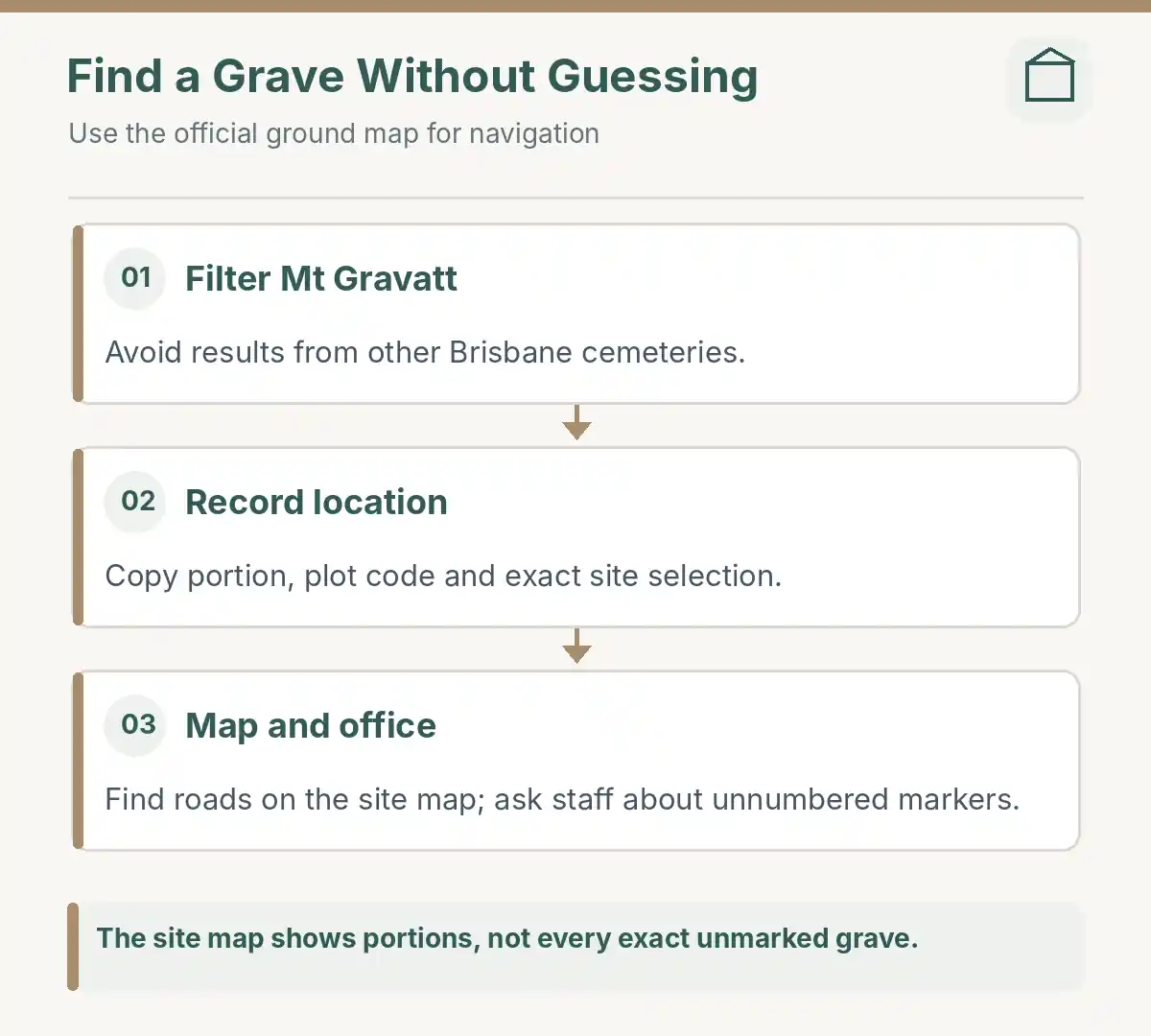
A useful site-visit note can have fields for cemetery name, exact administrative location, row or portion, printed map reference, inscription observed, date of observation and unresolved questions. A photograph of a neighboring marker can be a navigation aid but is not evidence of the deceased’s identity. If two same-name listings share an approximate date, search wider Brisbane records for independent residence or funeral clues before selecting a site. In a correction request, give the Council your documentary support and ask staff to review the record; do not assert that an unmarked grave is a mistake. Our walkthrough on how to search for a grave by name in online memorial indexes sets out each step.
More Records and Archives Guides
How We Research Mount Gravatt Locations
We compared Brisbane’s deceased-search interface with the site-specific historical and map guidance. We separately checked the Council’s published warnings about missing registers, next-of-kin privacy and erroneous old records. No actual individual or burial was looked up for the examples, and no kinship is implied by a shared site. Commercial disclosures are available in our affiliate disclosure.
The cemetery opened in 1918. Its crematorium opened in 1999, so distinguish these two facilities when evaluating an event.
Yes. The site page links to a map of portions, roads and facilities. A section map alone may not identify an individual grave.
The Council says it does not make next-of-kin information available publicly, and many old records did not collect it.
No. A memorial may commemorate someone without marking the resting place, and shared wording does not prove an interment or family relationship.
Some plots have no monument; older monuments may be unnumbered. Keep the search location and ask the cemetery for assistance.