
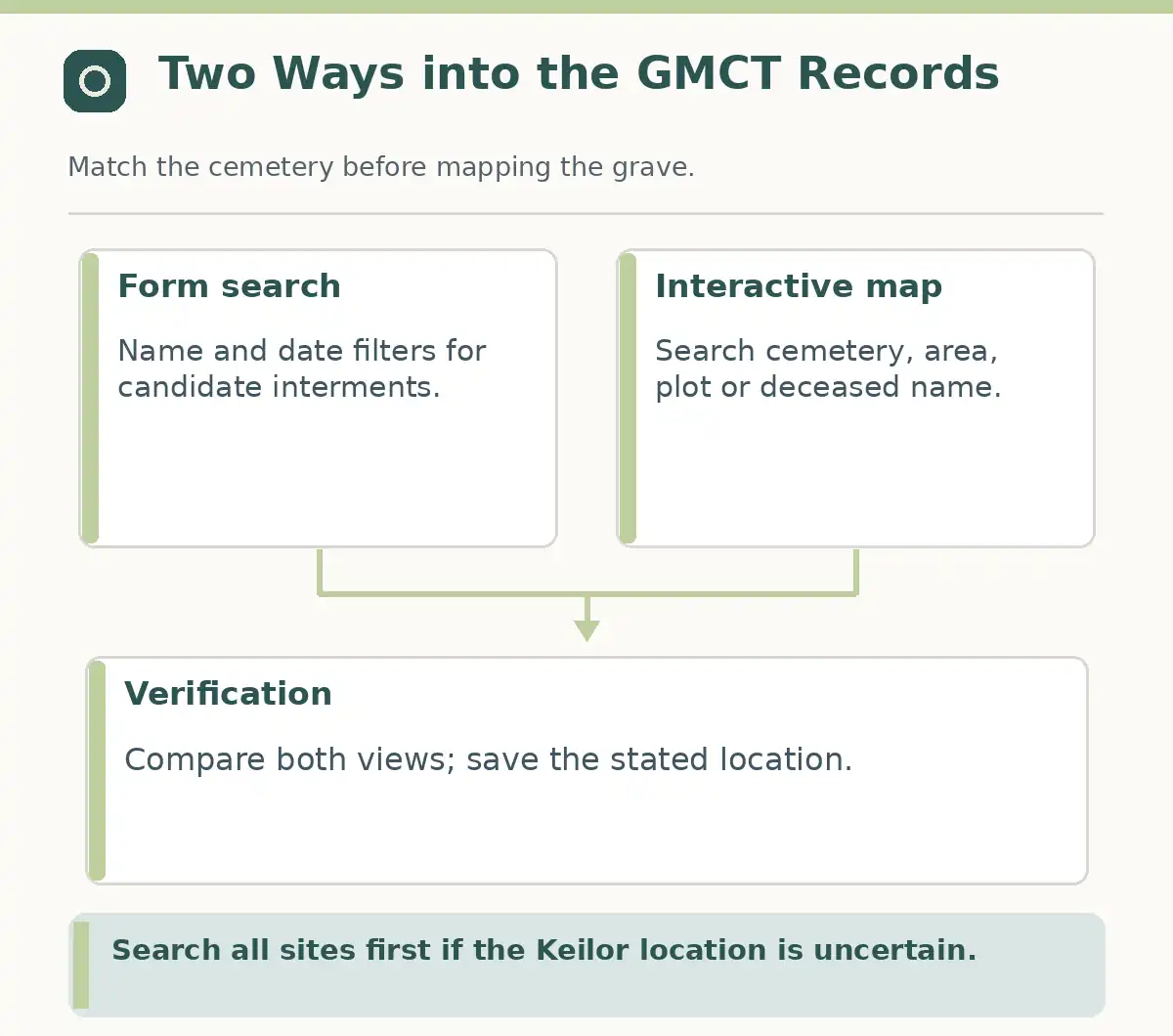
To search for a historical burial at Keilor Cemetery in Melbourne, use the Greater Metropolitan Cemeteries Trust’s Find a Grave service rather than relying on a crowdsourced gravestone page. GMCT offers both a form-based deceased search and an interactive cemetery map. Begin with a known surname or date range; if the location is uncertain, search all GMCT cemeteries first, then narrow to Keilor when the match is supported. A cemetery entry shows a recorded disposition or location, not a proven biological relationship with another occupant.
Find the correct GMCT cemetery search route
The trust’s official search page says you can search by a form or an interactive map. Form fields help filter possible deceased matches; the map explores plot locations and cemeteries visually. Do not require a middle name, exact death date or complete spelling if you are uncertain. The GMCT family-history guide specifically recommends leaving uncertain details blank and trying name variants. Because historic cemetery names can change, use All locations for an initial broad check when the burial place was passed down only orally. Then capture the cemetery name shown by the result and verify whether it actually identifies Keilor rather than a different trust-managed memorial park.
Copy the recorded location before interpreting a map
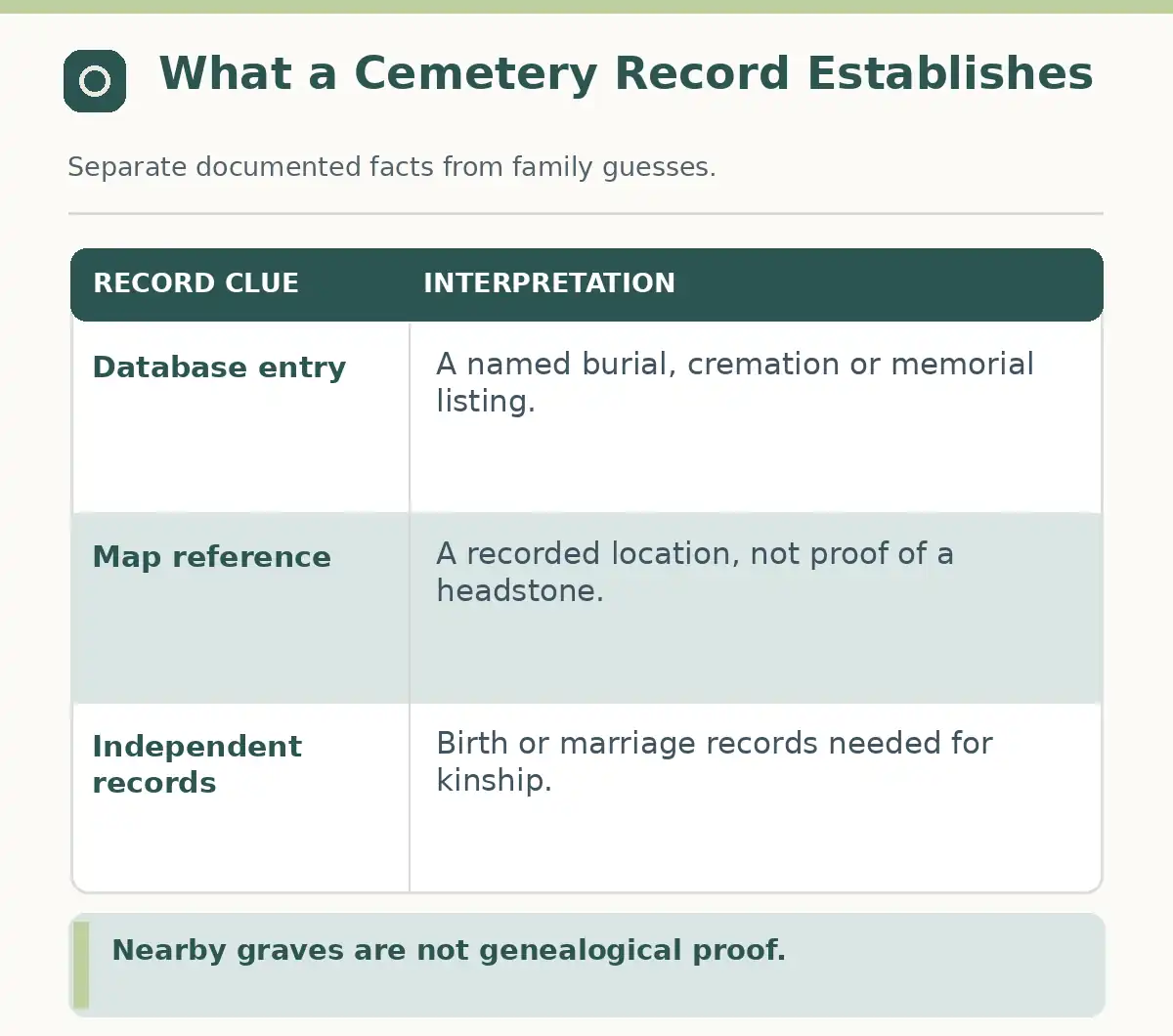
For each promising match, note the name as recorded, relevant date, cemetery, section or area, plot or grave identifier when available, and where the result was retrieved. Open the interactive map and locate that section. A map pin or an on-screen area outline is a navigation aid; it may not by itself represent an individual headstone. Burial, cremation and memorial arrangements can lead to different search displays. Keep ‘recorded in cemetery database,’ ‘plot located on map’ and ‘inscription seen on site’ as separate claims in your notebook. If a burial record has no specific photograph, do not write that a monument exists. Only a location verified from a cemetery record should become directions for an in-person visit. For the next step, our guide “Brighton General Cemetery Records” explains how to find the grave and verify it.
Test broad and narrow name searches systematically
Start with an exact surname and another documented name detail, then loosen restrictions if no result appears. Try spelling variants, initials and former surnames when supported by independent documents. GMCT notes historical records may contain errors or missing details due to changes in record-keeping practices over more than a century. If the name is common, restrict by a reliably known period or the cemetery after broad discovery; do not set an unverified date merely because it helps produce one match. Record the full search query and note whether you searched Keilor alone or all trust sites. If an indexed result offers little information, use an independent death certificate, obituary or burial notice to test the candidate’s identity. Our guide “Fawkner Memorial Park Burial Records” shows how to find a grave and test identity.
Do not confuse neighboring graves with family membership
Several memorial names or interments in one section are not conclusive evidence of family relationship. Grave ownership or rights of interment may involve a purchaser, administrator or another person not buried there; a monument can commemorate someone whose body lies elsewhere. Even two individuals sharing a surname and plot should be linked only after a separate record supports the relationship. A strong comparison uses independent birth or marriage records to connect specific parents, spouses or children. Where GMCT’s historic information is incomplete, note precisely what the database does and does not say. Avoid repeating an online memorial’s unsupported family list as an official cemetery register entry. For the next step, our guide “Pinnaroo Lawn Cemetery Brisbane” explains how to find burials and ashes memorial sites.
Use the operator’s guide when the historic record looks wrong
The official FAQ explains that some historic entries may be incomplete or contain minor errors and invites documented review. If a death date, spelling or plot identification conflicts with an authentic civil certificate, preserve both readings and seek a records review through GMCT. The trust requests documentary evidence from a government source when considering register corrections; an unreferenced online family tree is not an equivalent substitute. Do not alter the transcript in your local log to make it fit a tree. If an official correction is made, keep a dated note of what changed and why. Burial records and legal death registration serve different administrative purposes and need different citations. As a practical check, imagine two entries under an almost identical surname, one recorded at Keilor and another elsewhere in GMCT’s network. The second should not be discarded solely because the family story says Keilor. Compare each entry’s reported date with a contemporary death notice, then look for a matching civil registration or an independently known spouse. If the map supplies a section but not a unique memorial photograph, label the position as an operator-supplied map location. In your citation, write precisely whether you used the name-search form, the map or direct correspondence. These different actions produce different strengths of evidence.
Build a Keilor-specific location and identity worksheet
Set up columns for the name searched, alternative spellings, GMCT result ID or reference, stated cemetery, section, plot, date, map check, on-site marker and independently proven identity facts. For two apparent John Smiths, write two rows and compare era, addresses, partners and death registration before retaining either. Record the operator’s official search URL and access date. Where a map appears precise but the official text is ambiguous, favor a request for clarification over an invented grave position. For memorial visits, respect cemetery access rules and other families’ privacy. A no-result after a few searches may mean a spelling, place, cremation designation or coverage problem, not a definite absence of burial. For a comparable plan elsewhere, our guide “New Zealand Cemetery Records” shows how to find a burial and verify the grave.

More Records and Archives Guides
How We Research Keilor Burial Evidence
This guide follows the GMCT official deceased search and the trust’s family-history instructions, both checked for the all-location option, map search and historical caveats. We do not treat a memorial display or another occupant as sufficient genealogical proof. Whenever the operator’s record and a government death registration differ, we report them separately and propose a documentary clarification. The affiliate disclosure explains our editorial relationships; the primary search route is GMCT.
Use the Greater Metropolitan Cemeteries Trust Find a Grave form or interactive cemetery map.
If the cemetery is not certain, the operator recommends starting with All locations because historical site names have changed.
No. A plot location, an interment and a physical memorial are distinct pieces of evidence.
No. Kinship requires independent records, not proximity or a shared surname.
GMCT provides a records-review route and asks for suitable documentary evidence of an error.