
At Pinnaroo Lawn Cemetery and Crematorium in Bridgeman Downs, Brisbane, the official Council deceased search is a starting point for both lawn graves and ashes memorials. It is not a family-tree database. The cemetery page explains that an allotment number is often shown at the bottom right of a plaque and that numbers generally run in sequence, but also warns that not every grave has a plaque or headstone. Your practical goal is to turn an indexed name into the correct type of resting or memorial site, then verify the specific location against a map or cemetery staff guidance.
Select Pinnaroo rather than a nearby cemetery
Brisbane City Council operates a combined grave and memorial location search for multiple Council sites. Start with the name, likely date of death, and Pinnaroo as the possible cemetery. If the result is from Mount Gravatt or another ground, preserve it as a separate candidate instead of silently changing the family story. Pinnaroo opened in 1962; a claimed nineteenth-century interment at this cemetery needs an explanation, such as later reinterment or confusion with a different place, before acceptance. The original cemetery address and details appear on Council’s Pinnaroo page. Record cemetery identity, not just the metropolitan area, in your citation.
Tell lawn burials from ashes memorials
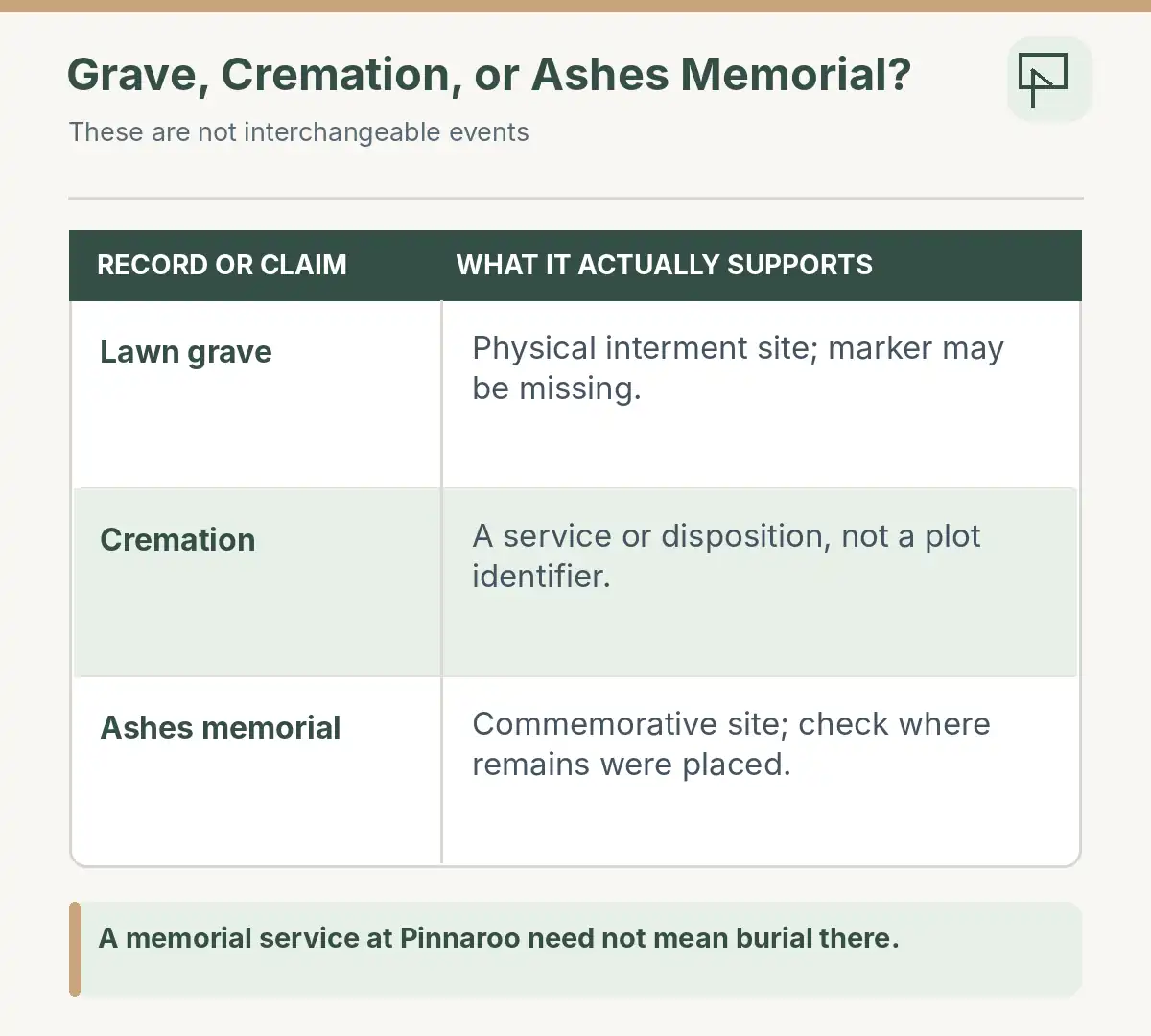
Pinnaroo provides lawn graves, ashes memorials, and facilities for cremations. A death notice mentioning ‘Pinnaroo’ might describe a funeral chapel, cremation service, placement of ashes, or physical burial. Those are separate events. When the Council record indicates a memorial position, do not assume the remains were placed beneath a lawn grave. Conversely, a grave listing can be present even when no permanent monument is displayed. The official page describes an ANZAC lawn and dedicated areas for returned-service personnel and spouses; this is a cemetery arrangement, not a basis for deciding that any particular named person served in the armed forces. For service claims, use the relevant military source instead. Keep a four-column worksheet: service place, cremation or burial action, memorial location, and supporting record. For a related choice, see our guide “VA Nationwide Gravesite Locator”.

Use allotment numbers and the map without guessing
For an on-site visit, open the Council page’s Pinnaroo Lawn Cemetery map and locate the named lawn, section or memorial area first. It is a navigation aid, not a guarantee that every grave will carry a legible number. Council says an allotment number is marked on the bottom right of most plaques and proceeds in sequence; ‘most’ is an important qualification. If the site number is absent or obscured, use surrounding mapped section cues and ask the cemetery office, not a presumed count of stones between rows. Note the date on the map or download because routes and grounds can change. Photograph the relevant marker from accessible paths, check the inscription on site and preserve the Council search reference independently. Our guide “Mount Gravatt Cemetery Records” goes into more detail.
Understand why records may be missing or wrong
The combined Brisbane burial database holds a large number of historical entries, but the operator says some older records are incomplete or inaccurate and some burial registers are missing. A search by exact spelling or a supplied birth date can therefore fail for multiple reasons. Begin wide and record every result that plausibly fits the person. Council invites supporting evidence for a correction, such as a historical certificate or a clear image of a marker, and provides a contact route on its search information page. Do not submit a guessed replacement date because an online tree disagrees. Identify whether the claimed correction concerns the person’s identity, the reported dates, the type of interment or a physical location.
Do not infer next of kin from adjacent memorials
Council expressly states that its public database is not a source of parents’, children’s or other next-of-kin information. Nearby plaques can represent unrelated burials, an administratively shared area, or people commemorated together without direct genetic ties. Construct a separate evidence chain for each person: official search result, certificate or independently issued funeral notice, then any appropriate probate or household document supporting the relationship. If a memorial plaque lists several names, transcribe exactly what it says, without rewriting it as evidence that each person is buried below it. Respect the restrictions on information about living relatives and any requirements for accessing original interment paperwork. Location and kinship remain distinct claims.
Prepare a useful request before visiting
Pinnaroo’s own page identifies its address as 285 Graham Road, Bridgeman Downs, Queensland, and publishes contact information and office hours. For a research inquiry, send the deceased’s documented full name and variants, approximate dates, the Council location result, the type of site shown, and the single question that staff can resolve. Examples include which lawn section a code refers to or whether an ashes memorial is distinct from the burial place. Do not ask cemetery staff to invent an ancestral relationship from a plot number. If traveling, check the current office and gate information on the official website. Note the answer, date, respondent and any cited administrative record so another researcher can replicate the location. For a related choice, see our guide “Carr Villa Memorial Park Burial Records”.

A site-specific field card improves an otherwise ambiguous memorial visit. Write down the surname as searched, the exact Pinnaroo site description, lawn or wall designation, plot or plaque code, search date, and whether staff confirmed the map position. On arrival, record the nearest accessible path and whether the numbered plaque is genuinely present; do not fill in a missing number by counting neighboring markers. If the inscription reports one date and the Council database another, photograph or transcribe both and request clarification with the supporting certificate. These notes can distinguish a map-navigation error from a real records disagreement.
More Records and Archives Guides
How We Research Pinnaroo Locations
We distinguish the operator’s Pinnaroo-specific numbering and service guidance from its broader multi-cemetery search database limitations. The illustrated search examples are hypothetical; they are not unverified claims about actual plot occupants. Read our affiliate disclosure for editorial transparency. We do not recommend paying anyone to obtain information that Council already provides free in its index.
Pinnaroo is included in Brisbane City Council’s combined grave and memorial search; use the cemetery field to narrow candidates.
Council says numbers appear at the bottom right of most plaques and generally run sequentially. Not every grave has a plaque.
No. A cremation memorial and a physical grave are different record types.
Council heritage information dates the opening of Pinnaroo Lawn Cemetery to 1962.
No. The public search does not establish next of kin. Verify relationships from independent historical records.