
The VA Nationwide Gravesite Locator (NGL) can lead to the burial or memorial location of a deceased U.S. veteran and, in qualifying cemeteries, eligible family members. It is not a complete national burial index. Most importantly, its coverage of private cemeteries depends on a government-furnished grave marker, and VA cautions that these records do not cover private-cemetery burials before 1997 in the way researchers may assume. Start with the type of cemetery and an independently known date, then read the result as a location clue—not automatic proof of identity, military service dates, or a family relationship.
Route the search by cemetery type
The National Cemetery Administration’s official locator includes VA national cemeteries, state veterans cemeteries, certain military and Department of Interior cemeteries, qualifying veterans in private cemeteries, and certain people recognized by a VA urn or plaque benefit. Those are different data streams with unequal completeness. Before typing a name, write down whether the family story concerns a national cemetery, a state veterans cemetery, a private grave, an overseas military cemetery, or merely a memorial plaque. If the suspected location is Arlington National Cemetery, consult its own records. For certain American military burials overseas, the American Battle Monuments Commission has a separate route. The NGL itself directs users to those custodians. A negative response from one category is not a comprehensive negative finding for the others.
Understand the private-grave 1997 limitation
A privately placed headstone is not the same thing as a government-furnished marker. The VA says its private-cemetery information was gathered to provide federal markers and that it lacks burial information for private-cemetery burials before 1997. VA also says an individual cannot simply be added because a family has found a privately supplied stone. Nor can entries be added when a government marker was furnished before 1997 and no eligible database record exists. A veteran who died decades earlier may nevertheless have a VA marker benefit recorded under a later qualifying action; inspect the precise source category rather than converting 1997 into a universal death-date cutoff. Use the VA marker eligibility guide for benefit context, not as proof that a particular grave is indexed.

Collect a candidate without conflating identities
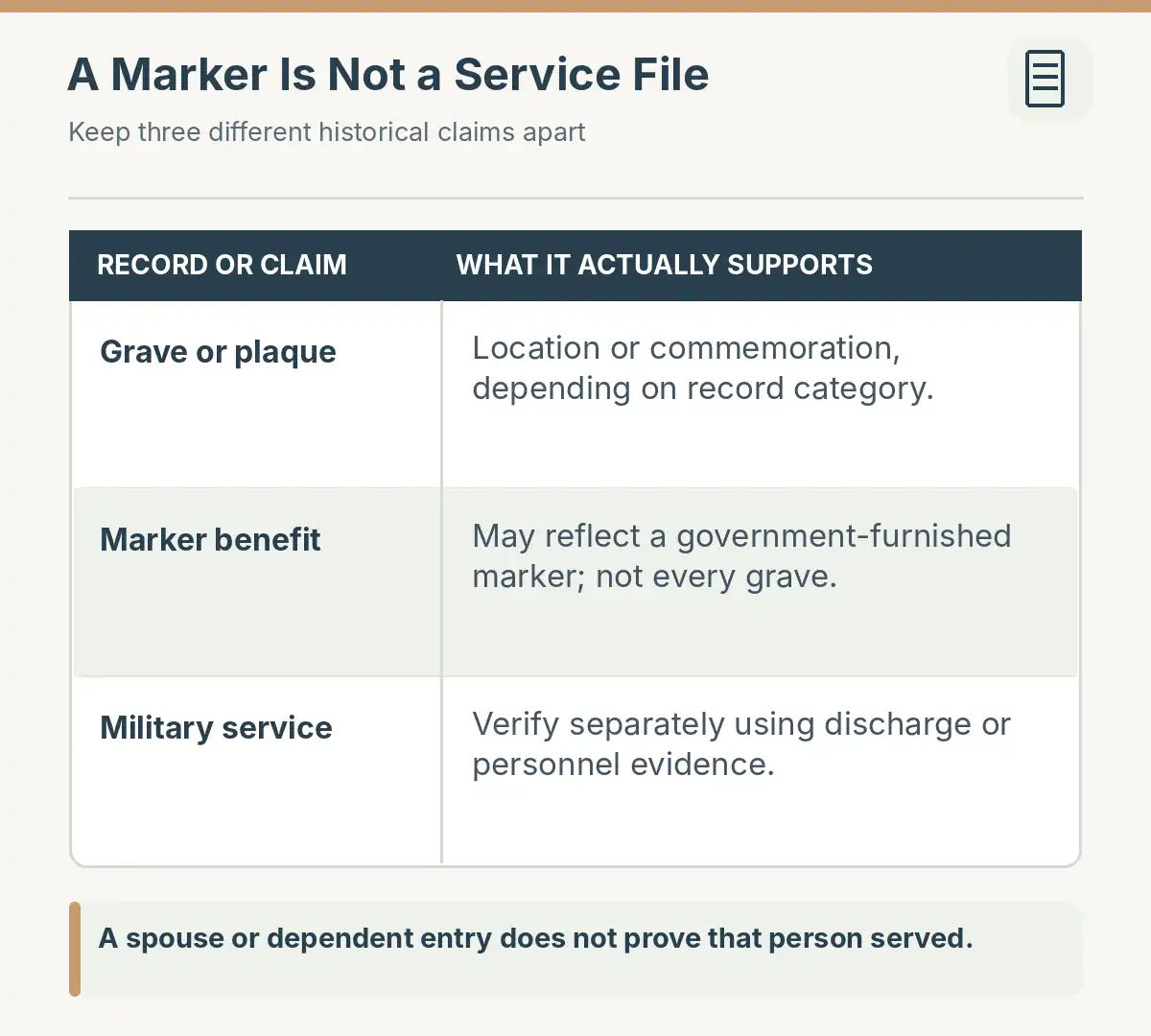
Search with the name as it appears on an independent contemporary document. Try a middle initial, spelling changes, a birth-date range, or a known death year when the first search is inconclusive. Copy the cemetery name, recorded dates, available grave or memorial location, and exactly how the person was described. For two people with the same surname, make two rows instead of prematurely attaching the result to a family tree. Compare birthplace, death locality, spouse and children where separately supported, and the cemetery’s own burial ledger. A memorial listing for a spouse or dependent may be linked to eligibility through another person and must not be interpreted as independent military service. If a middle initial differs, retain the disagreement in the log until a better record resolves it. If you want the full process, read how to find where an ancestor is buried when no grave appears online.
Distinguish a government marker from military proof
A government grave marker identifies how a grave has been memorialized under a benefit, not a complete military personnel dossier. The eligibility rules also differ by service circumstances and period. Do not infer combat service, a particular unit, a rank history, or an honorable discharge simply from a grave search. Instead seek a service record, discharge document, pension file, muster roll or credible cemetery interment record appropriate to the claimed era. The VA guide to service records explains formal records-request routes. When a marker has a branch or war inscription, transcribe it as a statement on the marker, then test it against records that were created for military administration. Markers may have been ordered years after the death.
Investigate missing or disputed NGL entries
The NGL notes that the contributing data can be updated daily yet remain uneven by source. A missing result could reflect an unindexed private grave, a spellings problem, a memorial-only benefit, a cemetery outside participating systems, or data that the operator needs to correct. VA advises contacting the cemetery directly for errors in national-cemetery records; for private graves and urn or plaque benefits it identifies Ask VA as the contact. Its published burial-location request asks for full name and variants, dates and places of birth and death, service entry state and branch when known. Do not send guessed military identifiers or sensitive information about living people. A recorded ‘not found’ means only that a specified search, on a specified date and platform, did not locate a candidate.
Create a location-to-person evidence table
Use separate columns headed claim, actual wording, source, date consulted, and independent check. For burial, cite the NGL display and the cemetery register if obtained. For military service, cite the appropriate individual service document; for identity, compare civilian age, household or probate evidence. A plot number supplies physical location, not by itself a biological connection to nearby graves. A memorial marker does not necessarily mark human remains at that position. Photograph an inscription only when accessible and permitted, and record whether it is a grave, a cenotaph or a plaque. If multiple family members share a plot, seek separate interment records for every named person before reporting who is buried there.
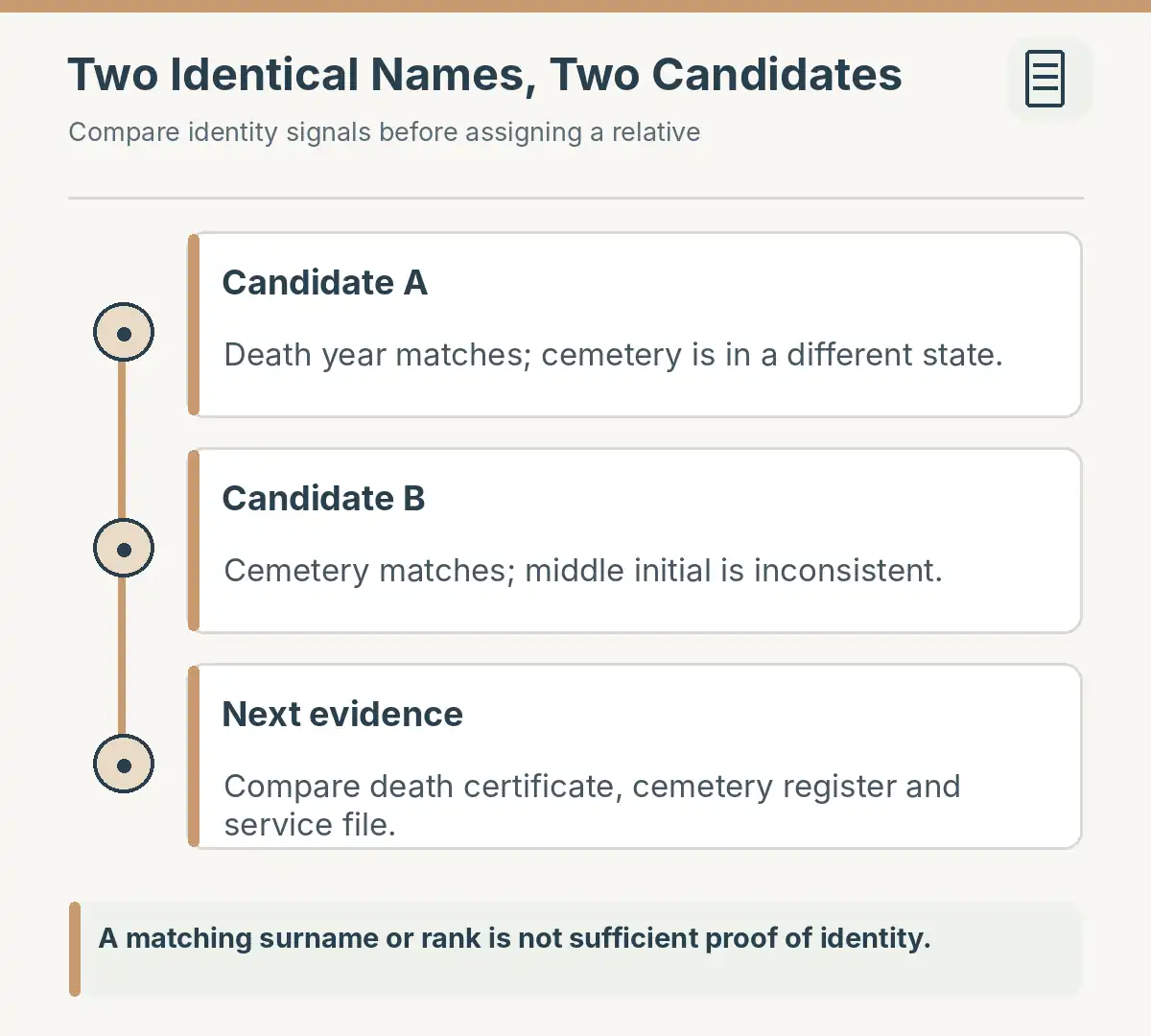
For a structured verification exercise, imagine a surname search returning an older private-cemetery marker and a younger veteran buried in a state veterans cemetery. The same county of origin is not a connecting fact. Record the full dates from each entry in separate rows, determine which registry supplied each location, and seek an independent death registration for the target individual. Only after establishing the correct civilian identity should you ask whether the service documents support the branch, unit or enlistment story. Save an exact URL or search path and consultation date for future audit; online corrections may change the displayed data without explaining earlier versions. For a related choice, see our guide “German War Graves Search”.
More Records and Archives Guides
How We Research VA Burial Search Limits
We separately inspected the NGL coverage and correction guidance, the government marker eligibility rules, and VA’s service-file request guidance. Our decision route deliberately keeps cemetery record, marker benefit, interment, commemorative plaque and verified service identity apart. The hypothetical comparison is a method illustration, not a lookup of a particular person. Our affiliate disclosure explains commercial transparency; no paid vendor is required for this research route.
No. The private-cemetery segment is tied to government-furnished markers and has documented gaps, including older marker records.
No. It is burial or memorial information. Use original or official military service documents to assess service.
Eligible family members in participating veteran cemeteries can appear. A spouse listing does not itself imply the spouse served.
Contact the national cemetery for national-cemetery entries, or follow VA’s Ask VA guidance for private grave and urn or plaque listings.
Try identity variants, identify the actual cemetery category, search its local records, then consider a formal burial-location request.