
Finding an ancestor’s burial place is not the same as finding their death date or locating an online memorial page. Work outward from a documented death locality toward a named cemetery; then seek an interment record and plot reference before trying to locate a grave on the ground. A family tradition, obituary or map pin can start the search, but a missing headstone does not rule out a burial. This guide is about resolving a particular person’s final resting place and planning a respectful visit, rather than surveying all types of cemetery archives.
Begin with the death place, but question every location
Start with the person’s last documented residence, death date range, death place if known, and religious or community links only when supported by records. Death and burial places can differ: a person may die in a hospital far from home, be returned to a hometown, or be cremated and interred later. If you have an obituary, read carefully for whether it names a cemetery, funeral location or only a church service. Treat a burial claim as provisional until it connects to a person-specific interment entry or an independently identified grave.
For a U.S. death certificate, locate the correct state or local registrar through the CDC’s Where to Write for Vital Records guidance. The CDC does not itself issue national death certificates. Availability and eligible requesters vary by jurisdiction and event date; do not promise public access to a recently filed certificate. A certificate may identify disposition arrangements, but the format and completeness differ among places and periods. Note exact wording and the informant when provided. If no certificate is accessible, funeral programs, cemetery-related correspondence and contemporary notices can still narrow the route.
Follow funeral notices into a likely cemetery
Read death notices, funeral announcements and obituaries as directions rather than final proof. One may identify the funeral home, officiating institution, planned service or burial ground. Search the funeral director’s surviving records or successor business if appropriate and available. A church burial ledger might name a graveyard, while a civil permit may document authorized disposition. Historical cemetery names and jurisdiction boundaries may have changed; map the place as it was called at the time of burial before applying its present-day address.
Build a small candidate list ranked by source: named explicitly in a dated funeral or burial record, plausible from household location, or suggested only by family tradition. Avoid guessing a burial from a surname cluster on a public memorial website. People can share names, and families may own plots in more than one town. Call or write one custodian at a time with specific questions and document each response. If a local cemetery no longer operates, seek its successor administration, city archive, faith community or historical society. Our guide to reading historical obituaries as evidence goes deeper into what they show and what they do not.
Confirm the actual interment rather than only the cemetery
Ask the cemetery office or records holder for an entry under the deceased person’s name, including interment date, lot, section, grave identifier and any notes about removal or reinterment. A lot-purchase book alone does not prove that the individual occupies the lot. Multiple graves may share a monument; conversely a burial may be recorded without a visible stone. Request a current section map or office directions only after the burial entry is matched to your subject by name, approximate dates and family context. Treat a paper plot number as historical until cross-checked against current mapping. For the next step, our guide “Gravestone Search” explains how to read old headstones without inventing family facts.
For a hypothetical person called Evelyn Reed who died in the 1930s, imagine a notice naming Cedar Hill Cemetery but no online photograph. The next research move is not to place a map pin where another Reed appears. Ask the cemetery’s custodian to check the burial register for Evelyn and provide a legible plot key if one survives. If the office identifies a grave but no marker, your conclusion can still be ‘interred in section C according to the register.’ The sample names and cemetery in this example are invented solely to demonstrate the method. Our guide “Brookside Cemetery Burial Search” shows how to find a Winnipeg grave and check the evidence.

Use online cemetery maps and veteran locators carefully
FamilySearch offers cemetery-site searches and features through which users can place burial-location markers on maps. A contributed pin is not an official survey coordinate unless its provenance is demonstrated. Keep the distinction between a cemetery-wide location and an individual grave. Photographs and public memorial entries can help identify stones and lot codes but need verification against inscriptions or cemetery records. If the selected cemetery record lacks an exact plot, do not assume the map pin names a specific grave.
If a person served in the U.S. military, the VA Nationwide Gravesite Locator is a valuable additional source. Its coverage includes specified national, veterans and other military or federal cemeteries, plus certain private burials with government markers. The VA warns its private-cemetery holdings have a narrower basis and should not be treated as complete for older burials. Lack of a VA match does not mean the person was not a veteran or was not buried. Use an actual cemetery office or local official to resolve incomplete or inconsistent locator information.
| Evidence reached | What you may say | What remains unknown |
|---|---|---|
| Obituary names cemetery | Burial was reported or intended there | Whether interment happened |
| Cemetery confirms interment | This person is registered as buried there | Whether a marker survives |
| Official lot map matched | Plot position corresponds to register | Whether a visible marker exists |
| Observed inscription | Marker is present with recorded words | Whether memorial exactly marks the remains |
Plan a safe and respectful visit to the right section
Before traveling, confirm opening times, access rules, plot numbering, visitor assistance and any seasonal restrictions directly with the cemetery. Older cemeteries may have sections renamed, paths removed or markers moved through preservation work. Request a current map and note whether staff distinguish grave locations from memorial or cenotaph locations. Respect sacred, private and culturally restricted burial sites; do not enter closed ground or publicize sensitive coordinates without permission. Document on-site impressions as observations, not as corrections to the administrative record. For a step-by-step method, see how to search for a grave by name in online memorial indexes.
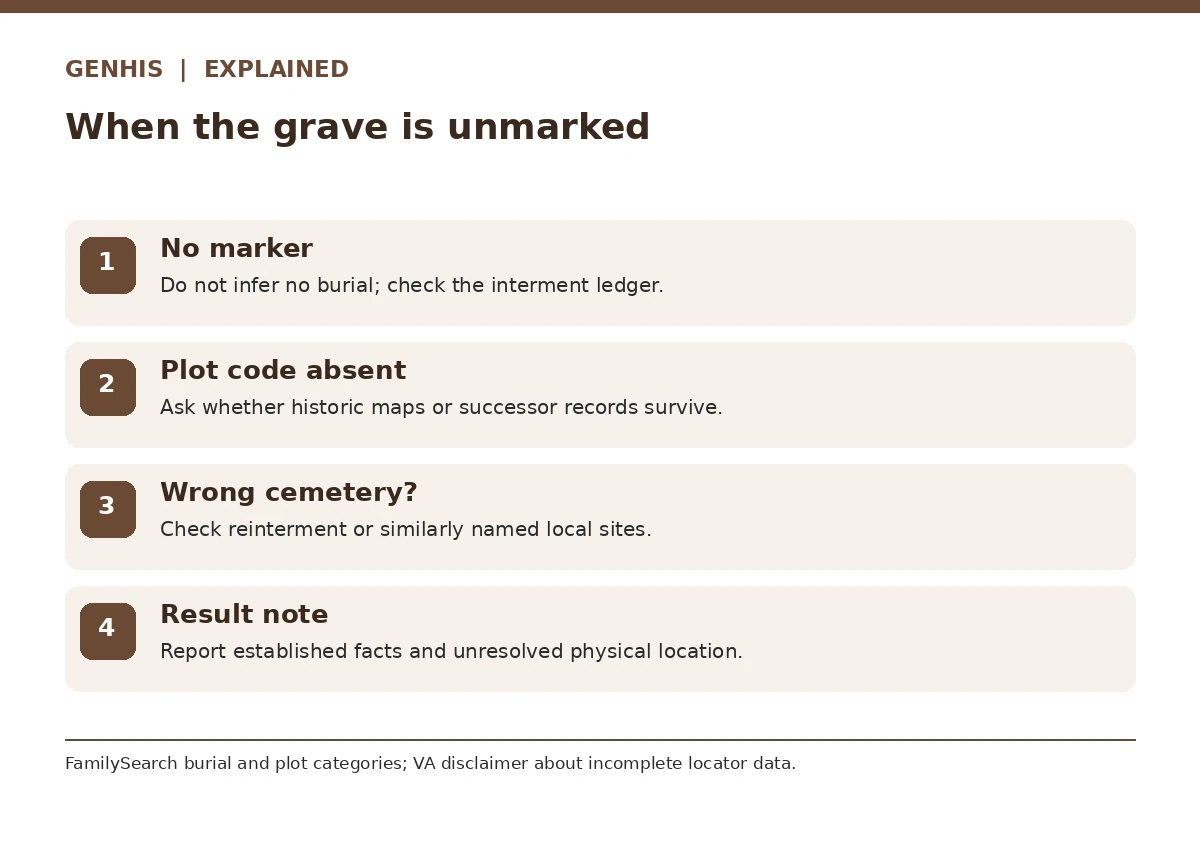
At the location, photograph a permitted overview showing landmarks and any marker, then close-ups of readable inscriptions. Note where the observation was made and the date; do not clean, scrape, chalk, rub aggressively or shift fragile stones to improve legibility. An unmarked grave may be visible only through a register or site plan. Absence of a stone is not evidence of absence of interment. If the alleged grave is in an abandoned cemetery, seek local heritage or conservation advice rather than disturbing soil or attempting amateur excavation.
Report confidence levels when the grave remains elusive
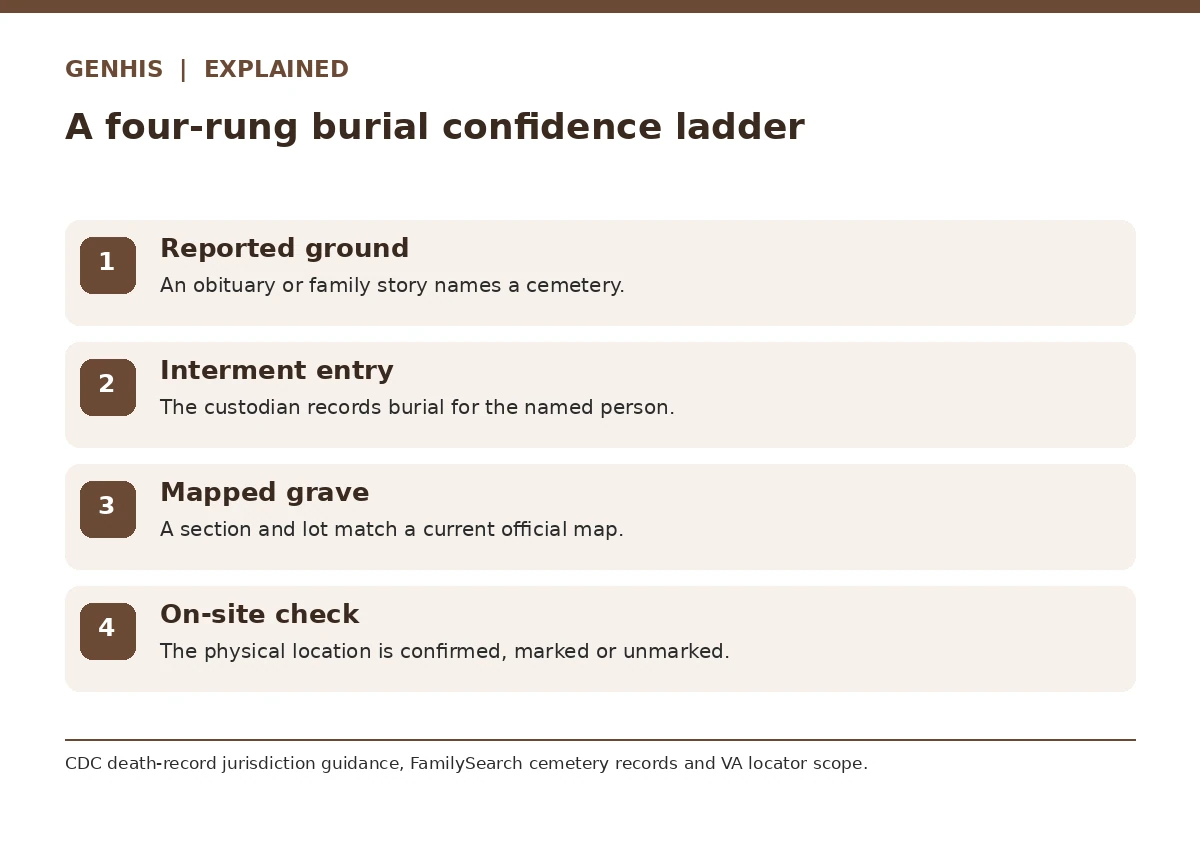
Use a four-step result ladder: a report names a cemetery; its custodian confirms an interment; an official plot reference can be matched to a map; and an on-site inscription or staff confirmation identifies a physical location. Each rung answers a different question, and missing higher evidence does not undo valid lower evidence. An obituary may identify only intended arrangements; a cemetery ledger may document a burial without a modern map; a memorial page may point to a marker without establishing a burial. State only the rung reached.
Keep a short evidence packet with the death source, notices, cemetery correspondence, exact register citation, map or site notes and untested alternatives. Include future research leads such as historic plot plans, municipal burial permits, church ledgers or possible reinterment documentation. If there are conflicting cemeteries, preserve both claims and investigate the chronology rather than picking the more appealing photograph. A useful conclusion may be ‘burial place not yet determined,’ accompanied by a reproducible list of where you looked and which dates those records cover. To go further, our guide “Cemetery Records for Genealogy” shows how to read registers, lots, and maps.
How We Research: sources, uncertainty and scope
For this article we compared guidance from cem.va.gov, familysearch.org, cdc.gov. We focused on the exact source type, its geographic and chronological coverage, the difference between reported information and documented events, and the limitations of indexes, transcriptions or contributed data. The worked examples are explicitly hypothetical, not discovered historical people. Recheck repository terms and local jurisdictions before making a purchase, requesting a record or visiting a site.
More Records and Archives Guides
Authoritative sources and limits of this guide
cem.va.gov — original institutional guidance. VA identifies which veteran and family burial records appear in its gravesite locator and warns about private-cemetery gaps.
familysearch.org — original institutional guidance. FamilySearch describes cemetery and person searches, mapped locations, and user-added burial pins.
cdc.gov — original institutional guidance. CDC provides state-by-state vital records office guidance by event jurisdiction rather than issuing national certificates.
familysearch.org — original institutional guidance. FamilySearch describes burial dates and plot identifiers in record types, which require type-specific interpretation.
Editorial disclosure: GenHis supplies general research information, not a legal finding, guaranteed archival inventory, record-ordering service or proof of an individual family relationship. Local rules and surviving sources vary. We do not claim partnerships or paid recommendations in this guide. See our affiliate disclosure for site policies.
Yes. Interments can be recorded in a burial register even when a marker is missing, lost, damaged or never installed.
No. Details vary by jurisdiction, date and certificate; some record disposition information, and others do not supply a usable burial location.
A user-contributed memorial or pin is a lead, not necessarily an official interment entry. Verify with a custodian or original source.
No. VA defines specific covered cemeteries and qualifying private-grave records, with omissions and date-related limitations.
Look for removal, transfer, reinterment or modern cemetery records and explain any difference between the original and later resting places.