
A historical obituary can be one of the most revealing documents in a family history: it may name a spouse, list children, identify a migration or describe the person’s place in a community. But those details were reported by someone, selected for publication and sometimes altered during editing. Treat each statement as a clue with its own evidentiary weight. This guide assumes you have located a particular obituary and want to evaluate its claims, rather than search for the newspaper issue itself.
Identify the notice, author, and publication context
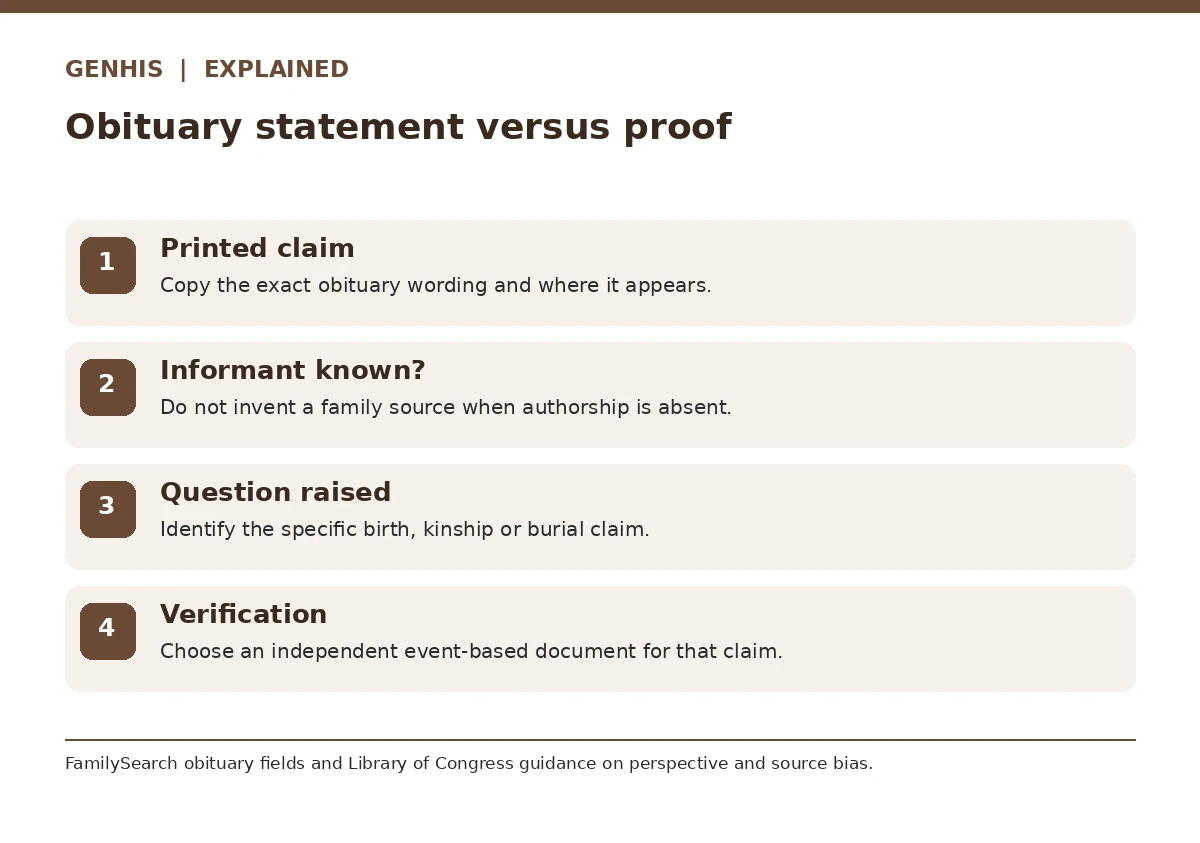
Begin with the original newspaper issue when possible. Copy its publication title, place, date and page and distinguish a paid family notice from a staff-written obituary or a reprinted wire story, if that distinction is stated. Many older notices do not identify an author or submitter, and silence should remain unknown. Ask whether the newspaper operated near the person’s final home or in a former hometown. A report published far away may have been copied from another title, with errors or omissions introduced along the way.
Preserve the whole column rather than a cropped transcription. On the same page, date headings and adjoining items can establish whether a digitized excerpt is actually a notice of death, an anniversary tribute or an account of a funeral from a later issue. If only an index entry is available, identify it as an index and avoid putting unsupported quotations in the ancestor’s biography. FamilySearch notes that obituary entries vary widely in the details they contain; no standard set of family members is guaranteed for a particular time or place.
Extract claims one at a time instead of copying a story
Make a ledger with five headings: exact wording, type of claim, person named, what the record establishes, and what must be checked. A published line such as ‘survived by three daughters’ establishes that a newspaper printed a claim about three daughters. It does not independently establish their births, parentage or whether other children existed. Dates of death, birthplace, occupation, education, addresses, military experiences and religious membership each need their own row. A richly detailed notice can still be incorrect on one important relationship.
Be precise with uncertainty and historical language. ‘Late of’ can describe former residence rather than a last address. ‘Brother’ may be literal kinship or a religious or community honorific depending on the context. ‘Mrs. James Cole’ may refer to a married woman under a spouse’s name, not an independent proof of her birth surname. Transcribe wording faithfully, then annotate your working copy rather than silently modernizing names or changing culturally specific terminology. Preserve quotation context while avoiding gratuitous reproduction of sensitive information about living descendants.
Grade the provenance of each family relationship
Obituary writers may have received details from a grieving relative, funeral home or community correspondent. If the informant is not named, do not assign personal knowledge to the writer. A spouse mentioned in an obituary is a valuable lead to a marriage record, household schedule or other independent source. A list of siblings should prompt searches for birth or baptism records that connect the children to shared parents. People listed as ‘cousins’ need additional evidence to establish an exact cousin degree. Never copy a family-tree relationship simply because an obituary index attaches a tree profile. If you want the full process, read how to extract and verify family clues from an obituary.
For a hypothetical obituary mentioning a widow, a daughter in another state and a nephew living nearby, separate three claims. The widow might be corroborated by a marriage certificate and household evidence; the daughter might require a birth or marriage record explaining a surname change; the nephew’s parentage remains unknown without a link to the deceased’s sibling. These are examples of reasoning, not historical persons. Add confidence notes only after matching place, dates and identity. Conflicting independent sources deserve explanation, not a vote based on the number of websites repeating one notice.

Read absences and flattering language with caution
An obituary is a selective memorial narrative, not a full census of a family. Omitting a child, marriage, estranged relative or occupation does not establish that it never existed. The choice of who was named could reflect family dynamics, local norms, available space, cost, and the submitter’s knowledge. The Library of Congress advises considering the viewpoint and possible bias of newspaper material. A concise death notice may contain almost no relationships, while a lengthy tribute can prioritize achievements over verifiable birth details.
The same caution matters for historically marginalized communities whose lives may be underrepresented in surviving mainstream newspapers. Do not assume lack of published notice means a person had no social ties or that an underdocumented community left no records. Investigate local-language, Black, immigrant, religious and community papers when appropriate, and handle historical descriptions of race, identity or status as the newspaper’s terminology rather than timeless genealogical facts. Clearly distinguish quoted source language from your own careful narrative. Our walkthrough on how to find old obituaries in newspapers and Library Archives sets out each step.
| Printed claim | Evidence status | Needed corroboration |
|---|---|---|
| “Survived by two sons” | Reported kinship, not certified parentage | Birth records or equivalent family link |
| Birthplace in prose | Reported personal history | Event-era birth or baptism record |
| One sibling absent | Silence, not proof of no sibling | Family and household records |
Corroborate dates, places, and events with better records
An obituary reporting death in a hospital might be timely evidence for where relatives believed the event occurred. A civil death certificate may establish registered location and date more directly, though its family background details can still depend on an informant. Test burial assertions against cemetery ledgers or interment registers; funerals and burials may occur at different sites. A reported birth date should be compared with contemporaneous birth, baptism or other early records instead of repeated as an unquestionable fact in a public family profile.
Create a follow-up table using the exact question raised by the notice. For example: claim = ‘born in County A’; best next source = historical birth or baptism records in the proper jurisdiction; problem = County A boundaries may have changed; action = check the boundary at the event date. For a military claim, seek an appropriate service source before asserting rank or unit. Every new document should be cited independently. If two newspapers reprinted the same obituary, they are not necessarily independent corroboration.

Write conclusions that preserve the evidence boundary
A defensible narrative uses language such as ‘the obituary reported’ for its unsupported assertions and stronger language only where independent records converge. A notice identifying a funeral church may be excellent evidence of an announced service, yet it cannot by itself show that the person was buried there. A named family member may have been a stepchild, adopted child, in-law or other relationship described in ordinary family terms. Record precisely what the document says before assigning a formal genealogical relationship.
Keep the obituary citation with image or reel provenance, the claim ledger, unresolved conflicts and a list of documents still needed. Where there is no original issue, write ‘indexed obituary entry’ or ‘uncited family clipping’ instead of a fabricated newspaper citation. An ethically written family history also avoids unnecessary details that could identify living people. The objective is not to discredit obituaries: it is to use their unique personal perspective while openly separating published recollection, independently verified fact and what remains unknown.
How We Research: sources, uncertainty and scope
For this article we compared guidance from familysearch.org, blogs.loc.gov, guides.loc.gov. We focused on the exact source type, its geographic and chronological coverage, the difference between reported information and documented events, and the limitations of indexes, transcriptions or contributed data. The worked examples are explicitly hypothetical, not discovered historical people. Recheck repository terms and local jurisdictions before making a purchase, requesting a record or visiting a site.
More Records and Archives Guides
Authoritative sources and limits of this guide
familysearch.org — original institutional guidance. FamilySearch lists typical obituary elements and notes variability across obituary records.
blogs.loc.gov — original institutional guidance. Library of Congress instructs researchers to consider authorship, publication and bias in old newspaper accounts.
guides.loc.gov — original institutional guidance. Library of Congress explains how to identify and inspect pages rather than relying on search extracts.
familysearch.org — original institutional guidance. FamilySearch labels a historical newspaper obituary collection as an index with names and event details.
Editorial disclosure: GenHis supplies general research information, not a legal finding, guaranteed archival inventory, record-ordering service or proof of an individual family relationship. Local rules and surviving sources vary. We do not claim partnerships or paid recommendations in this guide. See our affiliate disclosure for site policies.
No. Its relationship terms are useful leads, but parentage needs separate records and attention to adoption, stepfamily and changing family language.
Yes as attributed claims, with a citation and uncertainty noted; compare civil and earlier records before presenting them as conclusively verified.
Notices may be incomplete or selective. Omission alone is not evidence the person never existed or was unrelated.
Not necessarily. Different newspapers may reprint the same submitted announcement; inspect bylines, wording and provenance.
Cite it as a transcription or index, preserve the source description, and try to find the original dated newspaper page.