
The Browning Genealogy Database is an important finding aid for obituaries and community history in Evansville, Vanderburgh County, and nearby southwestern Indiana. Evansville Vanderburgh Public Library identifies it as the lifetime obituary-compilation work of Charles Browning. Search a historical name, keep the exact index entry, then identify the original newspaper issue or another independent record. An obituary can report relatives and residence, but a database hit by itself is neither a certified death record nor proof that every relationship is correct.
Know what Browning compiled and where it applies
Browning Genealogy began with alphabetized notes from Evansville newspapers. The organization reports that the original files span material beginning in 1906 and that a new consolidated search site was launched in 2024. These are statements about a continually growing compiled database, not a guarantee that every local death from 1906 forward has an item. Coverage extends beyond Vanderburgh County into parts of southern Indiana, western Kentucky, and southeastern Illinois, but entries depend on publications and projects that were actually indexed. Start with the source’s locality and date rather than treating the collection as a national death register.
Record the collection name and the provider you used. The Browning organization describes a free searchable index, while the public library offers a separate resource page. If a result resembles a person in your tree, write down the displayed name, any article or publication information, place, date, and the exact spelling. An old newspaper could carry a delayed obituary, anniversary notice, funeral notice or retrospective mention. Those are different events; distinguish the date of death from the date an issue was printed.
Search names and separate equally plausible people
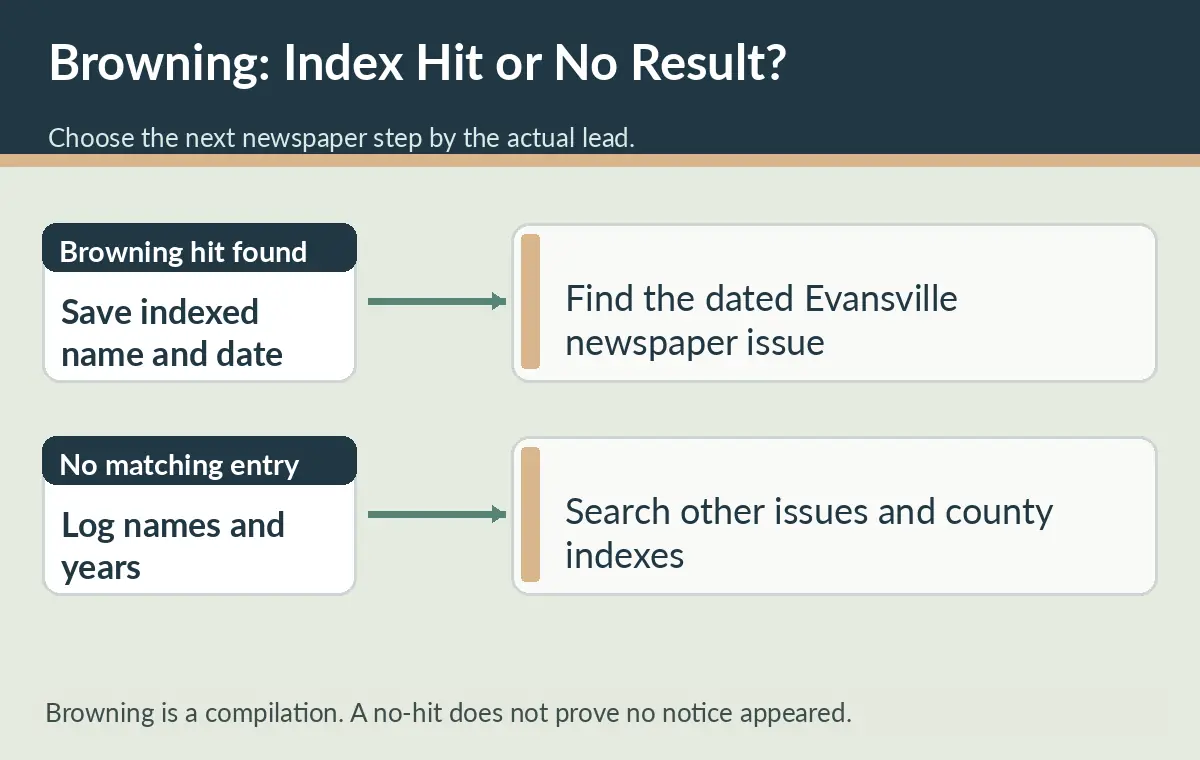
Search a full name first, then documented variants such as initials, maiden surnames, and common spelling alternatives. Narrow to a likely decade or community when the interface permits. A surname match in Evansville may concern a person who died elsewhere but had local relatives. Use an evidence sheet with columns for index form, article date, death date as reported, newspaper title, stated residence, and named associates. Record empty searches and the filters used; a no-result search does not prove the person never lived or died in the region.
Consider two fictional people called Helen Miller who appear in notices a decade apart. Do not select the one with the more familiar spouse name until a census, marriage record, address, church record or independent vital entry links that identity. Treat the survivors named in a notice as reported relationships: a stepson, a nephew or a foster child may have been described in the language familiar to the newspaper’s informant. Equally, an omitted family member is not proof that the relative had died earlier.
Use library newspapers to reach the dated issue
The EVPL genealogy page lists both the Browning index and historical Evansville newspapers as separate resources. The digitized Evansville collection provides page images for historical issues, but access terms are not identical to the freely accessible Browning index; the library currently identifies resident-card or in-house restrictions for its historical newspaper service. If you have access, open the article’s actual issue and page, check that the text corresponds to the indexed person, and note all printed corrections or follow-up notices.
If you cannot view the issue online, use the library’s Indiana Room, microfilm holdings, or ask about a targeted copy request with the date and title you found. Do not cite a newspaper as if you saw it when you only inspected a Browning database summary. In your notes distinguish ‘Browning index reports an obituary’ from ‘Evansville newspaper, issue X, page Y, states …’. The second citation requires examination of that issue. If the index has no newspaper citation, identify the missing metadata as a research task rather than inventing a title.

Test obituary statements with independent records
An obituary’s death day may be a valuable lead, but the reported birth place, parentage and spouse statements may be secondhand or incomplete. The Indiana State Library’s Vanderburgh guide lists county death indexes, newspaper microfilm, city directories and court records as separate evidence streams. Match the obituary to a historical death registration when available. Compare residence in a directory or census with the address in the notice, and look for a marriage entry if the identity depends on a spouse.
Create a claim table instead of pasting the whole notice into a family tree without distinctions. A funeral service in Evansville does not by itself establish that the person was interred there, and a named cemetery in a notice does not necessarily give a precise grave plot. A married daughter’s surname is a clue to seek her own marriage document, not proof of a specific biological parent-child connection. When different records give different ages, preserve both reported values and examine who supplied each one rather than choosing an average birth year.
Record a reproducible negative search
A good negative entry reads: ‘Browning Genealogy searched for Miller and Millar, death years 1920–1930, Evansville and surrounding locales; no matching record identified on the search date.’ It does not read: ‘There is no obituary.’ Browning is a compilation, not a comprehensive run of every newspaper. Try the library’s newspaper collection directly, neighboring county papers, church notices, and social columns where a family event might have been covered. A person may have died before the earliest compiled coverage, outside its geographic footprint, or under an unexpected name.
Keep an alternative-case column. For an indexed notice with an uncertain town, search the obituary’s associated people in directories and census years on either side of the death. Consider that a newspaper was printed days after a death; search adjacent issue dates if the date in an index is unclear. Whenever you use an online newspaper OCR result, open the issue image because OCR can distort names and columns. A carefully logged failure in one database can justify the next source, but it does not amount to exhaustive evidence of absence.

Cite the index and newspaper as different sources
For a Browning hit, cite the database or library host, indexed person, indexed date and any stable reference displayed, plus the day you consulted it. For the original notice, cite newspaper title, place, issue date, page and column if available, and the image or microfilm repository. If you only saw a transcription, say so. A useful research conclusion says which specific statements were checked against civil death and relationship records and which remain unverified; do not manufacture genealogical certainty from a single detailed obituary.
The source list below points to primary custodians and an independent state guide. You can keep the whole workflow free until an archive imposes its own access or copying rules; the public library’s newspaper service may require local credentials. Use GenHis’s affiliate disclosure for the site’s general referral policy; no commercial affiliation is asserted for the institutions named here. Preserve URLs and retrieval dates because the search interface may change while an issue-based newspaper citation remains useful.
More Records and Archives Guides
How We Research This Collection
We checked the Browning Genealogy site’s historical account against Evansville Vanderburgh Public Library’s collection descriptions and the Indiana State Library’s county guide. We kept a compiled obituary pointer separate from a viewed original issue and compared each reported family claim with independent vital, court or directory evidence before suggesting a conclusion.
No. Its obituary compilation centers on Evansville and neighboring counties in parts of Indiana, Kentucky and Illinois.
Its organization describes the searchable database as free, though access to original newspaper images may follow library rules.
No. The index is a finding aid; open the newspaper and verify reported relationships with independent records.
Evansville Vanderburgh Public Library lists historical newspapers, microfilm and the Indiana Room; check current access conditions.
Try dates and variant names, then other newspapers, county death indexes and local sources; a database no-hit is not proof of no obituary.