
To find an old obituary, begin with a likely death place and time period, then establish which newspapers actually served that community. Search digitized pages and obituary indexes, but verify the title’s coverage before interpreting a blank result. Some families published only a short death or funeral notice, while others never purchased or received a published notice. The goal of this guide is to locate a dated original page or a reliable holding reference—not to infer the absence of an obituary from a failed name search.
Define a publication window before searching names
Start with a death-date range sourced from a certificate, cemetery record, correspondence or another document. Record the person’s likely residence at death, but include the place of the event and nearby communities if different. A newspaper covering a small town may have been printed in a neighboring city. If you have only a burial date, search on both sides of that date rather than presuming the service or publication happened the same day. When the death year itself is uncertain, create a wider range and narrow it with independent records before subscribing to large search databases.
Write a search brief: name variants, last known household, possible towns, faith or community affiliation when legitimately documented, death range and one distinctive associate. Historical notices may identify married women under a spouse’s name, omit a middle name or render a surname phonetically. Search those variants carefully, without assuming that an initial always means the ancestor. Separating what is known from what is guessed prevents a keyword hunt from expanding endlessly and makes the eventual negative search meaningful.
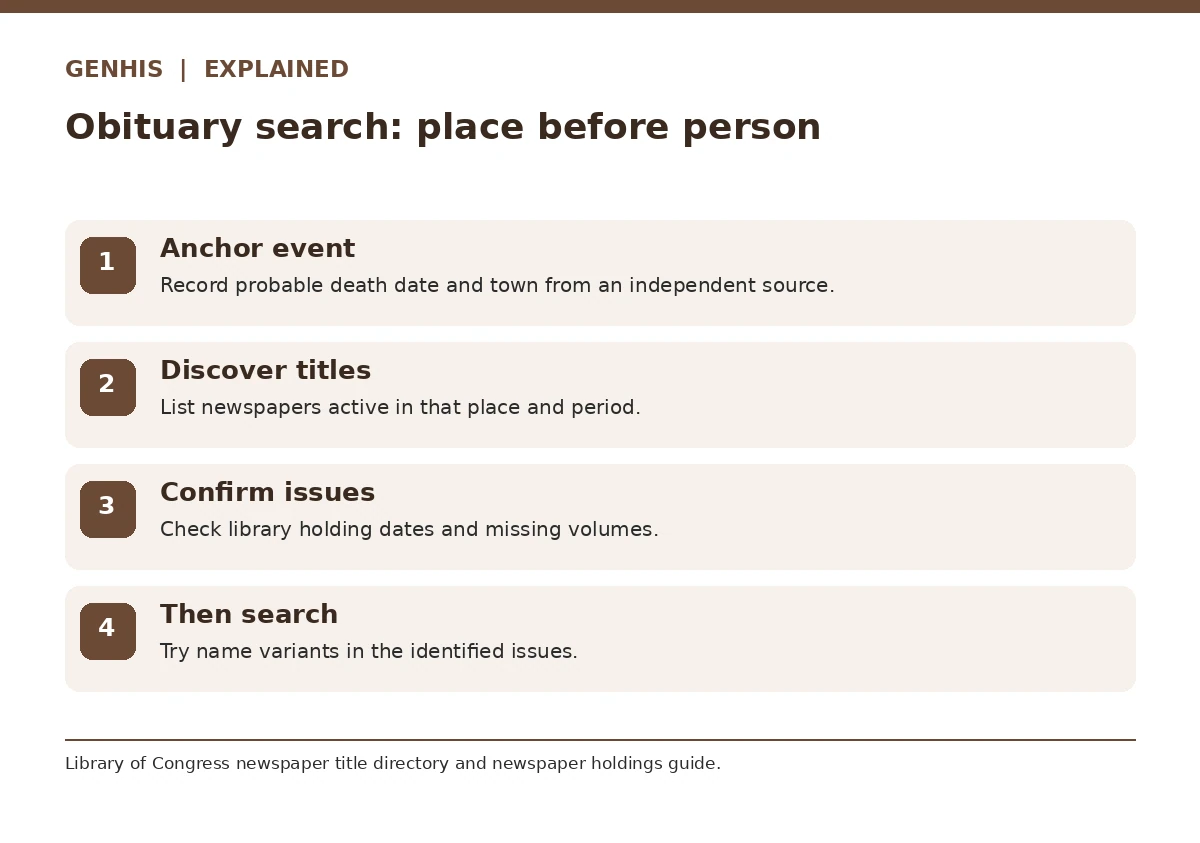
Find the newspaper first using a title directory
Use the Library of Congress Directory of U.S. Newspapers in American Libraries to identify publications by town and year. The directory is a discovery tool for titles and holdings; it does not imply the complete newspaper is digitized. Compare a title’s start and end dates, earlier names, weekly versus daily schedules and which libraries report holdings. Ask whether issues for the relevant week survive rather than relying on a database label promising broad state coverage. A partial reel or a missing issue can explain silence in a digital search.
For a concrete but fictional exercise, suppose the search is for a person who died in a small county in 1912. First identify local newspaper titles active in 1912, then note which library holds that year’s issues or a nearby weekly. Only after confirming the right publication should you test the person’s name. If no local title survives for the week, check county-seat newspapers, regional papers, religious periodicals and institutional bulletins that may have carried notices. Do not report an item as located unless an identifiable issue or indexed record has actually been examined.
Search digital newspapers with variants and proximity
Chronicling America is a valuable free discovery source for selected U.S. historic newspapers, not a universal newspaper archive. Search by name, then narrow the date range and place or title. The Library of Congress documents exact-phrase and proximity tools; trying surname within several words of given name can recover inverted names, initials or imperfect spacing. Add a recognizable street, occupation, spouse or town only when those details are independently supported and likely printed. A very tight combination of filters may discard the right result.
Treat optical character recognition as a navigation aid, not a transcript. Smudged type, broken columns, unusual letters and page folds can make an accurate obituary invisible to a name search. Browse nearby pages and issues manually when the title and month are promising. Try ‘died,’ ‘funeral,’ ‘interment’ or a church name, and inspect death-notice columns alongside longer stories. Save the whole page, issue date, title and page number; a clipped line stripped of its masthead cannot be cited reliably.

Look beyond a single site or newspaper index
FamilySearch explains that some obituary collections are name-indexed while other images are not indexed; additional copies may reside in its Digital Library or attached to family-tree profiles. Treat user-attached memorial content as a lead until the underlying issue is identified. Local libraries and state historical societies may hold microfilm, newspaper clipping files, subject indexes or community papers that the major web platforms do not include. A librarian can often tell you whether the requested dates are held, what access restrictions apply, and whether a remote copy is possible. To go further, our guide “Auckland Libraries Family History” shows how to use Kura, local newspapers, and Archives.
If you consider a paid newspaper service, verify title-level and date-level coverage before buying access; payment never guarantees that a particular obituary exists. Search for a record locator first and compare with free local-library resources. Sources can overlap because multiple platforms license the same microfilm. Record the unsuccessful searches with collection, date, spelling, filters and search mode. Repeating the same ineffective global query in three interfaces is less useful than finding a different newspaper or moving from OCR to manual browsing. If you want the full process, read how to search historical newspapers when names and OCR fail.
| Search situation | What can be concluded | Next attempt |
|---|---|---|
| Relevant issues available, OCR empty | The indexed search missed or lacks the notice | Browse issues and notices manually |
| No surviving issue identified | Coverage is unknown or absent for that title | Try other titles and library holdings |
| Index snippet without issue | Possible notice, source context incomplete | Request actual dated newspaper page |
Identify the actual item and capture a useful citation
A notice can appear on a page headed deaths, funeral services, memorials or local news rather than under the word obituary. Once you find a candidate, inspect adjacent text to establish where the item starts and ends. Verify the full name, event timeframe and any identifiers against independently collected facts. Newspaper writers frequently relied on relatives or submitted copy; an impressive paragraph of family relationships still reflects the source’s reporting, not certified civil registration. If two same-name obituaries appear, save both until the identity issue is resolved. For a step-by-step method, see how to extract and verify family clues from an obituary.
For citation, record publication title as printed, city of publication, complete issue date, page and column if visible, item heading or first words, repository or database, URL or reel identifier, and retrieval date. Keep a full-page image and a transcription with unclear words marked as uncertain. A search-result snippet is not a substitute for the newspaper page. If copyright or repository rules prevent redistribution, keep bibliographic notes and a permitted personal reference rather than reposting an unauthorized complete facsimile.

Know when to stop and change the research question
A careful negative search means checking actual titles that covered the place and period, deciding whether their relevant issues survive, trying justified name variants and examining likely columns. It does not mean that every newspaper worldwide was searched. A family may have placed a notice weeks later, in a former hometown, in another language or nowhere at all. Record those alternatives as possibilities, never as fabricated publications. Look to death certificates, undertaker or cemetery records for information that newspapers could not supply.
End with a short status statement: original obituary located and cited; index-only candidate awaiting page; title identified but issues inaccessible; or no notice found within a precisely described coverage window. These categories tell the next researcher exactly what remains. If you eventually find a clipping without a masthead or date, use wording and historical context to generate candidate newspaper titles but do not invent its publication details. The retrieval question remains separate from whether the notice’s family claims are true. For more detail, our guide to reading historical obituaries as evidence looks at what they show and what they do not.
How We Research: sources, uncertainty and scope
For this article we compared guidance from familysearch.org, blogs.loc.gov, guides.loc.gov. We focused on the exact source type, its geographic and chronological coverage, the difference between reported information and documented events, and the limitations of indexes, transcriptions or contributed data. The worked examples are explicitly hypothetical, not discovered historical people. Recheck repository terms and local jurisdictions before making a purchase, requesting a record or visiting a site.
More Records and Archives Guides
Authoritative sources and limits of this guide
guides.loc.gov — original institutional guidance. Library of Congress shows how to identify historical newspaper titles and confirm library holdings and dates.
guides.loc.gov — original institutional guidance. Library of Congress documents available newspaper search choices and filters.
blogs.loc.gov — original institutional guidance. Library of Congress recommends name variations, proximity searching and saving full-page context.
familysearch.org — original institutional guidance. FamilySearch describes indexed and unindexed obituary resources and external collection paths.
Editorial disclosure: GenHis supplies general research information, not a legal finding, guaranteed archival inventory, record-ordering service or proof of an individual family relationship. Local rules and surviving sources vary. We do not claim partnerships or paid recommendations in this guide. See our affiliate disclosure for site policies.
Often, through selected digitized newspapers, FamilySearch indexes and public library resources; coverage depends on the newspaper and exact dates.
OCR errors, spelling variants, missing issues, unindexed images or the absence of any published notice can all cause a miss.
Not necessarily. A brief announcement can give service details while a longer obituary may include biography and relatives; search both types.
Use newspaper-title directories, library holdings, microfilm, historical societies or nearby newspapers that served the same area.
Describe it as an undated clipping of uncertain origin; do not invent a newspaper title or date, and continue investigating provenance.