
Historical newspaper searching works best as a controlled sequence: identify the paper that covered a place, check whether its surviving issues include the relevant dates, search different kinds of notices, and then inspect the actual page. A person who never appears in a full-text result may still be in an unindexed issue, a badly recognized column, or a neighboring town’s paper. This guide gives you a newspaper coverage-and-OCR recovery worksheet rather than another obituary-only search. Begin with a documented location and approximate event window; keep the record claim separate from your interpretation.
Define a newspaper question before typing a name
Write one question that a contemporary newspaper could reasonably address: Was a shopkeeper reported as moving premises between two census years? Did a marriage notice name a bride’s father? Did a school prize list give an otherwise missing middle initial? Newspaper research should not begin with a single surname entered into every website. Describe the event, place and possible week or season, and add names of institutions or associates that could appear in the same story. If the event date is uncertain, record the range and explain why you chose it.
Build a place-and-time worksheet with fields for locality as written then, adjacent communities, event window, likely newspaper language, potential editions, and sources used to locate the paper. A modern city boundary is not automatically a historic newspaper’s circulation area. A small village may have been served by a county-seat weekly; migrant communities may have published in another language. Search for the paper as a historical institution before deciding that a person has no news coverage. This step is the difference between an evidence-based negative search and an uninformative empty result.

Identify titles and surviving issues separately
The Library of Congress Chronicling America guide and its historical newspaper holdings guide distinguish newspaper titles from particular issues preserved in print, microfilm or digital collections. Use a title directory to discover where a newspaper operated and which repositories may hold it. Then verify the exact month and year on the holding’s calendar or catalogue entry. The publication years of a title are not proof that every issue in that span survives or is online.
Make three columns: paper existed, issue survives, and full text is searchable. Mark each as confirmed, possible or unknown, with a citation for your answer. If a digital database has missing Wednesdays or damaged reels, record that gap before searching a supposed Wednesday notice. Collections can overlap, and duplicate pages do not supply independent testimony. When one website’s collection ends, search library catalogues, state libraries and historic societies for unscanned reels; record access and reproduction conditions rather than guessing that they are free. If you want the full process, read how to find old obituaries in newspapers and Library Archives.
Search event language as well as personal names
Search a surname with variants, initials, common transcription errors, the occupation, workplace, street, town and relevant organizations. A single individual may appear as “Mrs. T. Brown” in a social column, by a nickname in a sports result, and by a business name in an advertisement. Try short distinctive combinations before long quoted phrases. Limit by place and time, then relax one filter at a time; record which version revealed a lead. Do not assume spelling in an advertisement exactly matches official registers.
Build a query ladder: exact full name; surname plus locality; spouse or parent plus event word; street or business plus date; then issue-by-issue reading if searchable text fails. Use event vocabulary suited to the period: “visiting”, “returned home”, “licensed”, “married”, “removed”, “estate”, or “school exhibition” can uncover details absent from modern category searches. A hit is merely a pointer to a page until you verify its text and context. The object is not to accumulate hits; it is to test a specific historic claim.
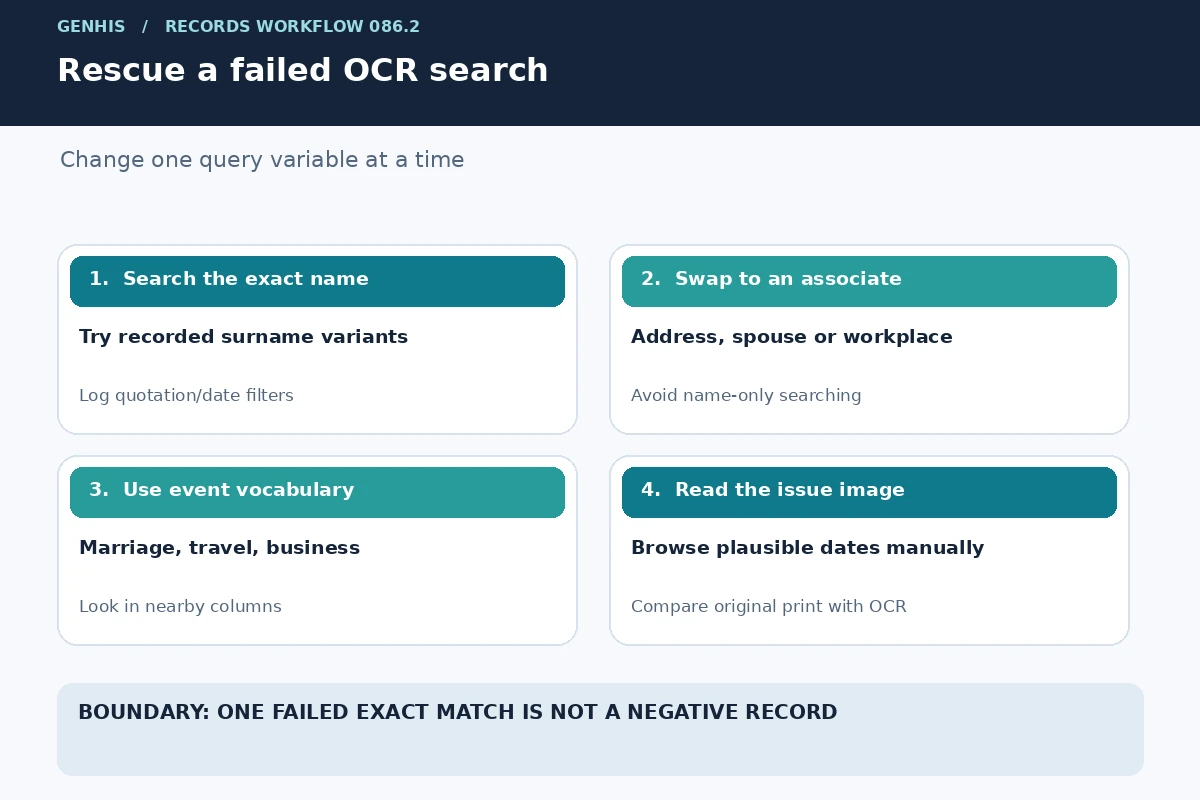
Recover records hidden by OCR errors
Digitized newspaper text is often created by optical character recognition. The Library of Congress explains in its research FAQ that OCR can misread damaged print, columns and names. If an expected name fails, stop repeating the same query. Change one variable: search for a neighboring word, a rare street, a date phrase, or another person’s name. Check the site’s image viewer and manually browse issues close to the target date. Always compare OCR output with the scanned page before copying a quotation.
In a hypothetical example, a 1912 announcement mentioning “Eleanor Vale” is transcribed by software as “E1eanor VaIe”. A direct quotation search would miss it; a search for the uncommon venue and the month might identify the correct issue. This invented example illustrates a technique, not a claim about any real family or available issue. On the worksheet, keep a field labelled search text failed and another for image manually reviewed. That distinction makes a negative result meaningful and reproducible.
Turn a newspaper hit into a usable citation
Open the page, not only a search snippet. Note newspaper title, publication city, issue date, page and column, item heading or distinguishing first words, repository, image locator and access date. Save or link to the page view showing neighboring content. Search hits can conflate multiple columns or OCR lines; a headline above the wrong column may create a false association. Where an item was copied from another paper, note both publications and seek the earlier text before describing the accounts as independent.
Capture the exact words that bear on the question, but do not convert a printed report immediately into a proven event. A marriage item may state that a ceremony was planned rather than completed. A visitor item may reflect a temporary stay rather than permanent residence. For each assertion assign a follow-up record: civil or church register for a marriage, deed or directory for an address, school or institution records for an award. This keeps newspaper research integrated with documentary genealogy rather than turning prose into unsupported pedigree facts. Our walkthrough on how to extract and verify family clues from an obituary sets out each step.
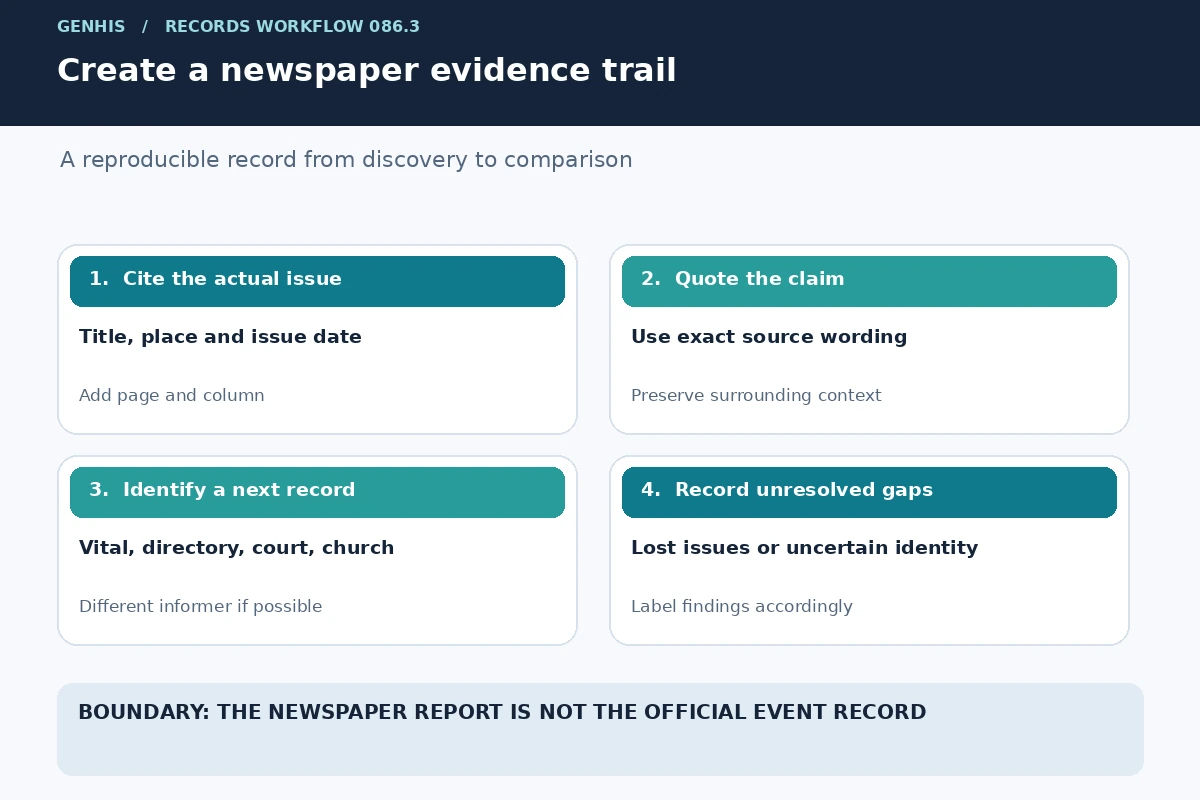
Log negative searches and the next repository
Your log should show database or physical holding, newspaper title, issues actually checked, search string, date range, result and reason for changing tactics. A null result means only that the inspected material did not yield the target using your methods. It does not establish that the event was unreported, the issue existed or the person did not live there. If you learn that the appropriate issue is lost, call that a coverage gap, not a failed identity hypothesis.
For a practical stop rule, review two independent title-finding resources and at least one likely issue run before deciding whether further newspaper work is efficient. If coverage is missing, shift to courthouse announcements, directories, local society files or event registers. If a usable item is found, state separately what the page says, what documents corroborate it and what remains unresolved. The outcome of this workflow is a traceable newspaper search audit, including evidence when the search did not work, not an unsupported claim of exhaustive coverage. Our guide to papers Past for New Zealand genealogy covers a related question.
More Records and Archives Guides
How We Research: Sources and Proof Boundaries
Our newspaper search workflow compares a title directory with issue calendars and examines the Library of Congress explanation of OCR errors. Unlike those pages, the unit of work here is a documented issue-coverage map and an OCR-failure recovery record. Hypothetical people and spellings are teaching devices only. A missing hit establishes nothing beyond the issue and strategy actually inspected.
Sources reviewed (20 October 2026): Library of Congress research guide. Library of Congress OCR FAQ. Historical holdings at the Library of Congress. Library of Congress search tips. Library catalogue and OCR references establish search techniques and coverage limitations; the reader must still check the specific newspaper issue and repository calendar.
Disclosure and limits: No newspaper database sponsorship or subscription access is asserted. Follow the GenHis affiliate disclosure. An archive calendar, fees and image access can change; confirm them with the custodian. Avoid identifying unrelated living people in published newspaper notes.
Frequently Asked Questions
OCR can misread print, columns and unusual type. Try nearby names or terms and manually browse surviving issues; a failed exact phrase is not proof of absence.
Check catalogue holdings and the archive issue calendar for the exact date. A newspaper publication span does not guarantee an uninterrupted online run.
No. Some collections expose page images without complete or reliable full-text indexing, and physical or microfilm holdings may not be digitized.
Record newspaper title and place, issue date, page/column, item title or description, image locator and holding repository.
No. Test the place, date, associates and claims against independent documents before assigning a same-name news item to an ancestor.