
An undated portrait rarely tells you a calendar year by itself. Build a date range from the physical photographic process, mount, studio imprint, clothing and background, then test that range against independently dated family events. Treat each clue as a constraint with a known weakness—not as a magic decade label. This guide produces a transparent earliest-to-latest interval and a shortlist of records to check. It deliberately does not identify living people or assign a photographed face to an ancestor on resemblance alone.
Make a complete record of what the photograph actually shows
Photograph or scan the entire front and back, including mount corners, handwriting, printed text and any envelope that came with the item. Record dimensions and distinguish a glass image, metal image, card-mounted print and later paper snapshot only when the material can safely be identified. The Library of Congress explains that photographic process and support matter for identifying and caring for images. Do not peel a photograph away from its backing merely to inspect a date stamp. Capture the object as it exists.
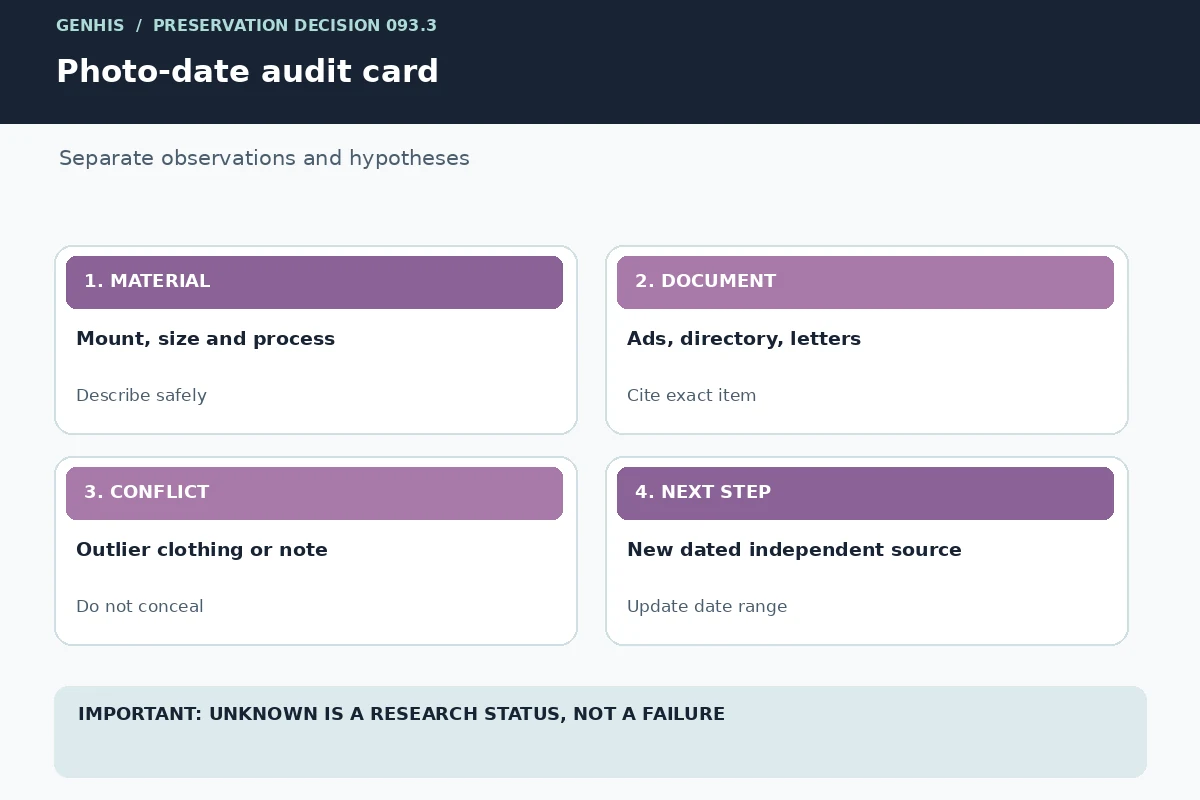
Create two note columns: observation and interpretation. ‘Embossed studio name on lower border’ is observable; ‘taken during the photographer’s first decade in business’ is only a hypothesis until checked. ‘Girl appears to wear a school uniform’ is an appearance, not a verified school affiliation. A handwritten date may have been added decades later by someone who did not witness the sitting. Preserve letter shapes and spelling rather than normalizing an inscription before researching the studio or locality.
Investigate the photographer and address rather than guessing
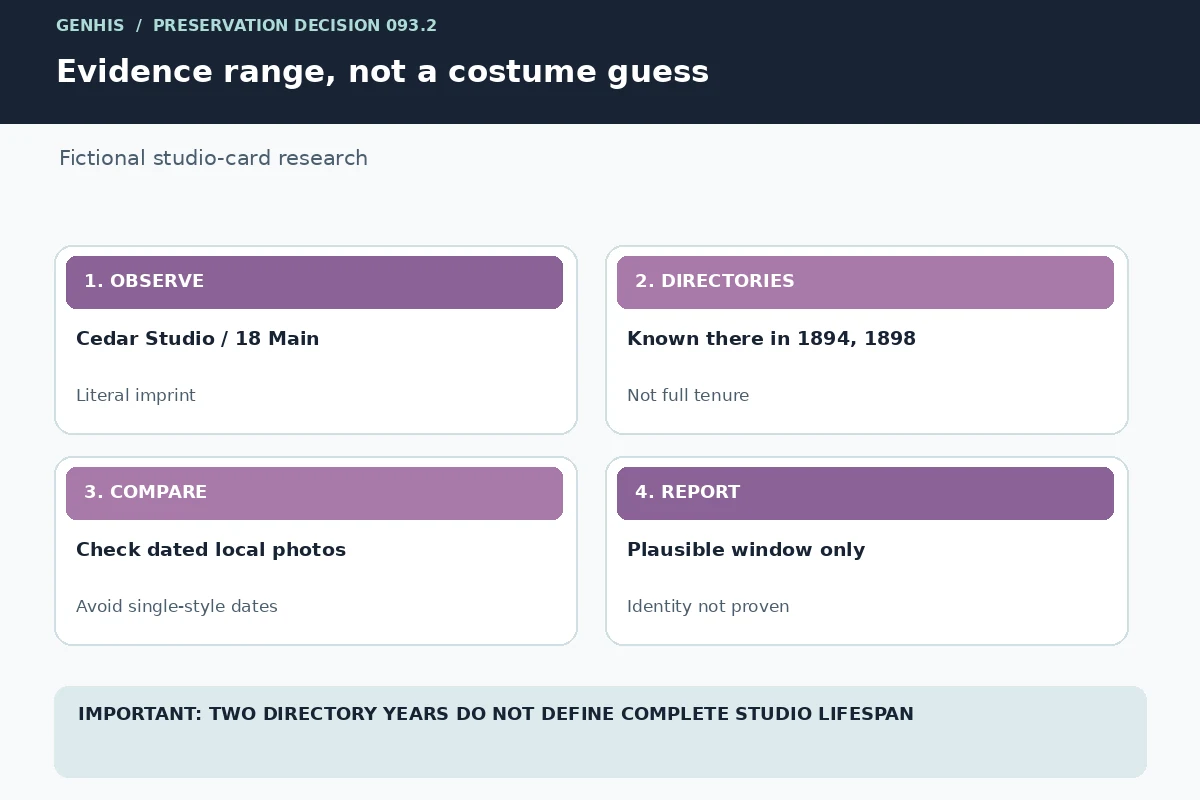
Transcribe a studio name and street address literally. Search contemporaneous city directories, advertising pages, local business listings, tax material and dated photographs bearing the same imprint. If a studio operated at a stated address only within a documented period, that can constrain when a particular mount was printed. But a studio name could survive after a proprietor changed, old card stock might be used later, and an address can reappear in retrospective advertising. Record the specific directory year and page as evidence for each proposed bound.
For a fictional card, the reverse reads ‘Cedar Studio, 18 East Main’, and directories show that business at the address in 1894 and 1898. Those two observations do not prove every photograph with that imprint was made between 1894 and 1898. The studio may have been at that address before or after those two snapshots; you need earliest and latest corroborated business references. Write ‘documented there in 1894 and 1898’ instead of silently changing it to a definitive photography date.
Use fashion and visual objects as supporting constraints
Clothing, hats, hairstyles, furniture and vehicles may suggest periods, but fashions varied by region, class, access and personal preference. A person may have worn older garments, posed in borrowed clothing, or chosen a studio prop long after it became fashionable. Compare several independent visual features with well-dated images from credible museum or archival collections, ideally from the same region. A single wide collar or sleeve shape should not be treated as an exact year, and digitally colorized images introduce additional interpretation.
Note both helpful clues and conflicts. If a vehicle model plausibly dates after a certain year but the mount looks older, investigate whether the studio re-used stock or the scene was photographed later than assumed. Ask whether an apparent military uniform or badge can be corroborated independently; avoid assigning unit, status or rank solely from vague insignia. Save the comparison image citation and the observation that it supports. An illustrative date estimate from a fashion chart is a broad possibility, never direct identification of the person.
Cross-check the image against dated family records
After establishing a cautious physical range, collect documents that might connect the setting or people: census households, school registers, city directories, dated letters, military service dates and authenticated family albums. Work from a named candidate, not from a face-recognition assumption. If the caption says ‘Grandma’s sisters’, it might refer to a relationship from the caption writer’s perspective, not the viewer’s. State explicitly whose memory or document supplies any candidate identification. Mark conflicting stories instead of selecting the most familiar one. Our guide “Family History Interview Questions That Invite Real Stories” adds more detail on this.
Suppose the hypothetical photograph is tentatively dated ‘around 1900’ but a proposed ancestor emigrated in 1915. The mismatch is a research question: Was the portrait mailed from another country, copied later, or mislabeled? A photo of a person does not establish the place of exposure simply because it belonged to a local family. Search for the studio’s place and consider circulation of prints between relatives. Correlation with records may tighten the date window, but cannot convert an anonymous figure into a named relative without evidence.
Express the date as a range with a confidence statement
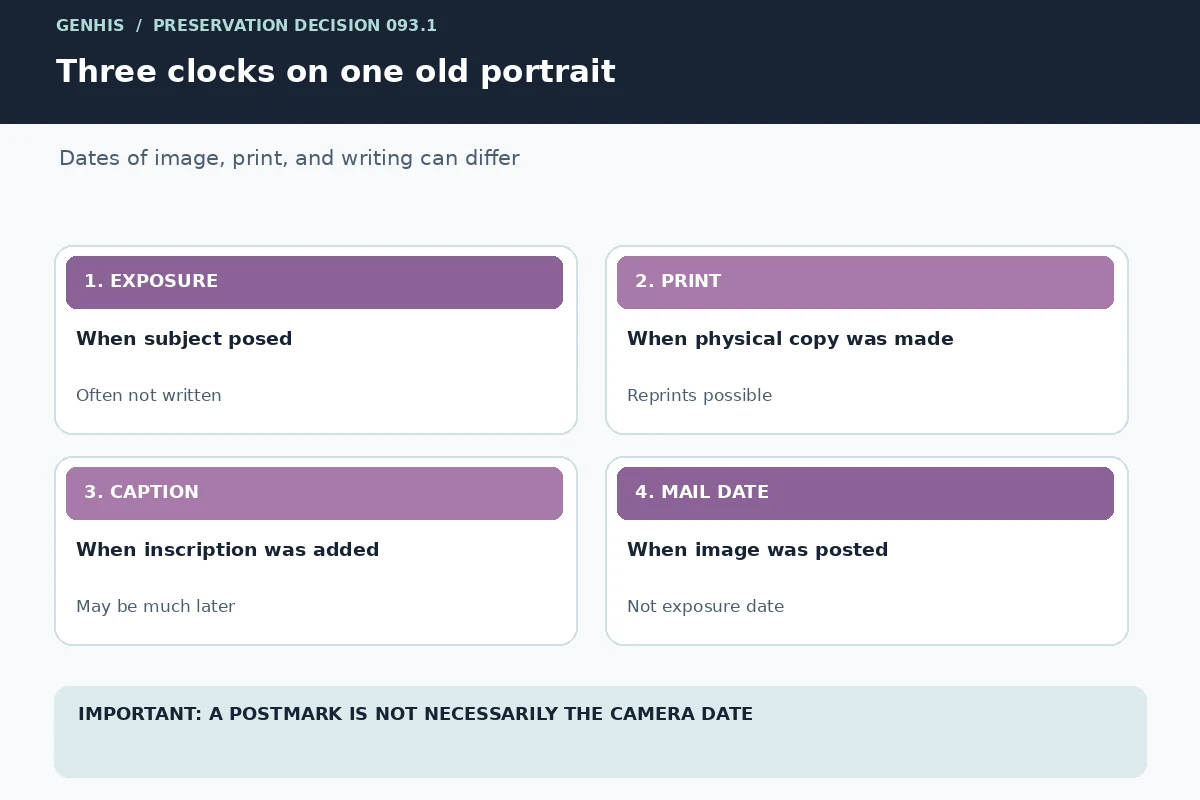
Use a four-line date worksheet: earliest support, latest support, independent corroboration and contradictions. Avoid pretending precise earliest/latest dates can always be calculated from clothing or photographic process. Prefer language such as ‘likely late nineteenth century based on mount and two documented studio listings; exact date and subjects unverified.’ A photo that appears to be an original print may itself be a later reproduction of an earlier negative. The date of the image subject, the physical print and the written caption may all differ.
For a fully invented example, the mount resembles period card stock, a local directory documents the studio in 1898, and a child thought to appear is documented in a household of the right place in 1900. A defensible summary might be ‘plausibly around the turn of the twentieth century; identity tentative.’ Do not force a narrower year just to make it fit a family tree. If evidence spans several decades, state that wider interval and record which further source would matter most.
Preserve contradictions and plan the next useful search
Record which original object you examined, who held it, when it was copied, the source of any comparative chart and the complete citations for directory entries. Make a separate candidate-identification log with a status field: documented, plausible, contradicted, unknown. An ‘unknown’ caption is a legitimate result. Share inquiries without exposing private information about living relatives and ask others to provide dated corroboration rather than an unsupported agreement that two faces look alike. Photograph the reverse again if a new inscription is found.
One next search should target the weakest constraint. If studio years are uncertain, consult the local directory archive; if a clothing assessment is weak, find dated comparators; if a person is tentatively identified, obtain a contemporaneous record linking the person and place. Do not rewrite the original caption on the print. A useful genealogy photo date is a reproducible chain of dated clues with remaining doubt visible, rather than a confidence-free year added to an online tree.
More Family Story and Preservation Guides
How We Research: Custodians, Evidence, and Limits
We used Library of Congress guidance on photo types, supports and handling together with NARA advice on preserving original identification marks. Search results for dating photos were compared with the GenHis queue so this page addresses evidence-backed time windows rather than photo scanning or physical repair. The studio address, May, Clara and date examples are fictional, not historical directory findings.
Sources reviewed (20 October 2026): Library of Congress photo care. NARA photograph care. NARA family digitization. Library of Congress photo FAQ. These custodians explain physical information preservation. No cited conservation page independently establishes the operating dates of the fictional studio in our example.
Disclosure and care limits: Dating is an interpretation, not a lab test or identity service. A photographed face should never be used by itself to identify a real person. The dating worksheet cannot identify a person by appearance; it provides no paid identification service. Review GenHis disclosure information and independently document each suggested date.
Frequently Asked Questions
Usually not. Fashions were adopted at different rates, and props or old garments may have been used later.
It offers a research lead; confirm business addresses and operation years using dated directories or advertisements.
It may hold a postmark or handwritten clue, but the date of mailing, printing and original photograph can differ.
No. Resemblance alone is weak identification evidence; compare independently documented place, time and provenance.
Report a broad documented interval, explain the contradictory clues and name the record that would narrow it.