
The most valuable family-history interview questions invite a person to describe experiences in their own words and leave room for uncertainty, silence and surprise. Rather than racing through fifty names and dates, use a small set of open prompts, listen for sensory details and capture who is remembering what. This guide gives a consent-first interview map, ready-to-use question sets and a follow-up worksheet. Its goal is a responsibly preserved oral history, not a transcript that magically verifies every family legend.
Ask permission and explain the recording plan
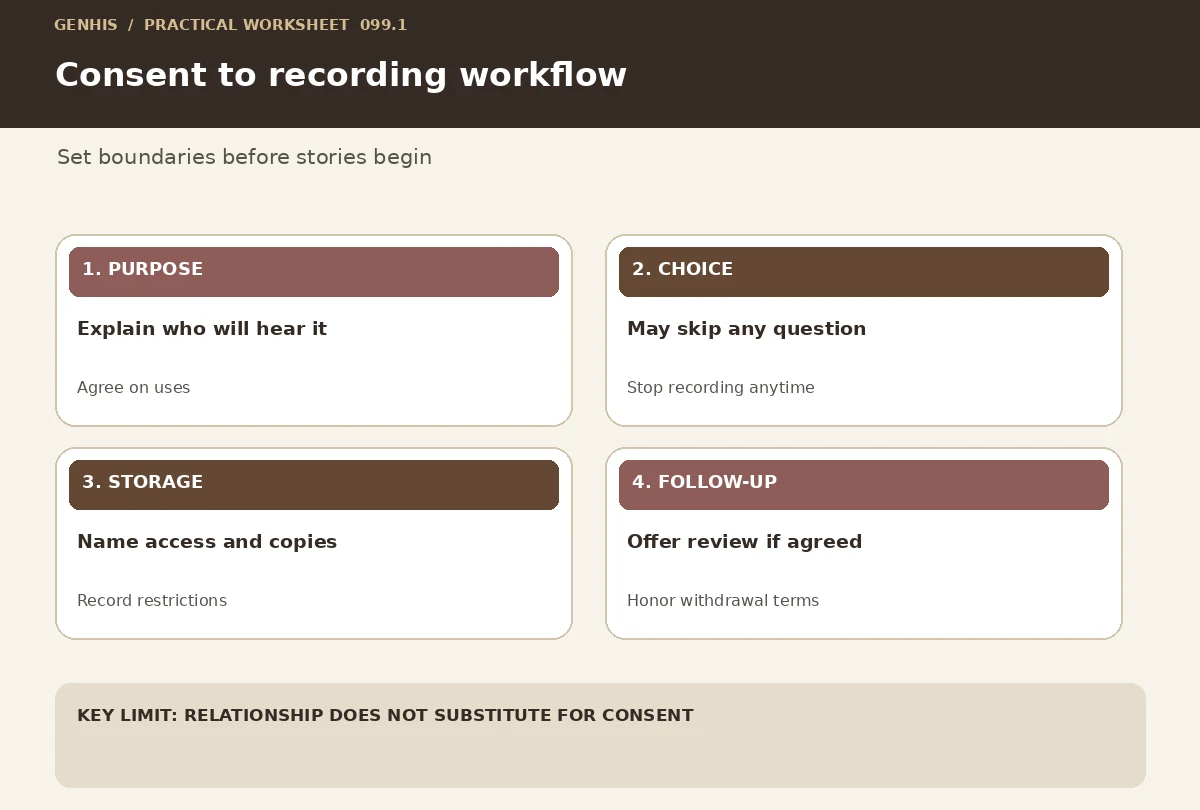
Contact the person before interviewing and explain why you want to hear their story, who may hear the recording, whether it will be transcribed and where it might be stored. Ask separately about recording and later sharing. Make room for a private conversation without a recording if that is what they prefer, and let them pass on any question. The Smithsonian Institution Archives oral-history guide advises preparing the topic, establishing rapport and telling participants their rights, including the ability to stop recording. Consent should not be assumed merely because the interviewee is a relative.
Agree on a comfortable duration, a quiet location, water and any accessibility needs. Test your audio equipment using your own voice, then clearly identify the interview date, interviewer and the participant’s preferred name if they consent. Ask whether the participant wants to restrict publication of particular topics, especially stories about other living people. Write down the agreed permissions and where you will store them, separate from the audio. Even a wonderful recording may not be ethically shareable with a wider family group without the interviewee’s agreement.
Begin with a scene instead of a pedigree quiz
Start with approachable questions such as: ‘What is the first home you remember?’, ‘What happened on a usual morning when you were ten?’, ‘Which sounds or smells remind you of your neighborhood?’ and ‘Who did you spend time with after school?’ These open prompts tend to invite stories rather than one-word answers. The Smithsonian Folklife interviewing guide recommends open questions and flexible follow-ups instead of a rigid questionnaire. It is fine to follow the speaker’s memory into a topic you did not predict.
When an answer is short, ask ‘What happened next?’, ‘How did you know that?’ or ‘Can you describe the room?’ Avoid supplying possible answers that invite agreement, such as ‘That must have been frightening, right?’ A gentler question asks how the person felt at the time, and permits them to say they do not recall. If an experience is traumatic, an interviewer should not push for disclosure or turn the recording into interrogation. Memories may be emotionally meaningful even when calendar dates cannot be established from them.
Explore relationships through daily routines and places
Ask about the rhythms of family life: ‘Who cooked for large gatherings?’, ‘What work did people do?’, ‘Where did neighbors meet?’, ‘How were birthdays or holidays celebrated?’ and ‘Who taught you a skill?’ Follow up with prompts about places, languages, school, journeys and community institutions. These subjects often produce details that can later suggest sources such as city directories, school records, maps, photographs and parish registers. A remembered street name is a lead to investigate, not automatic proof that someone lived at a particular address in a particular year. For a step-by-step method, see how to trace family history through stories, places, and records.
For migration or changing households, try: ‘What did you bring when you moved?’, ‘Who helped you find a place to stay?’, ‘What did you miss?’, and ‘What changed after the move?’ If the person describes a step-parent, adoptive relationship or nontraditional household, use the terms they choose rather than forcing every person into a genetic pedigree. Different family members may remember the same move differently. Preserve their versions with clear attribution rather than editing them into a seamless story. Questions can reveal culture and relationships without assuming ancestry from a surname or appearance.

Use photographs without planting answers
Show one photograph at a time only when doing so is comfortable for the interviewee. Ask first, ‘What do you notice?’ and ‘Have you seen this before?’ rather than ‘Is this Aunt Mary in 1938?’ Point to an observable object, inscription or building separately from a proposed identity. Keep the actual image’s stable identifier and record which details came from the interviewee’s recollection. If they are unsure, quote that uncertainty. Never add a confidently named person in the photo’s metadata on the basis of an interviewer-suggested name alone.
A practical follow-up chart has four columns: exact words spoken, subject or document mentioned, how the speaker knows, and record to check. A statement like ‘I think my grandfather kept a shop on Market Street’ becomes a searchable hypothesis. A city directory may support the shop’s existence, while a tax record could offer more context; neither validates every part of the remembered story. The interview is testimony about lived experience, and its evidentiary weight depends on firsthand knowledge, elapsed time and external corroboration.
Preserve the interview as a source with context
Immediately after the session, save the original recording without destructive editing, note its date and file format, and create a second copy in another location. Make a transcript or indexed summary that allows someone to find specific sections. Mark words that are difficult to hear rather than silently improving them. Where you annotate a surname spelling or historical date, distinguish a later editorial clarification from what was actually said. The Library of Congress family-interview guide encourages asking consent and preserving the story through transcription or shared recordings.
Use a simple filename such as INT_007_2026-10-20_master.wav and store a metadata page recording permissions, participant, interviewer, topics, duration and file locations. The filename is an illustrative pattern, not a requirement for a particular audio format. Give the participant a chance to comment on proposed excerpts when appropriate. Keep private material out of public uploads. If family members disagree about a person or event, label competing memories by speaker; do not erase one version to make a clean family-tree narrative. Our guide “GEDCOM Files Explained” goes into more detail.

Turn stories into research questions respectfully
After the conversation, pick two or three claims you can research without intruding on living people. Convert each into a question with date, place and possible source types. For example: ‘Can a directory or employment record place the family-owned shop in this neighborhood during the period recalled?’ Log both positive and negative searches. Avoid treating oral memory as an inferior artifact: it can uniquely preserve humor, vocabulary and family practices even when its chronology needs independent checking.
Return a recording or a listening copy in the format the person prefers, subject to their consent and technical access. Thank them without demanding new disclosures, and ask whether they wish to add or correct details later. If the recording may become part of a family-history book, discuss quotation and image permissions before the manuscript is circulated. The interview is successful when the participant feels respected, the original words are preserved, and your research notes make clear which statements are firsthand, remembered secondhand or still unknown. Our walkthrough on how to create a family history book with sources and permissions sets out each step.
More Family Story and Preservation Guides
How We Research: Source Checks and Uncertainty
We reviewed Smithsonian Archives and Folklife interviewing practice and Library of Congress family-history interview guidance. Prompts are illustrative, and no real testimony or identity was invented. The editorial focus is interviewer behavior and evidence handling, not confirming an oral tradition as fact.
Interview techniques reviewed: The Smithsonian Institution Archives guide covers rapport, rights and open questions. The Smithsonian Folklife guide supports flexible follow-ups, while the Library of Congress family oral-history page motivates recording and transcription with permission. Interview prompts here are written for this guide, not copied testimony.
Consent and privacy notice: The suggested prompts are not permission to record, quote or circulate a participant memories. Confirm interviewee preferences and applicable law, and consult GenHis editorial relationship information for publication transparency. No interview recording service is endorsed.
Try an open memory prompt such as “What was a typical day like in your childhood home?” instead of a date quiz.
No. Explain the recording, sharing plans, and the participant’s freedom to stop or skip questions first.
Transcribe the specific recollection, name who said it, note whether it was firsthand, and search suitable independent records.
Allow silence and skipped questions. Do not pressure someone to disclose trauma or details about other living people.
Discuss permission and use restrictions with the participant first; owning the file is not a substitute for consent.