
A family-history book should be a readable account with traceable evidence, a clear scope and careful treatment of private lives. It is not simply a pedigree chart printed with longer captions. You can produce a useful short volume with one family branch, a few well-documented scenes, maps, photographs and honest explanations of what remains uncertain. This guide turns raw notes into an editable manuscript, an evidence ledger and a preservation package. It avoids invented stories, assumed family links and publishing details of living relatives without permission.
Define the reader and the boundaries of the story
Decide who the book is for: siblings, younger relatives, a local-history group or a wider research audience. A private ten-copy booklet can use a different voice and level of personal detail from a publicly searchable digital publication. Choose one question the book will answer, such as how a documented household moved between two towns, rather than promising an exhaustive history of every surname. State the beginning and end dates of the narrative and why they were selected. Narrow scope makes fact-checking and editing feasible.
Sketch an outline that alternates evidence with lived context. A short volume might begin with a source-based family overview, follow with chapters about places and livelihoods, and conclude with an appendix of uncertain relationships and records not yet located. Put a one-page family chart near the front, but warn readers that charts summarize conclusions rather than independently prove them. The National Archives beginner research guide highlights historical sources that can anchor such chapters; their existence does not imply a particular family appears in any one collection.

Build an evidence ledger before writing scenes
For each important statement, create a claim ledger: claim, supporting source, citation details, confidence and any conflicting evidence. A death certificate might state one age while a census suggests another; record both, check who supplied each answer and explain why a final date is still approximate. Cite the actual register, schedule or archival document where possible, not simply a tree profile that repeats it. The Library of Congress guidance on citing primary sources explains that citations identify the creator and context and help the next reader relocate the item.
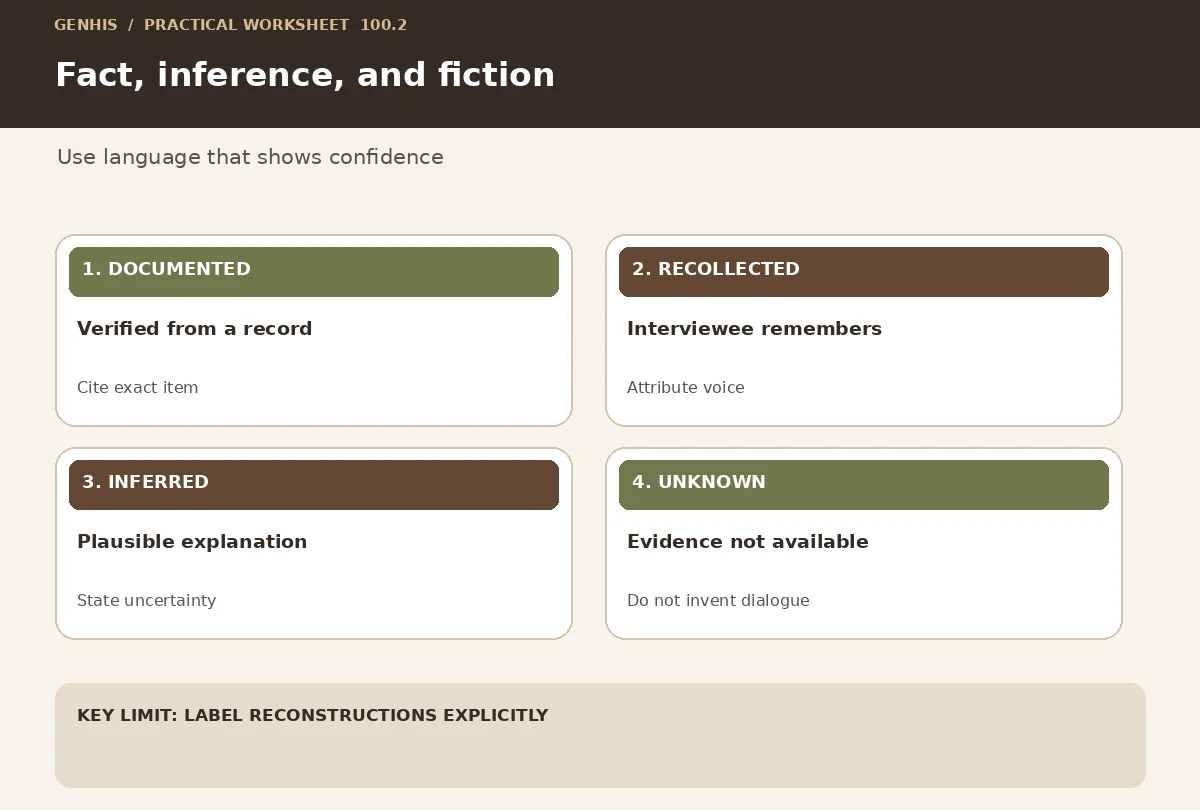
Use distinct language for evidence and reconstruction. ‘The 1910 census places the household in this county’ is a record-based statement after you have checked the relevant schedule. ‘They probably traveled by this road’ is a conjecture until supported by travel, land or community material. Never convert a plausible setting into dialogue that reads as recorded speech; if you choose a creative reconstruction, label it transparently. Include a short note about record gaps, changing county boundaries, surname variants and uncertain parentage. Readers will trust a book that tells them where its evidence ends.
Select photographs and obtain appropriate permissions
Choose illustrations because they answer questions: a labeled family photograph can show relationships only to the extent those identities have been documented; an old map can explain travel or a jurisdiction change when its date and scale are appropriate. Give every item an ID tied to the source file, repository, creator and permission status. Preserve captions as initially written, and mark later identifications or corrected place names separately. Avoid cropping away inscriptions, margins or back-of-photo information in your archival master; use a clearly labeled derivative for page layout. For a step-by-step method, see how to open a GEDCOM file safely and check the imported tree.
Physical possession of an image does not automatically settle copyright or consent for public distribution. Ask contributors what uses they permit, retain the answers and review rights where necessary. Historical archives also may specify reproduction conditions or require attribution. Protect living people’s addresses, children’s details and confidential correspondence. For every planned illustration, your permissions table can say approved for family print, approved for web, unknown or withheld. Do not place an item marked unknown into a publicly downloadable PDF simply because the book seems like a family project. For a step-by-step method, see how to digitize family photos into a searchable, backed-up archive.
Write chapters around questions rather than name lists
Begin each chapter with a question that matters to your reader, such as where the household lived after the mill closed or which records document a remarriage. Then walk through a small sequence of events with sourced quotations and a map, photograph or timeline where it adds actual explanatory value. If you have a family interview, attribute spoken memories to the participant and label any later historical checks. Do not build connective tissue from invented emotions or conversations. Explain unfamiliar record terminology briefly so younger readers can follow without consulting genealogy software. For a step-by-step method, see how to choose genealogy software with an evidence-first trial.
Try a sample chapter on two fictional households sharing a surname. One census alone cannot establish they were related; an additional probate record or independent document may clarify or leave the question unresolved. The chapter can show what the records say, outline possible interpretations and state what would settle the issue. A transparent unresolved question makes a stronger conclusion than forcing a tidy ancestor line. Keep chapter lengths manageable and avoid pasting a full transcript or dozens of census tables into the main narrative when a selective extract and an appendix will do.
Design a book that survives new evidence
Draft in an editable document format and separate the narrative manuscript from image masters and source logs. Use consistent heading hierarchy, readable type, descriptive captions, page numbers and an index or list of names when useful. Footnotes or endnotes should connect claims to their sources, and image credits should follow each image or an easily found credits section. Choose a trim size and page margins only after a proof print, and inspect legibility of reproduced handwritten records at the actual final size rather than on a zoomed computer screen.
Print a draft for at least one person who knows the family and one careful reader unfamiliar with it. Ask them to identify unsupported jumps, confusing names, missing explanation and wording that invades privacy. Maintain a corrections log with page, issue, source and disposition. Give your book a version number and an errata page, because genealogical conclusions can change when new records emerge. Avoid a vendor lock-in: maintain an accessible PDF, editable manuscript, image-source folder, and citation index instead of relying only on a single book-design platform.

Preserve the book and its supporting research
A finished volume is a snapshot of research, not the complete archive. Keep the final print-ready file, text-only or accessible copy, manuscript, image licenses, document transcripts, citation index and original scans as separate documented assets. The Library of Congress personal digital archiving resource discusses organizing digital materials and retaining copies over time. Make redundant backups in independent locations and periodically check that representative files restore correctly. A print-on-demand copy is not a backup of editable sources or the evidentiary reasoning behind a family statement.
Share copies according to their permitted audience. If relatives provide corrections, record who supplied them and seek documentary corroboration before revising disputed relationships. Update the digital master with a revision date, preserve the previous edition and note substantive changes. A useful family-history book invites future questions by showing its sources, distinguishing confirmed facts from possibilities, crediting contributors and leaving space for histories that did not survive in written archives. This is a sustainable end to a first edition and a disciplined beginning for further research. Our guide “Family History Interview Questions That Invite Real Stories” adds more detail on this.
More Family Story and Preservation Guides
How We Research: Source Checks and Uncertainty
We checked Library of Congress primary-source citation principles and personal digital archiving advice against National Archives source-led genealogy guidance. Suggested chapter structures and fictional example households are editorial tools, not claims drawn from an actual family.
Book-production source foundation: Our reference for exact document attribution is the Library of Congress primary-source citation guide. Digital retention follows its personal archiving resources. For the research workflow we considered the National Archives starting guide, and for the handling of interview excerpts, Smithsonian interviewing practice.
Rights and publication boundaries: A family booklet may still reproduce protected photographs or sensitive testimony, so document permissions separately from historical source citations. This independent guide has no printing sponsor; consult our site disclosure. Seek qualified advice for unresolved copyright or release questions.
As long as the sourced story warrants. A focused branch history is preferable to padded pages and unsourced assertions.
Yes. Brief notes or an appendix help future readers verify dates, documents, and relationships.
Not automatically. Review copyright, contributor permission, sensitive details, and the intended print or online uses.
State what records actually say, describe competing possibilities, and label unresolved connections rather than inventing a link.
No. Keep an editable manuscript, source scans, permissions, citations, and independently restorable digital backups.