
An old letter is both a written account and a physical artifact. Its paper, folds, ink, envelope, postmark, address and original order may carry family-history evidence that a typed transcription cannot preserve. The safest approach is to inspect gently, store without adhesives, capture the envelope and every page, and keep literal text separate from interpretations. This guide supplies a letter-level preservation and transcription card, not a recipe for washing, bleaching, ironing or mending fragile paper at home.
Record the letter's physical context before unfolding
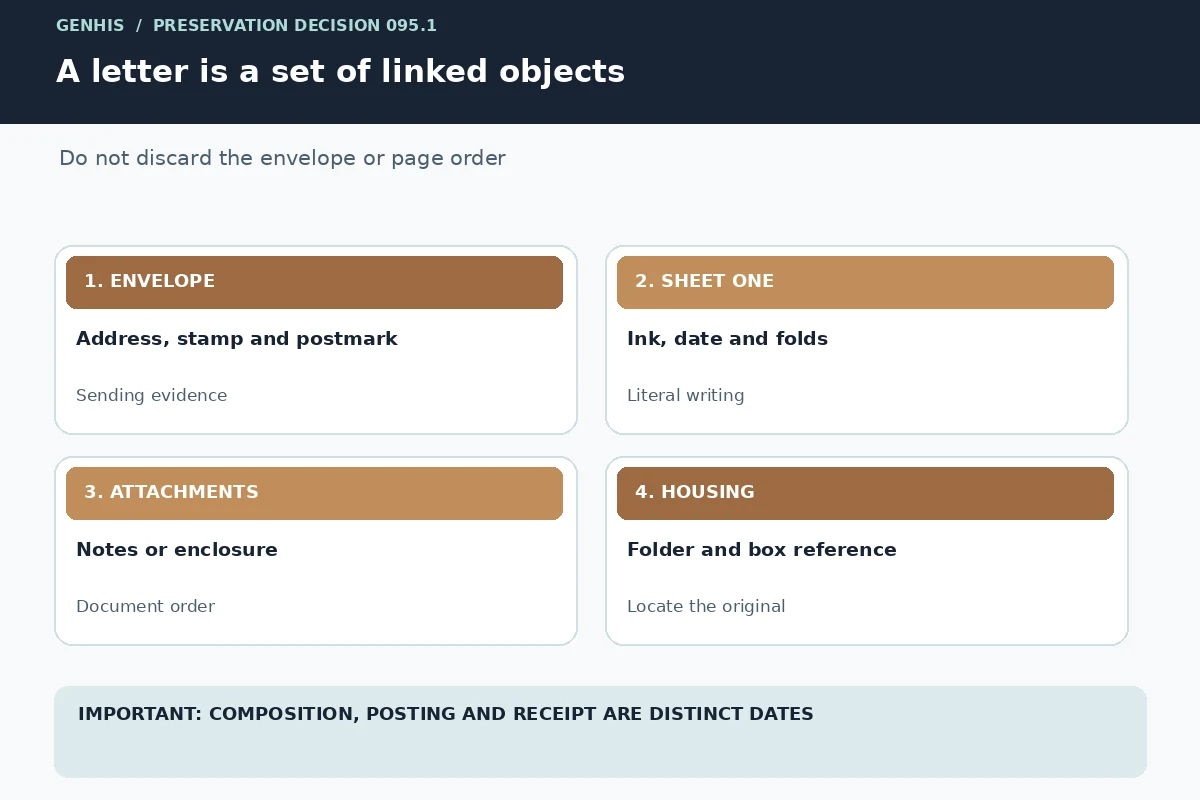
Start with a clean, dry, uncluttered table and washed hands free of lotions; the National Archives family handling guidance notes that paper may be handled with clean hands because gloves can reduce dexterity. Identify envelope, number of sheets, folds, visible damage, attachments and handwriting before changing their arrangement. Photograph the bundle and envelope surfaces, including stamps or addresses. If pieces are loose, preserve their original sequence and note how they were found. Do not remove pinned items without considering whether their placement records meaningful association.
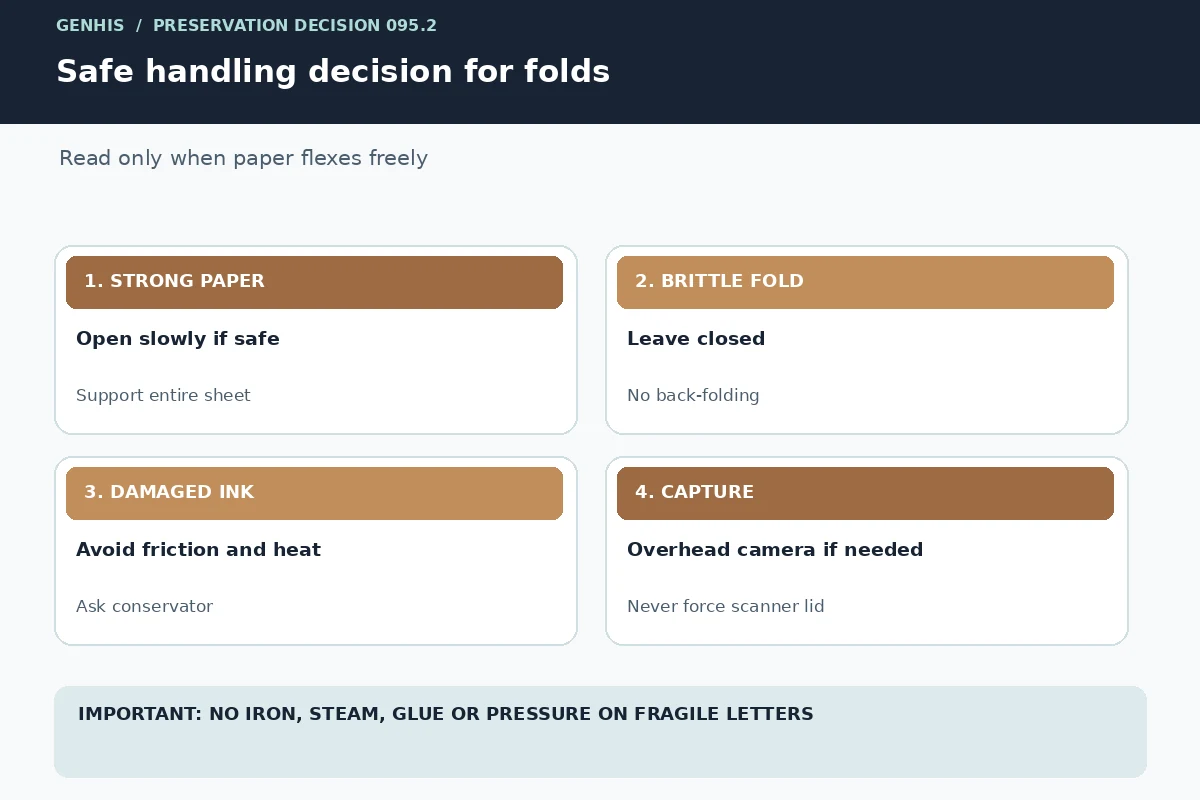
Open a fold only if the paper flexes safely. The NARA guidance on folded records advises against back-folding and recommends leaving stiff or brittle material folded until controlled treatment is possible. Do not steam, iron, humidify, apply pressure or try to dissolve old adhesive yourself. A letter with powdered ink, active mold, torn corners or fused pages may be unsuitable for even ordinary reading. Make a condition note and seek conservator advice rather than sacrificing the artifact to learn one phrase sooner.
Choose protective paper housing and keep associations clear
Store supported letters in archival-quality folders and boxes sized so pages are not bent around corners. Avoid adhesive tape, rubber bands, paper clips, sticky notes and acidic newspaper as separators. The National Archives family-archives article emphasizes protecting papers with good folders and boxes and not forcing documents flat. Keep envelope and letter together as an identified group, but separate them with appropriate conservation-grade support if staining or physical rubbing poses a risk. Label the folder rather than writing on the original sheet.
For letters on extremely brittle paper, retaining a folded state in a supportive housing may be safer than opening or flattening. An oversized letter should have a housing that fits it, not a smaller box requiring new folds. Storage conditions should be cool, relatively dry and stable, away from sunlight, water and fluctuating heat. Papers can differ in acidity and ink stability, so a one-size ‘plastic sleeve’ rule is unsafe. For unusual inks or severe deterioration, request material-specific advice from a professional rather than assuming an online recommendation applies.
Copy both the document and its envelope accurately
When safe, photograph or scan each side in sequence, including blank pages when they clarify pagination or attachment. The National Archives digitization advice warns that a scanner lid can damage oversized originals and that automatic feeders are unsuitable for fragile papers. If the letter cannot lie flat comfortably, use an overhead camera and supports rather than pressure. Photograph folds and any decorative seals without disturbing them. Give images stable identifiers such as L006_env_front, L006_p01_recto and L006_p01_verso.
Record equipment, capture date and any missing surfaces. Keep the untouched photographs as master representations and crop copies only for reading. A higher-contrast digital derivative might make fading ink legible; label it as enhanced and preserve the unaltered capture because processing can create false edges or erase pale strokes. Preserve original envelope marks even when their dates disagree with a handwritten letter date: posting, composition and eventual receipt could be different events. Do not treat any single mark as a complete correspondence chronology. If you want the full process, read how to scan old family photos safely.
Transcribe the text without silently correcting the writer
Make a diplomatic transcription that preserves the writer’s spellings, apparent line breaks, punctuation and uncertain passages. Show gaps using a consistent notation such as ‘[illegible]’ and label editorial insertions. Avoid ‘fixing’ names, geographic locations or dates in the transcript itself; add suggested readings separately with reasons. If two family members interpret a surname differently, keep both readings and cite the exact digital page where the letters appear. A typed modern paragraph is easier to read but is not a replacement for the original writing.
A fictional example might begin ‘Dear Nell, I came to Br[?]ton on Thursday.’ One could propose ‘Brixton’ only after checking the geographic context and other letters. Keep the uncertain letter sequence in the diplomatic transcription and put the candidate place in a research note. If the envelope is postmarked two days later, that constrains sending but does not prove the writer composed the letter on the postmark date. Details about occupations, births, illness or family relations are testimony by the writer, not independently verified civil records.
Interpret provenance and relationships with documentary checks
List who wrote the letter, to whom, where it was sent, when, and how you know each claim. A salutation such as ‘your cousin’ may use a broad social or family term; it does not by itself specify a precise genealogical degree. Compare an address with contemporary city directories or household records before identifying the sender. A letter that passed through several family members may have later annotations in a different hand. Distinguish original text, envelope evidence, later annotation and modern family recollection in the research log.
Preserve privacy when private letters mention people who may still be living. A family may own a physical paper without holding unrestricted rights to publish every personal detail or reproduce it online. Share an access transcription selectively and keep sensitive material in restricted storage when appropriate. Cite a letter with writer, recipient if known, approximate date, page or image number, description of physical collection and current custodian. If any element is unknown, say so explicitly. A letter may suggest a relationship worth researching without proving the full relationship claimed. If you want the full process, read how to preserve old family photos with safe storage and handling.

Create a preservation and evidence handoff for each letter
At completion, the packet for L006 should have an item identifier, envelope and page images, condition note, housing location, literal transcription, interpretation notes and source citation. Mark the difference between observed details and untested hypotheses. Log what was not possible: perhaps the inside sheet was too brittle to unfold or the postmark was unreadable. The remaining work can then be assigned to a conservator or another researcher without rehandling the original merely to rediscover uncertainty.
Store the originals flat or in safely supported folds as indicated by condition, protected from light and handling; show digital copies for routine family discussions. If the paper develops new damage, document the change and ask an expert before treatment. Good preservation of a family letter makes it possible to read the same evidence again, including its mistakes, omissions and physical context. It does not guarantee the factual accuracy of everything its author wrote, and it never requires altering the original to make a more attractive transcript. For a step-by-step method, see how to digitize family photos into a searchable, backed-up archive.
More Family Story and Preservation Guides
How We Research: Custodians, Evidence, and Limits
We checked NARA family-paper handling, folded-record maintenance and digitization guidance, then compared the topic with existing GenHis photo-care and research methods. This page focuses on an individual letter as physical artifact and recorded testimony, not photograph storage. L006 and the example address are invented solely to explain citation and uncertainty.
Sources reviewed (20 October 2026): NARA family-handling tips. NARA paper handling. NARA letter-care guidance. NARA family digitization. These paper-care references support the no-force handling rule and contextual digitization; they neither authenticate a personal letter nor verify its writer’s claims.
Disclosure and care limits: This is not an authorized conservation treatment or a grant of publication rights. Protect private correspondence and details concerning living people. Historical personal letters may contain private information even when physically owned by a family. The publisher disclosure explains relationships, not consent or copyright to publish correspondence.
No. Improvised heat and moisture can damage ink and paper; keep fragile folds supported and consult a conservator.
No. Ordinary tape and glue create long-term physical and chemical problems; support the paper in suitable housing.
Preserve their documented association and capture both. If housing needs separation, maintain matching IDs and contextual notes.
No. The original includes physical and handwriting evidence, while the transcript contains interpretive decisions and possible reading errors.
Not by itself. Context and independent records must clarify whether the writer meant a specific genealogical or broader social connection.