
In RG 208, section 208.3.5, the National Archives describes about 1,200 cartoons and drawings in the Office of War Information’s COM group, including original drawings, mockups and works by artist Charles Alston. This is a strong archival starting point for studying wartime illustration, especially representations of Black Americans and public messages during World War II. But an original artwork is not automatically proof that the final image appeared in a particular newspaper or that everyone pictured is a documented historical subject.
The task is to distinguish three things that internet reproductions often blend: the original art, the agency’s intended message and the documented publication or display. A signature or attribution on a catalog record can support an artist identification, while an issue of a newspaper is what proves appearance in that issue. A date assigned to one COM item cannot safely be applied to every drawing in a broad group with varying item dates. Start with one identifiable work and work outward from its precise archival citation.
Find COM Artwork, Not a Different OWI Image Group
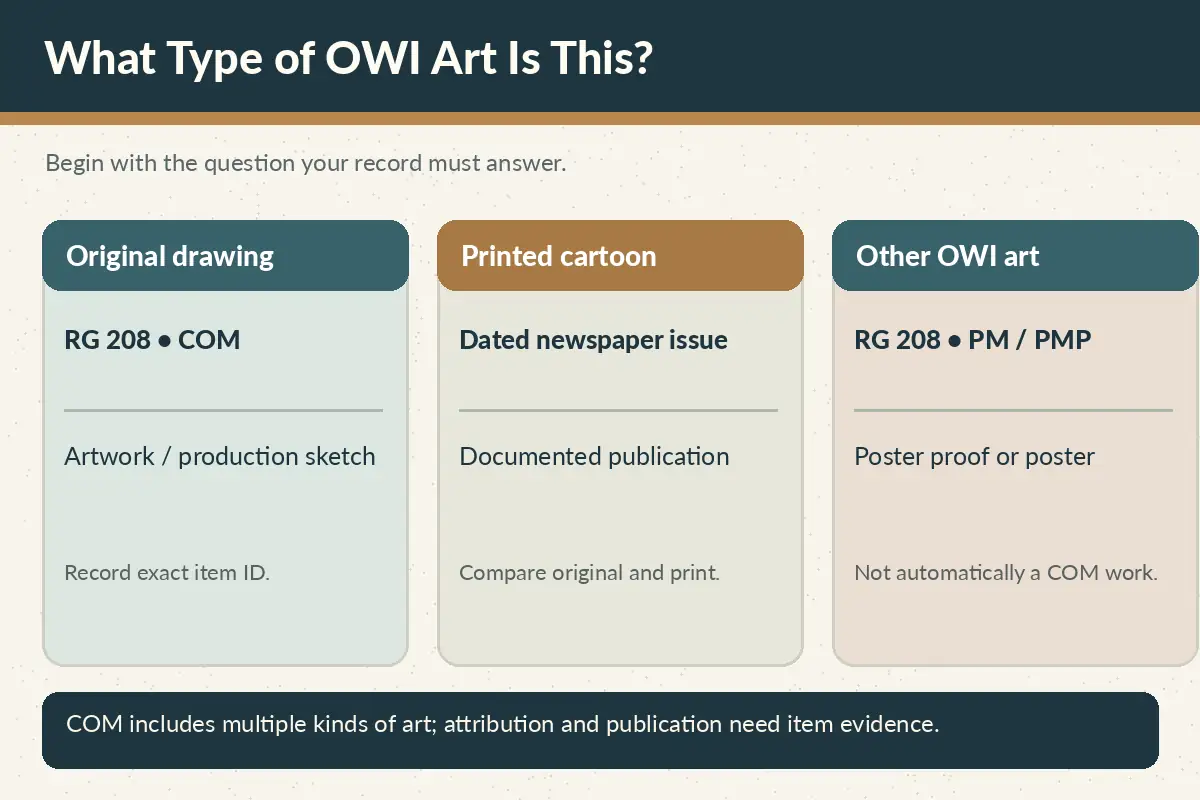
RG 208 contains many varieties of media: photographs, printed posters, radio recordings and graphics bureau records as well as COM drawings. Select the 208-COM identifier and the stated artwork title before assuming two web reproductions are identical. An item could be an original sketch, a production mockup or another type of preparatory artwork. Read the title, credited artist, date, physical medium and recorded series hierarchy on the individual description. The guide’s rough total is collection context, not a numbered index to 1,200 separately authenticated Alston works.
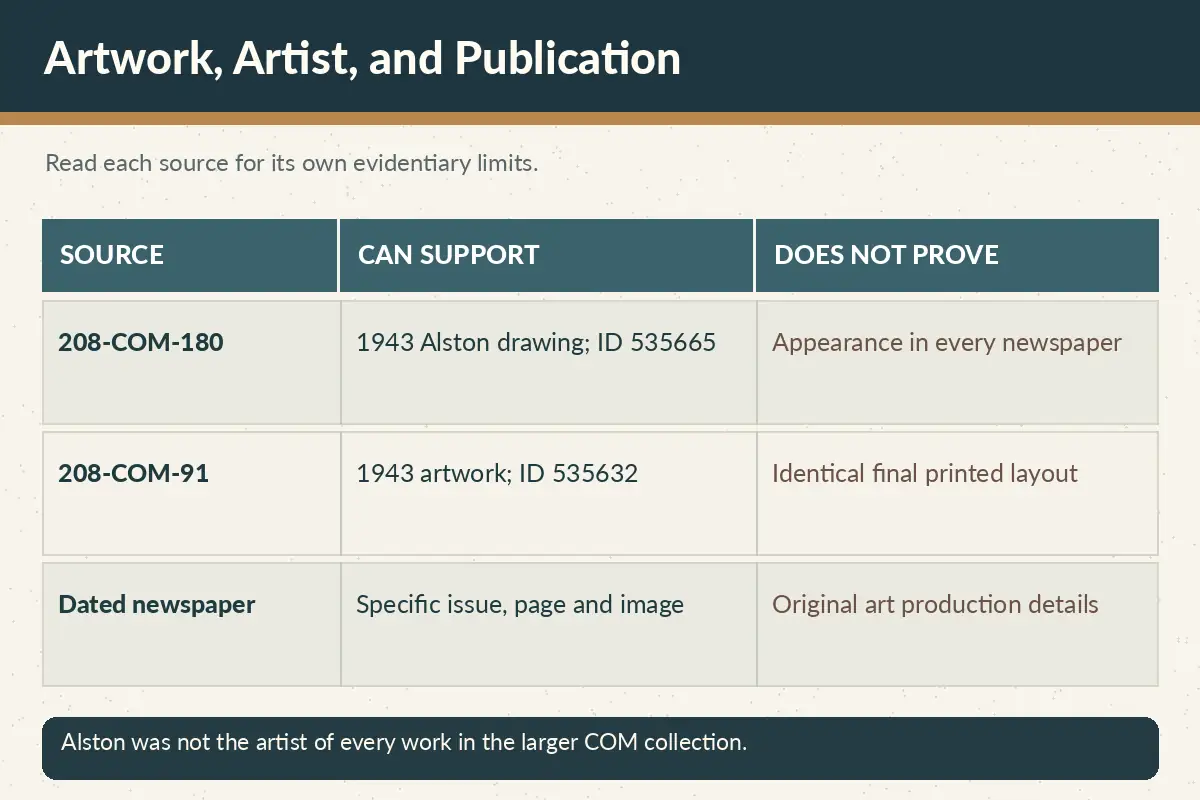
The NARA-associated educational resource DocsTeach gives examples with item-level citations. “And We’ll Continue To Fight For Liberty!” is identified as 208-COM-180, dated 1943, with National Archives Identifier 535665. A second example, “You Can Make This Kind of Ammunition,” is 208-COM-91, also dated 1943, identifier 535632. These concrete identifiers are useful starting points, but neither substitutes for checking the reproduction or making an independent claim about where the image was printed.
Distinguish Original Artwork From Its Public Message
Look at the intended audience and the drawing’s own text without confusing an appeal with a factual report. Wartime graphics could exhort readers to support the war effort, recognize historic figures or participate in civic life. A statement presented inside a cartoon reflects its rhetorical purpose; it is not always a full historical account of the referenced event. Describe precisely what the artist illustrated, which words are visible and who issued the artwork when a credible item record identifies those facts.
When interpreting an image, note composition, paper condition, edits and signs of production use. A mockup might preserve alternate layouts, corrections or instructions that do not appear in the distributed version. A modern crop can remove a marginal identifier and make two stages look alike. If an item depicts a named historical individual, separate the archival artwork’s title from independent biographical evidence about that individual. A public educational portrait is not a document proving the details of a person’s life merely because it is preserved by NARA.
Verify Publication Rather Than Assume It

The presence of a drawing in the Office of War Information’s records demonstrates preservation and an agency connection, not circulation in every newspaper or a particular city. To demonstrate publication, find a dated issue, page, clipping, distribution record or other direct proof. A published image may have different lettering, cropping or tonal values than the original mockup. Compare those differences and record the newspaper title, edition, date and page. An unattributed repost on a social network is not sufficient evidence of contemporary publication.
Search newspaper databases with the exact artwork title or distinctive short phrase where copyright permits, but avoid relying only on modern transcriptions. For a family history of someone who remembers an image, the memory can explain why the picture matters; it does not establish that the person viewed a particular issue. The document that actually proves distribution might be a signed print order or an issue containing the illustration. Mark an unlocated print appearance as unconfirmed, even when the composition seems ready for press.
Date the Item Using Its Own Description
The RG 208 guide summarizes the COM group without assigning an exact creation day to each item. The item-level DocsTeach examples above are dated 1943, so they can be discussed as 1943 works when their descriptions support it. Do not backdate them to the beginning of the Office of War Information or assign one portrait’s date to a different drawing. Be explicit about distinct dates: concept sketch, final artwork, agency accession, publication, later exhibition and digitization. Those dates answer different historical questions.
Catalog creators and custodians may differ because files have moved across federal offices. Preserve the original listed agency and series title, then the repository reference, rather than identifying every drawing simply as a Treasury or WPA product because the artist also worked on other public projects. An artist’s career may encompass several agencies. Attributing an artwork to a particular program requires the artwork record, not a biographical assumption about employment or later fame.
Research a Named Person Without Inventing a Portrait
Some COM artwork is about notable people; much is wartime messaging. A drawn figure might represent a social role or idealized citizen rather than a real sitter. To claim a likeness of an ancestor, require a named caption or another reliable identity source, not a family resemblance. If the work names a public figure, verify the name against the archival description and cite biographical evidence separately for dates, occupations or achievements. Respect the conventions and historical context of mid-century visual language without assuming that a single image tells the whole story.
If descendants preserved a newspaper clipping that looks like a COM artwork, compare layout, border, lettering and any copyright or agency credit with the archival original. Differences can help trace a reprint or altered edition, but they also caution against claiming the two are identical. Make a table with item identifier, original title, artist attribution, archival date, confirmed distribution date and verified newspaper citation. A good family-history use may be explaining the imagery of an era, not asserting an undocumented connection to its creation.
Make a Reproducible Artwork Citation
Cite the National Archives as custodian, RG 208, the full COM series title, an item’s 208-COM number, its exact title, date and National Archives Identifier where supplied. For online copies, distinguish the item record from a third-party illustration. The Catalog instructions describe how item records relate to broader holdings; the copy-request guidance applies when a needed version is not online. Do not treat the series count as the number of drawings by Alston alone.
In the final narrative, use a carefully bounded conclusion: an identified 1943 COM original was preserved in federal records and carries a particular title, artwork and attributed creator; a separate dated newspaper confirms or does not yet confirm distribution. If a work has no verified publication trace, the original still provides important evidence of design and message. Writing the uncertainty down protects both the artist’s historical record and the credibility of the research.
More Family Story and Preservation Guides
How We Research These Federal Holdings
Our starting authority is the National Archives RG guide, especially section 208.3.5, which supports the specific dates and record categories described above. We then use NARA’s Catalog instructions to distinguish record-group, series, file-unit and item descriptions, and consult its reproduction guidance if an item is not available online. The guide is an inventory, not a complete transcript, digitization guarantee, individual name index or certification of a family connection. Each statement about a named person needs independent support and a traceable document citation. The site’s affiliate disclosure explains our editorial and relationship policy; the public archive links here are not claimed as paid partnerships.
No. RG 208 describes a mixed group of cartoons, drawings and mockups; confirm each individual credit.
No. You need a dated issue, distribution record or another direct source for publication.
An item-level 1943 artwork, “And We’ll Continue To Fight For Liberty!”, cited by DocsTeach with NARA identifier 535665.
The artwork can show how someone was represented, but life events and identity should be verified using independent historical sources.
Start with the NARA RG 208 guide, section 208.3.5, and search COM item descriptions by exact title or identifier.