
A wartime photograph of civilians returning to Laval can document a moment, but the story attached to it may come from a government exhibition, a press caption, or a later museum transcription. The National Archives lists “Rebirth of a French Town” among the Office of War Information’s exhibit photograph groups in Record Group 208, series YE. This title is an archival lead, not proof that every view records the same day or that each pictured person can be identified. Research the precise print before turning the image into a family story.
This topic demands special care because liberation-era captions sometimes describe accusations, reprisals, or conflict within communities. A caption can establish that a contemporary source made a claim; it does not automatically establish the truth of the claim or a person’s legal status. Compare the original print and its reverse, the sequence or exhibition arrangement, and independent local sources. Name an individual only when documentary evidence supports the identification, not from resemblance or an unverified online caption.
Find the Laval Set Within the Larger YE Group

The NARA still-picture guide groups several World War II photo exhibits under YE, including “Yanks in the E.T.O.,” “Lest We—Or They—Forget,” “US Navy Wins Supply Battle of the Pacific,” and “Rebirth of a French Town.” These are different themed displays. Request the Laval photographs by exhibition title and ask whether individual items have original identifiers, captions, prints or negative references. A broad YE label does not mean that every image in the record group depicts Laval.
Create a sequence register including exact repository, item number, original title, photographer credit when present, print markings, medium and the stated time of the scene. Record whether the text appears on an original caption slip, a later mount or a modern database record. The exhibit title reflects editorial selection by the wartime information agency, not a comprehensive municipal census or chronicle of every resident’s experience. Avoid using its selection as a representative sample without independent study.
Separate Scene Date, Print Date, and Later Copy
Exhibition photographs were frequently copied and distributed beyond their initial audience. A second repository may hold a later print of the same original image; a collector may have added labels in another language. Look for source marks, credit lines, copy-negative numbers, paper annotations and accession dates before deciding whether two records are identical. A modern museum record can preserve invaluable metadata, but its accession date does not establish when a photograph was exposed.
For example, Paris Musées catalogs a Laval print credited to OWI photographer Lawrence Riordan. The print bears wartime caption and censorship markings, as well as later copying or museum context. That is evidence about the particular object’s provenance, not a basis for attributing every YE photograph to Riordan. When the original caption reports an allegation against a person, preserve the distinction between the text on the print and independently verified events. Do not republish a potentially defamatory allegation as a proven fact.
Read Images as Selected Wartime Narratives
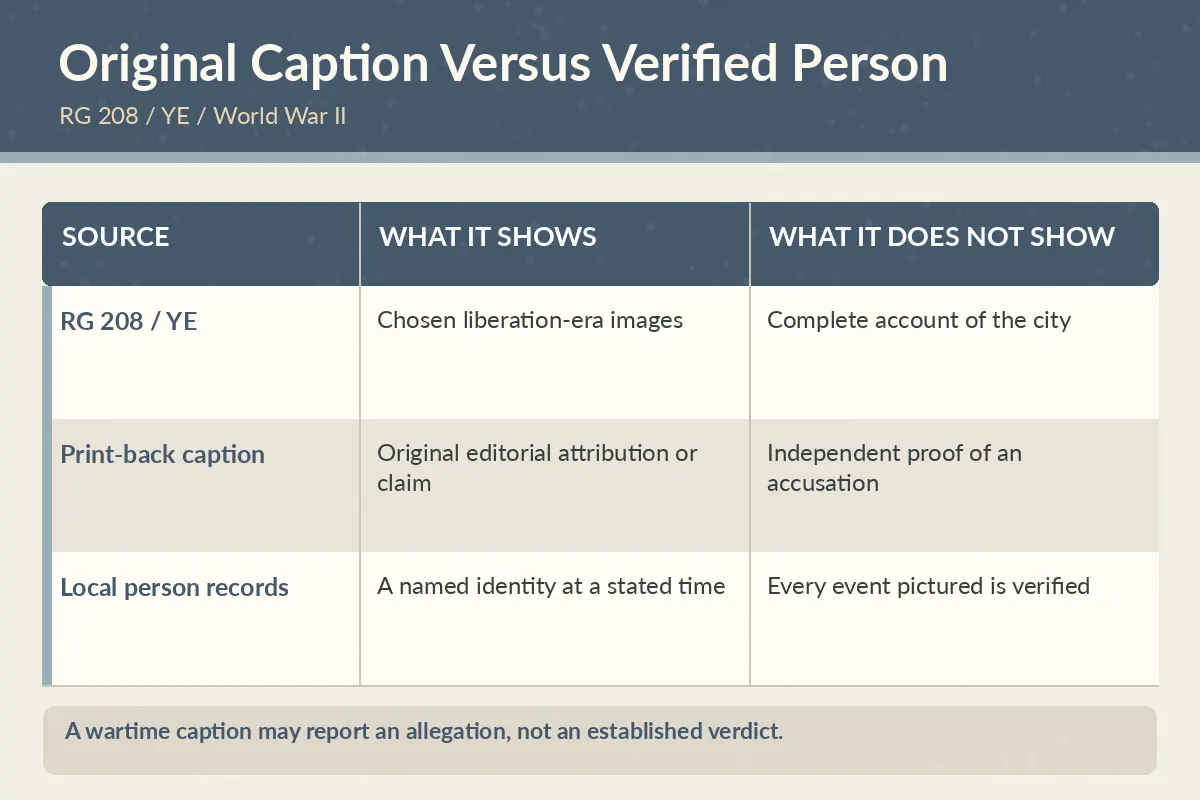
An exhibition titled “Rebirth” conveys an editorial argument about recovery. Its photographs can show returning civilians, streets and visible damage, but their ordering may have been chosen to create a narrative arc. A still image cannot, by itself, tell how representative a scene was, who made a particular decision, or what happened just outside the frame. Identify the visible activity narrowly and compare it with contemporary city records, newspapers and reliable local histories when possible.
If a print depicts a family outside a damaged property, the photo does not establish the household’s ownership or the reason they were there. A building could be temporary shelter, a business, a borrowed home or an administrative office. Use street names only if supported by an original caption and independent map or address evidence. Do not infer a precise location from another photograph in the set without documenting the link. For multiple exposures, note the viewpoint and evidence of chronological ordering.
Verify Individuals Using Non-Photographic Records
For a named Laval resident, search municipal and departmental archives, civil registers within applicable privacy and access rules, period directories, contemporary local reports, and family correspondence. A surname in a caption may be a transcription or translation; compare French spellings and original documents. Do not identify a living descendant or make sensitive claims solely from photographs. A plausible facial resemblance between an old print and a family portrait remains tentative without other evidence.
If a caption describes someone as an accused collaborator or a member of the Resistance, treat the description as an attributed contemporary statement. Whether an accusation was true, investigated or resolved needs separate records. Likewise, a person pictured among celebrating crowds is not necessarily a member of a political organization. Write a claim-by-claim ledger: source wording, person asserted, location and date, independent corroboration, and unresolved alternatives. This permits a careful account of an emotionally difficult historical period.
Use the Exhibition for Local History Without Invented Outcomes

The YE photographs are valuable for studying visual representations of liberated France and the public information strategy of the United States. A local historian can compare storefronts, street layout, damaged buildings and visible signs with period maps and independent photographs. But a display assembled for a foreign audience is not a neutral survey of the town, and the absence of a neighborhood from the exhibit is not proof that it escaped war damage.
For publication, cite the record group, YE designation, original item and caption, and the repository holding the copy you actually used. Explain attribution and translations rather than presenting them as a single anonymous voice. Check item-level rights where applicable. Our modern drawings explain source evaluation and are not a reconstruction of any accused individual or a facsimile of an OWI photograph. The strongest result is a modest, verifiable statement about the pictured place and the provenance of the picture.
More Family Story and Preservation Guides
How We Research This Evidence
This guide is anchored in the official archival description: NARA’s Still Picture Branch guide, RG 208 section 208.3, identifies the “Rebirth of a French Town” photographic display set about refugees returning to Laval under the YE designation, alongside several other exhibits. That supports the existence, arrangement and broad dates of records as described, not the accuracy of claims about an unseen individual item. Check a specific identifier, original caption or register line, date, creator and physical arrangement before using the material in a family or place history. Where archival descriptions conflict with an event timeline, preserve both and explain why they answer different questions. Each schematic image in this article is an original modern educational illustration, not an image of the record itself.
We checked the source information on 2026-11-14; that is an access-check date, not the historic creation date. Follow NARA’s Still Pictures guidance for image requests or research preparation guidance for questions about original holdings and access. Exact availability, digitization, use rights and individual identities must be established at item level. Consult the affiliate disclosure for site transparency; mentioning a repository does not imply a paid relationship. We use this method to trace the Laval image sequence and evaluate wartime captions without inventing individual identities or outcomes, making explicit what remains uncertain.
No. NARA describes a selected photographic exhibit about Laval, not a list of residents.
YE groups several themed OWI exhibits; request the specific Laval set and item.
No. Attribute the caption and seek independent evidence for the underlying claim.
No. Copy and accession dates must be distinguished from the original exposure.
Not alone. Use appropriate land, civic, or household records.