
At The National Archives, MAF 98 includes general reports and technical information from the Scientific Adviser’s Division of the Ministry of Food about foodstuffs, rations and nutrition in the period 1936–1959. These papers are valuable for explaining the scientific assumptions and administrative debates behind wartime and postwar food policy. They are not a collection of family ration books and do not normally name ordinary shoppers. The distinction matters when turning a relative’s memory of a scarce ingredient into a historical account.
A technical report may measure nutritional content, discuss preservation or recommend a distribution policy. A household account instead asks which foods a named family had access to and ate. Neither can replace the other. Your research should therefore begin with an explicit scale: national policy, scientific experiment, local supply, or individual behavior. A report can give excellent context for a family story while remaining incapable of confirming whether Grandma served a particular meal on a specific Thursday.
Choose the Topic and Date Before a Search
The National Archives’ public health and social policy guide places MAF 98 in the historical food and nutrition record landscape and warns that some committee minutes are organized by date only. Search Discovery by foodstuff, scientific topic, committee terminology and approximate year. If a contemporary memoir supplies a date for a new rule, preserve it as a clue to minutes rather than assuming the event immediately changed household supplies.
A wartime policy might have been considered, tested, announced and implemented on different dates. Build separate columns for experiment, recommendation, decision, public notice and observed local effect. Consider whether the question belongs to the 1939–1945 war years or to later rationing and postwar adaptation; MAF 98’s span extends beyond the war. Do not use a late technical report as unqualified evidence for early-war conditions, or cite a single scientific paper as if it summarized the whole civilian food experience.

Read the Scientific Report as a Source
Find the precise authoring division, report date, distribution status and the document’s stated purpose. Was it a laboratory result, technical review, committee paper or final recommendation? Note the tested foods, assumed conditions and the audience for whom the findings were intended. Laboratory estimates and standardized rations cannot automatically describe meals eaten by children, factory workers or people with special medical needs. A technical claim should be quoted sparingly, cited precisely and interpreted in the report’s historical context.
For example, an investigation into the nutritive value of a substitute ingredient might explain why officials were willing to promote it. It cannot prove that a named household bought it or liked it. Report a finding as ‘the scientific division assessed’ rather than ‘the population ate.’ When possible, track a study into later correspondence or official policy documents and note whether the recommendation was adopted, modified or dropped. The difference between research and implementation is central to meaningful family food history.
Separate Entitlement, Availability and Consumption
Rationing rules define an entitlement under a particular regime, not a guarantee that every shop had the food in stock or that every person consumed the full allocation. Households differed by age, occupation, location, preferences, garden produce, social networks and access to public meals. Documents from MAF 98 are best used to establish the policy and scientific backdrop. Local newspapers, shops’ notices, household accounts, diaries and surviving ration documents are more direct sources for a family’s material circumstances.
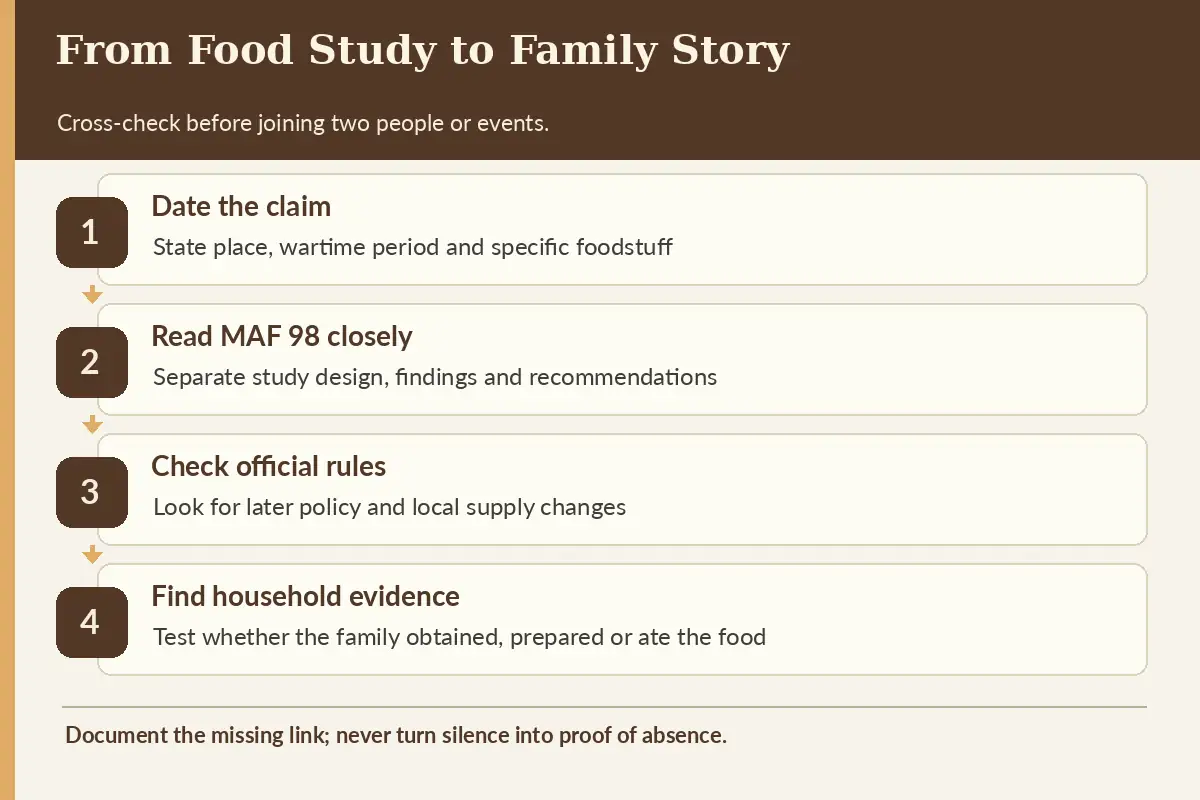
Make a four-step evidence ladder: official nutritional research, announced ration or supply rule, local access and the household’s own purchase or eating record. Mark any missing step. A relative’s recollection is valuable oral evidence when attributed and dated, but may compress several years of food changes into one memorable episode. Compare the remembered meal with the rules operating at the stated time rather than calling it false because it does not match a modern generalized ration chart.

Treat Committee Minutes and Missing Names Carefully
Some MAF 98 committee minutes are arranged by date without searchable subject-level descriptions. A keyword search that finds no result can miss the relevant meeting entirely. Identify plausible meeting periods from departmental reports or public announcements and browse the dated material as the archival description allows. Record all variant terms for ingredients, nutrition problems and committees, then copy the reference and date of any original minute reviewed. A short catalog entry is not a transcript of the minute.
Individual families generally will not appear in national technical reports, even when the policy affected them. This absence is expected because of the record’s administrative purpose. Do not advertise MAF 98 as a way to ‘find your wartime grandmother by name.’ For an individual’s story, seek local school-meal records, workplace canteen evidence, a personal diary, domestic correspondence or oral testimony, observing any privacy limits. The scientific file provides a different, complementary layer of the evidence.
Tell a Family Food Story Without Overclaiming
A defensible account can say that a dated Ministry of Food report considered a certain nutrition issue, that an independently sourced rule applied in a particular period, and that one person’s diary records a meal or purchase. It should not skip from the first statement to the last. State whether the dish was remembered by an eyewitness, reconstructed from a family recipe, or inferred from national policy. Those distinctions make family stories more informative and more respectful of their uncertainty.
Use Discovery guidance to keep the difference between an archival description and a reviewed report visible in your citations. A recipe reproduced from a later cookbook should not silently become a wartime original. Include the exact archival reference, document date, food context and relevant independent household evidence. Our affiliate disclosure explains site transparency; it does not confer authority on any commercial source. The aim is an honest narrative that connects policy to lived experience without inventing meals.
More Family Story and Preservation Guides
How We Research This Historical Record Type
We begin with the repository’s own description of the series, then separate its administrative purpose from the reader’s family-history question. We review chronological coverage, name-search limitations, original-versus-index distinctions, survival, access restrictions and the actual wording of each proposed finding. The subject-specific official guide and a second independent archive source provide the initial route; an individual ancestor is not asserted without inspecting a relevant original item.
Our approach reports uncertainty openly. A missing index hit is a bounded search result, an application is not an approval, a payment decision is not necessarily a receipt, and a map or technical report is not person-level evidence. Whenever we cannot locate the source needed to prove the next assertion, the article states that gap and shows which separate record would resolve it. The affiliate disclosure is available for transparency; no paid relationship is implied.
No. It chiefly concerns the Ministry of Food Scientific Adviser’s reports and technical research, not ordinary household files.
The National Archives describes scientific reports and technical information for 1936–1959.
No. Entitlement and consumption are distinct; use household and local evidence for the latter.
Some committee minutes are organized by date rather than subject; browse the appropriate period.
Date the recipe or testimony, identify the relevant policy and local supply context, and state what remains unproven.