
The Postal Museum preserves Treasury correspondence in its POST 1 archive class. For a British Post Office employee, a letter about a pension or gratuity may describe a career far more fully than an appointment index. Yet the administrative story matters: the Post Office recommended awards and Treasury officials reviewed financial decisions. A letter reporting a proposal should never be rewritten as proof that the worker received money. Start with a precise question: which employee, in which department, was considered for what kind of award, and what outcome survives?
The Museum’s family-history guides distinguish normal retirement pensions, ill-health pensions, marriage gratuities for some women leaving employment, and death gratuities for families of employees who died in service. Those categories lead to different interpretations. A gratuity to a family does not by itself identify all heirs. Retirement on medical grounds is not a death certificate. A grant awarded at the end of service is not a roster of every posting. Keeping the category intact gives the eventual family-history claim a sound basis.
Find a Pension Through the Award Year
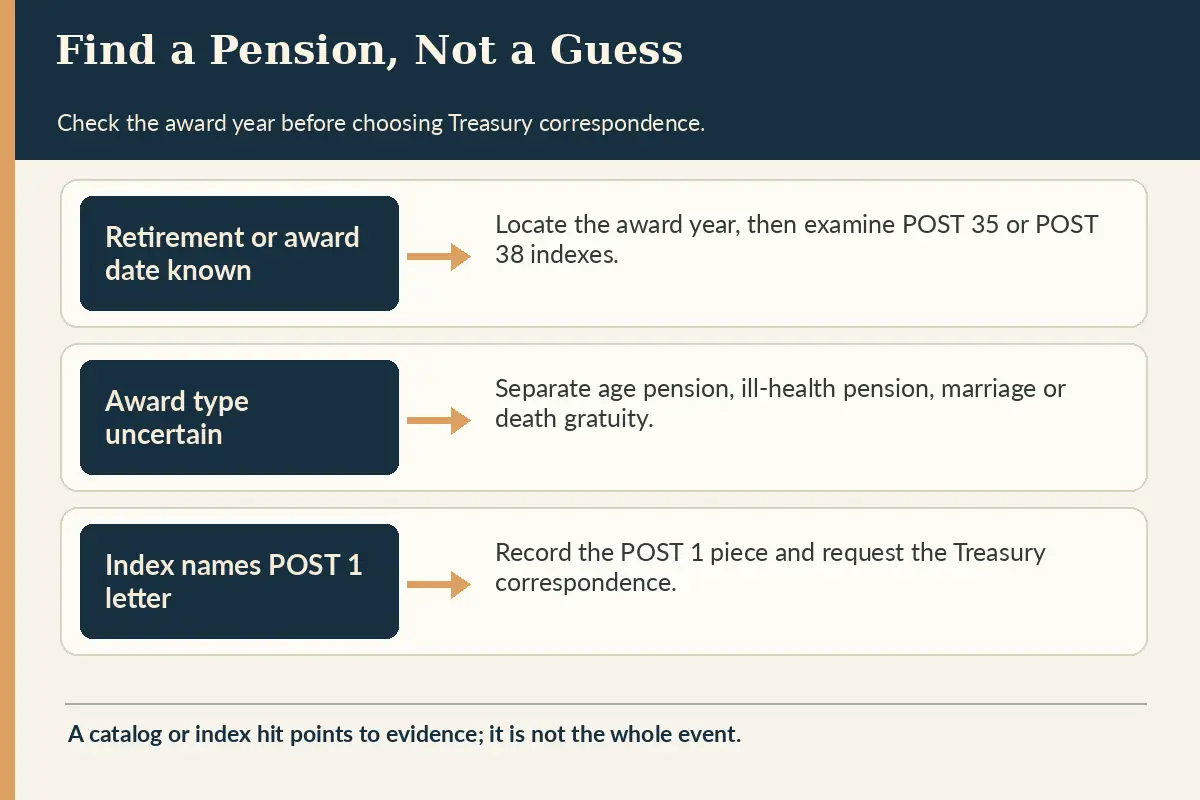
Begin with a likely year of retirement, death in service or marriage gratuity, not just the employee’s birth year. Ordinary retirement was commonly associated with age 60, but personal circumstances and changing rules mean a date estimate should be treated as a hypothesis. The Museum describes pension and gratuity indexes associated with POST 35 and POST 38, arranged by year of award and then surname. Search the appropriate year and nearby years under alternative spellings, initials and married names where relevant.
Copy the entry exactly, including the award class, year, place and any reference to a Treasury letter. Many people had common surnames and the same district could employ several workers of similar ages. An index hit is a finding aid, not a full administrative file. If you cannot locate an entry in the expected year, widen the window and ask whether the person’s departure was actually a transfer, resignation or death. A failed index search is not evidence that a career ended without financial support.
Read Treasury Letters as Decisions, Not Biographies
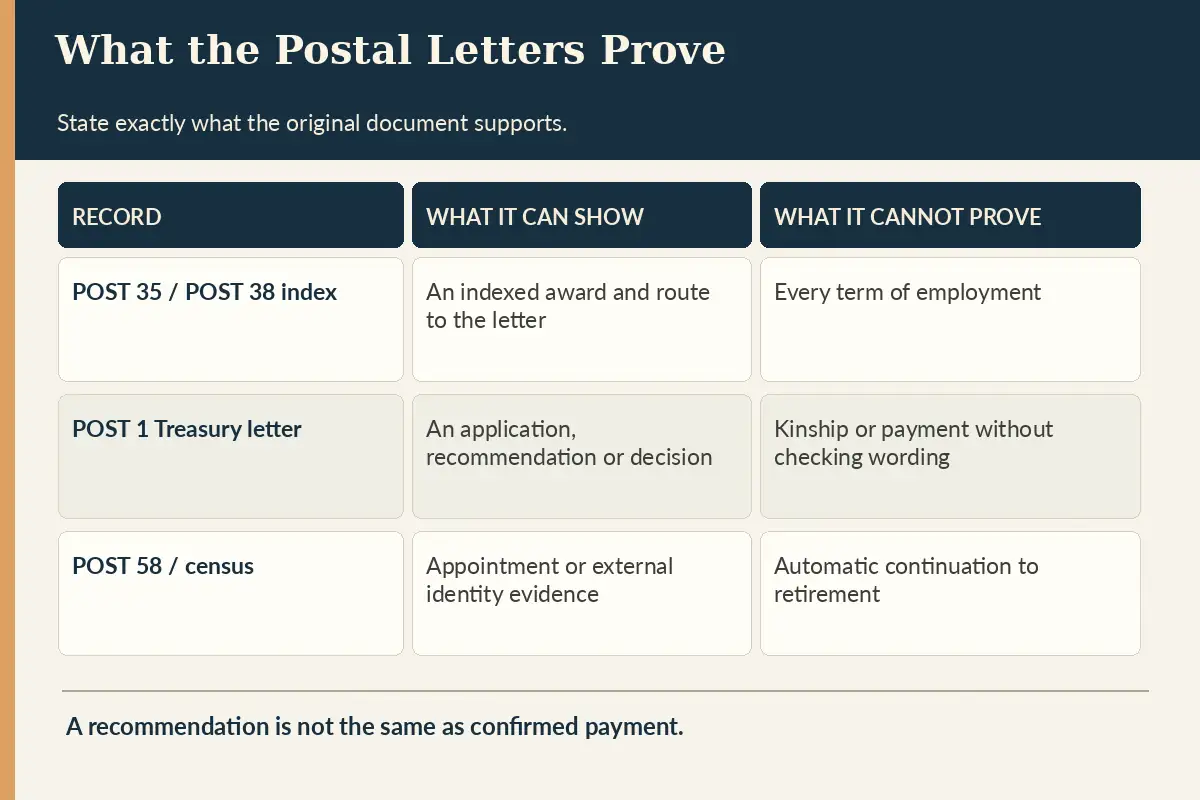
From about 1860 to 1940 applications for pensions and gratuities were sent to the Treasury, with related correspondence held in POST 1. The original letter may summarize employment duration, grade, conduct, absence or the reasons for an award. Record whether the item is an employee’s application, the Post Office recommendation, a Treasury response or a later acknowledgment. Those documents can stand in different positions in the same decision process. A detailed recommendation still does not prove that a particular sum was issued without a final outcome.
The archive uses precise class-and-piece finding numbers, such as POST 1 followed by a piece number. Retain the number and, when possible, a page or folio identification, date and correspondent. The Museum’s guides stress that some Treasury letters did not survive; do not infer that a missing letter disproves the indexed award. Some entries after the wartime administrative change are much shorter. If a secondary dataset has transcribed selected fields, inspect its provenance before treating it as a substitute for original correspondence.
Recognize the Change in Records After 1940
In November 1940 the Treasury delegated power to award pensions to the Post Office. The Museum says that after that change detailed submissions to Treasury became exceptional and surviving indexes may contain only brief entries. This is a major date gate. Applying the rich POST 1 correspondence expectation to a later retirement can create an imaginary missing file. For a post-1940 departure, find the index first and check what administrative evidence the relevant archive actually retains.
For earlier periods, be cautious in the opposite direction. Pre-1860 pension material was less inclusive and may especially represent higher grades. A historical system’s eligibility rules mean absence from pension records cannot establish that a named woman or man never worked for the service. The research goal is to describe the preserved financial decision, then build the broader work history from separate employment, local and household sources. Record the temporal limitation explicitly in any family narrative.
Match the Worker, Not Just a Familiar Name
Postal employment can take a person across offices and departments. Compare the worker’s grade and location in POST 1 with an appointment entry in POST 58 where the period allows, and consider establishment books or staff publications when available. A pension summary might mention a total period of service without listing every workplace. Where the employee moved, distinguish an appointment at one office from a later pension submitted under another. Never fill the intervening years from the final office alone.
An external record should independently test identity: census occupation, a marriage certificate, address evidence or a contemporary newspaper can help distinguish same-name employees. If an employee received an ill-health award, preserve the document’s own reason and avoid diagnosing a disease from a broad administrative category. If a death gratuity is involved, locate independent death and probate evidence before assigning it to a particular person. The file’s title is often less important than the role and date of each named party.
Turn the Pension Trail Into a Reproducible Note
Prepare a ledger with four columns: question, exact record reference, direct observation and still-unproven inference. A reliable first sentence might say that a named person was listed in a pension index for a given award year. A second sentence, after the original is consulted, may state what the Treasury letter recommended or recorded as granted. A third source can test the worker’s identity and eventual life events. Keeping these sentences separate stops a promising occupational clue from becoming an invented biography.
For source access, consult the Postal Museum family-history guide and the Postal Museum catalog. Explain whether a piece was inspected directly, viewed on microfilm, or accessed as a transcription. As with all research on GenHis, the affiliate disclosure applies; no paid service or partner relationship is implied by an archive link. The useful outcome is a documented next search, not a guessed retirement story.

More Records and Archives Guides
How We Research This Historical Record Type
We begin with the repository’s own description of the series, then separate its administrative purpose from the reader’s family-history question. We review chronological coverage, name-search limitations, original-versus-index distinctions, survival, access restrictions and the actual wording of each proposed finding. The subject-specific official guide and a second independent archive source provide the initial route; an individual ancestor is not asserted without inspecting a relevant original item.
Our approach reports uncertainty openly. A missing index hit is a bounded search result, an application is not an approval, a payment decision is not necessarily a receipt, and a map or technical report is not person-level evidence. Whenever we cannot locate the source needed to prove the next assertion, the article states that gap and shows which separate record would resolve it. The affiliate disclosure is available for transparency; no paid relationship is implied.
Not automatically. Check whether the letter records an application, recommendation, authorization or actual disbursement.
Use the likely award year and surname in the relevant indexes, then follow the exact class-and-piece reference.
The Post Office assumed greater award authority and detailed Treasury submissions became exceptional, leaving briefer index evidence in many cases.
It suggests an administrative reason for leaving, but verify the marriage independently in civil or parish evidence.
Eligibility, resignation, different award categories, missing letters or an incorrect date can explain the mismatch.