
The National Archives lists LC 13/1–5 as Office of Robes letter books from 1830 to 1901 within the Lord Chamberlain’s departmental records. They can illuminate correspondence about clothing and ceremonial suppliers, including tradespeople associated with royal warrants. But a named supplier, official letter or warrant-holder reference does not, by itself, establish that a particular garment was ordered, delivered, paid for or worn by a named royal person. Begin with the document type and dated correspondence, then look for independent bills and accounts before describing a completed commercial transaction.
Identify the Office of Robes and the Letter Book
The Office of Robes belonged within the Lord Chamberlain’s administrative sphere. Search the LC 13/1–5 letter books by the appropriate part of the 1830–1901 range, together with the full name or business style of the supplier. A letter book is a departmental correspondence record, not automatically the private archive of a court dressmaker or an exhaustive register of all trades. Record the sender, recipient, subject, letter date, whether a copy or original is indicated and the exact reference. If a letter was copied later, preserve that distinction in its chronology.
The National Archives notes royal warrant holders in LC 13 for items supplied at ceremonial occasions, including peruke-making, embroidery and feathers, and for personal items such as combs or perfume. Different suppliers could have held different kinds of appointments. A firm’s appearance in one letter need not imply a royal warrant in force on that date or an exclusive contract. Avoid attaching an honorific trade description to every named supplier without the actual warrant evidence and relevant dates.

Separate Warrant, Request, Bill and Account
Create a four-column record chain: authority or correspondence; order or request; original invoice; recorded payment. These stages may be preserved in different series. The National Archives describes original bills from tradesmen in LC 11 and Office of Robes accounts in LC 12, with the latter especially relevant for 1860–1901. Depending on the query, LC 13 might clarify why an item was discussed while LC 11 contains its bill. These are related record classes, not a guaranteed linear sequence for every piece of clothing or every year in the letter books.
An invoice may show a claimed quantity and price without proving acceptance or actual settlement. An account entry may show financial recognition without establishing precisely who wore an item, and a warrant may concern supplier status rather than a particular sale. Enter source dates in separate fields, then state the strongest supported conclusion. If no account survives, do not invent a payment; if a name appears only in a letter, do not present the person as a paid court servant. Keep tradespeople, officials, attendants and recipients as distinct roles.
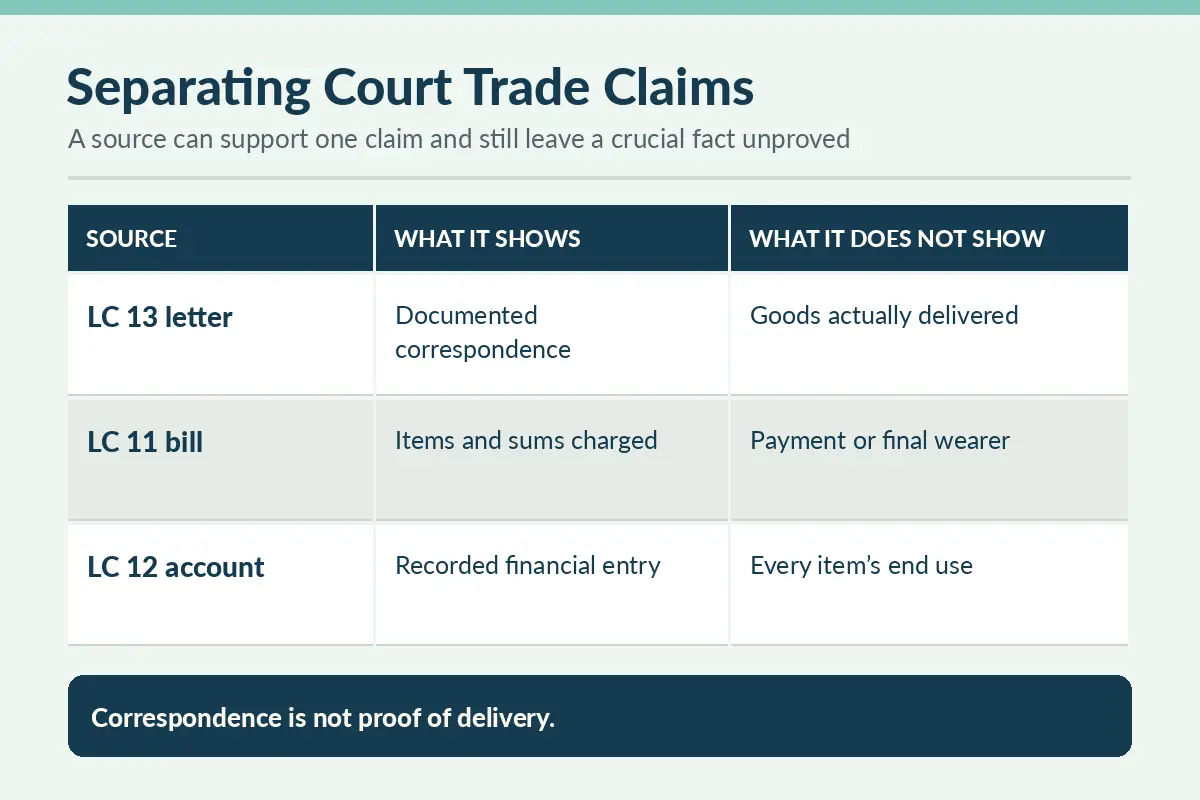
Resolve Historic Business Names and Ceremonies
A supplier may appear under a personal name, a partnership or a changing shop name. Record names verbatim and compare dated London directories, tax or trade listings, address changes and contemporary advertisements. Two firms with the same surname are not necessarily one business. A court ceremony named in a letter can be a planning context rather than proof that an item was completed in time. Use dated bills, accounts and surviving programs or independent accounts to establish the timing and actual outcome of an event.
Where an invoice mentions embroidery, feather-work or mourning attire, distinguish the commercial product from the wearer. The same workshop might have supplied an institution, official or court department rather than a named sovereign. Even a letter referring to ‘Her Majesty’ must be read in its particular context and cannot be made into a claim about the final use of a specific object without corroboration. If a physical artifact survives in a museum, compare material description, measurement and provenance carefully instead of treating a visual resemblance as identification.
Build a Defensible Court-Trade Biography
For a family-history question, begin with the occupational and business identity and ask what the royal connection actually involved. A letter, warrant reference or bill may provide names, trading addresses, particular goods and date windows. Combine those leads with independent census records, partnerships, apprenticeship documents, wills and directories to distinguish several generations in the same workshop. A formal firm name can outlive the original proprietor; it cannot prove the named ancestor personally made or delivered each item.
An audit trail should record each archive piece, document type, person or firm, official role, commodity, date of communication, date of billing and any separately evidenced payment. Write ‘named in correspondence’ when that is all the piece shows. Reserve stronger language, such as ‘billed the department,’ for an actual bill and ‘was paid,’ for a credible transaction record. This restrained phrasing is more useful to readers than a dramatic narrative that calls every listed tradesperson a royal appointee.
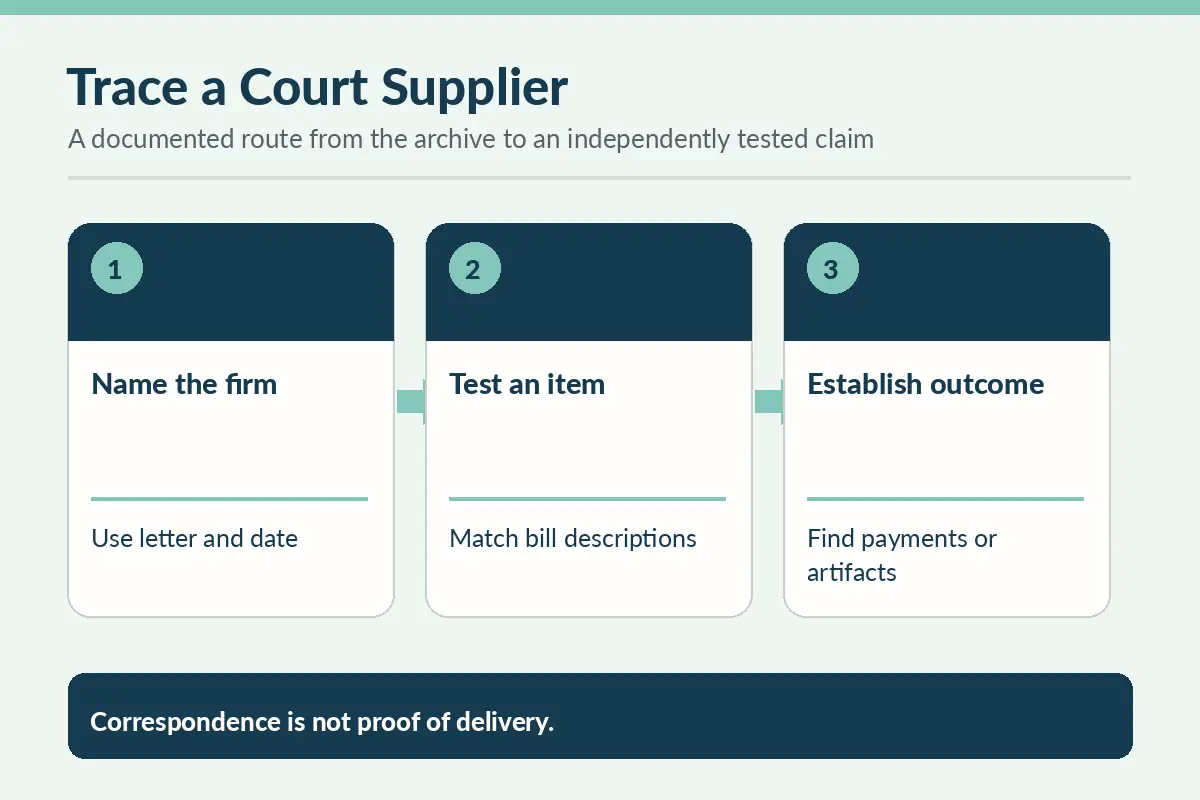
Consider a hypothetical nineteenth-century embroiderer named Henry Vale. An LC 13 letter mentions his workshop while discussing a ceremonial occasion. That does not establish that the final garment was made by Vale, delivered to a named royal person or paid for. Look next for a matching item description and date in LC 11, and for a related account in LC 12 where applicable. Confirm the workshop’s address and proprietor in a contemporary directory before linking it to the family. The example is fictional and illustrates a research method; no archival discovery of this person is implied.
More Records and Archives Guides
How We Research This Archive Series
Our editorial check on November 8, 2026 used primary archival guidance for the precise series and corroborating repository guidance for context and access limits. We distinguish a record series description from the evidence in an actual piece. The illustrated examples in this article explain a process, not purported discoveries of real people. Archive access, survival, privacy and catalog detail must be verified again for any individual request.
For each proposed claim, write down the research question, the date and geographical scope, record creator, full reference, page or image identifier when available, the exact words that support a narrow interpretation, and an independent source that could test the conclusion. Preserve no-results searches as search results, not as proof an event never happened. A genuine citation should let another researcher retrace the specific record. The illustrative graphics are editorial interpretations, never facsimiles of historical documents. Read our affiliate disclosure; none of these research links imply an affiliate partnership.
No. Read the exact letter and distinguish correspondence from an independently documented warrant.
The National Archives identifies LC 11 as a series containing original tradesmen’s bills.
Office of Robes accounts can help test financial records, particularly for the later part of the period.
No. A letter or supplier record does not establish final use without further evidence.
Compare dates, business addresses and independent records before assigning correspondence to one person.