
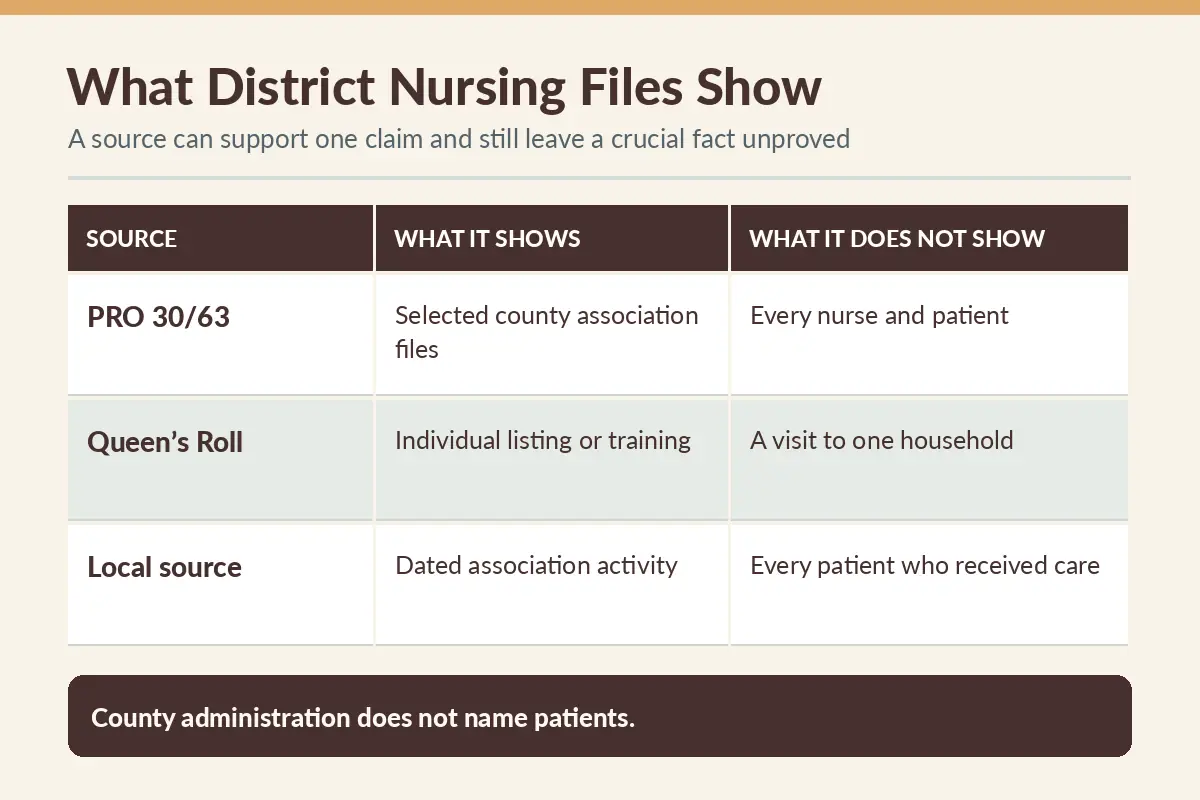
The National Archives identifies PRO 30/63 as selected records relating to the Queen’s Institute of District Nursing, arranged by counties and illustrating the Institute’s role in training nurses and supervising county and district associations. That description makes the series useful for locating organizational history but not a guaranteed register of all nurses or patients. Begin with the historical county and association, record the actual piece description, and consult independent professional or local records before attaching a person to the institution. A county file is not proof that an ancestor received care or worked in a named district.
Identify the Historical County and Nursing Body
Start with a historical county name, a town and the likely district nursing association rather than searching only for a family surname. TNA says the selected PRO 30/63 files are arranged by county, so a change of local boundary or association name may matter more than a modern address. Record each name as the historical document uses it, and test neighboring counties if local administrative divisions changed. A county-level reference can describe supervision or correspondence, not every local nurse’s appointment or every patient encounter.
The Queen’s Nursing Institute developed out of late nineteenth-century efforts to organize nursing at home. The Wellcome Collection places the establishment of Queen Victoria’s Jubilee Institute for Nurses in the late 1880s and describes an aim of training district workers and supervising affiliated associations. Keep that institutional history separate from the date of each PRO 30/63 file. The archive guide does not supply one complete creation-date span for every county piece, so do not fabricate a fixed series range or assume it covers continuous operations in all localities.

Read Administrative Files at the Right Level
County files may lead to information about standards, organization, training, affiliation or inspection, but only claim specific contents when the actual item has been examined. An index description may identify a county while concealing whether a volume contains letters, statistics, reports or lists. Make a two-column note: the catalogue’s precise assertion and your observations after seeing the record. If you have only the catalogue description, do not invent a staff roster, a patient case or a particular practice. Record the reference and request access or a copy before giving a detailed quotation.
Even where numbers of nurses are supplied, a statistical figure is not a list of individuals. The district association’s work could span several villages or change during a period. Use dated local annual reports, municipal directories, newspaper notices or association histories to test location and operation. When an association appears in a regional file, distinguish its central supervisory body from the actual community nurses and clinics. That separation prevents plausible but unsupported family-history claims about a nurse attending a particular household.
Find a Named Nurse in Other Collections
The National Archives warns that its own medical collections generally document administration and policy more than detailed careers of individuals. For named Queen’s Nurses, the Wellcome Collection catalogues surviving Queen’s Nursing Institute records, including the Queen’s Roll and training materials. Wellcome explains that the roll used volumes before 1937 and later cards; it is not identical to the county-arranged PRO 30/63 administrative files. A nurse named in a local story should be tested against such individual records, with attention to roll number, dates and the exact geographical association.
A roll listing, training record, employment reference and patient encounter remain distinct propositions. If a nursing roll confirms qualification, it does not alone prove a nurse served at a particular house. If a local annual report names the staff of an association, that suggests service in an area but still does not identify patients. For a biographical research log, track each nurse’s recorded name, qualification or training date, association, address, independent employment evidence and remaining gaps. Do not attach confidential patient identities to a public organization narrative.
Distinguish Institutional History From Patient History
A family memory that a relative was ‘visited by the district nurse’ may be accurate yet too broad to identify a specific professional. Use place and date to establish whether a district nursing association existed, then keep the personal claim separate until a lawful independent source supports it. Avoid speculative naming of patients, illnesses or diagnoses; the institutional file is not a substitute for confidential medical records. Research involving recent care must respect privacy and access restrictions, and a lack of open patient material should never be filled by inference.
A productive conclusion may establish that a nursing association operated in a particular county and that a named nurse had an independently documented connection to it. A further claim that she visited one ancestor requires more. State the difference explicitly in any family-history article or tree. Keep a full audit trail: county and association, PRO 30/63 piece, record date, source type, local corroboration, named-person source and exact unresolved question. This method gives a useful institutional history without creating invented patients or employment records.

In a fictional example, a family letter describes a ‘Queen’s Nurse’ visiting a grandmother in a small town. A PRO 30/63 county file points to the local association, and a dated town directory confirms that the association used an office nearby. These sources do not name the visiting nurse. A separate Queen’s Roll entry might identify a plausible practitioner in the same period, but that is still only a candidate unless linked by direct personal or local evidence. Record the three evidence steps independently: association existed, nurse was listed, and visit to this household remains unproved. That last blank protects the story from accidental invention.
More Place and Jurisdiction Guides
How We Research This Archive Series
Our editorial check on November 8, 2026 used primary archival guidance for the precise series and corroborating repository guidance for context and access limits. We distinguish a record series description from the evidence in an actual piece. The illustrated examples in this article explain a process, not purported discoveries of real people. Archive access, survival, privacy and catalog detail must be verified again for any individual request.
For each proposed claim, write down the research question, the date and geographical scope, record creator, full reference, page or image identifier when available, the exact words that support a narrow interpretation, and an independent source that could test the conclusion. Preserve no-results searches as search results, not as proof an event never happened. A genuine citation should let another researcher retrace the specific record. The illustrative graphics are editorial interpretations, never facsimiles of historical documents. Read our affiliate disclosure; none of these research links imply an affiliate partnership.
No. The National Archives describes selected county-arranged Institute records, not a complete individual roll.
Use surviving Queen’s Nursing Institute roll or training collections and other independent local evidence.
No. Establish the precise document date and compare independent annual or local records.
Do not presume so. Patient histories require separate lawful and privacy-aware evidence.
Check historical county and association names and document each candidate before merging places.