
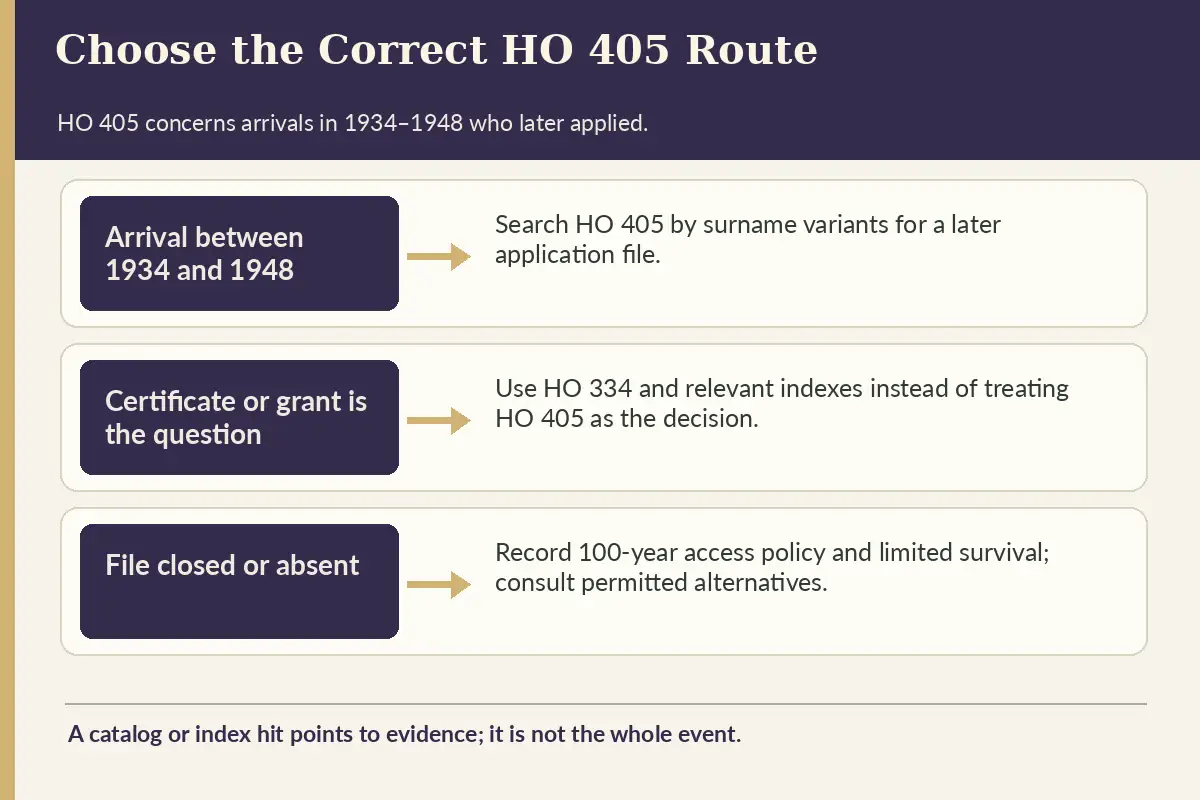
The National Archives describes HO 405 as naturalization case papers concerning foreign nationals, many from continental Europe, who arrived in the United Kingdom between 1934 and 1948 and at some point applied for naturalization. The arrival window and the application event are not necessarily the same date. A surviving file may include forms and correspondence extending much later than the person’s arrival. It is therefore an error to call a 1940 arrival a 1940 grant of citizenship just because that year appears in a file description.
The files are application records, not a complete index of immigrants and not an automatic register of British citizens. The National Archives reports that only about 40 percent of applications in HO 405 survive. Some files contain correspondence into the 1960s and occasionally much later. The researcher needs two separate hypotheses: whether the candidate appears among those whose files survive and whether any naturalization was actually approved. A match with an identity detail in a case paper can be useful while leaving the legal outcome entirely open.
Search by Surname and Confirm the Arrival Window
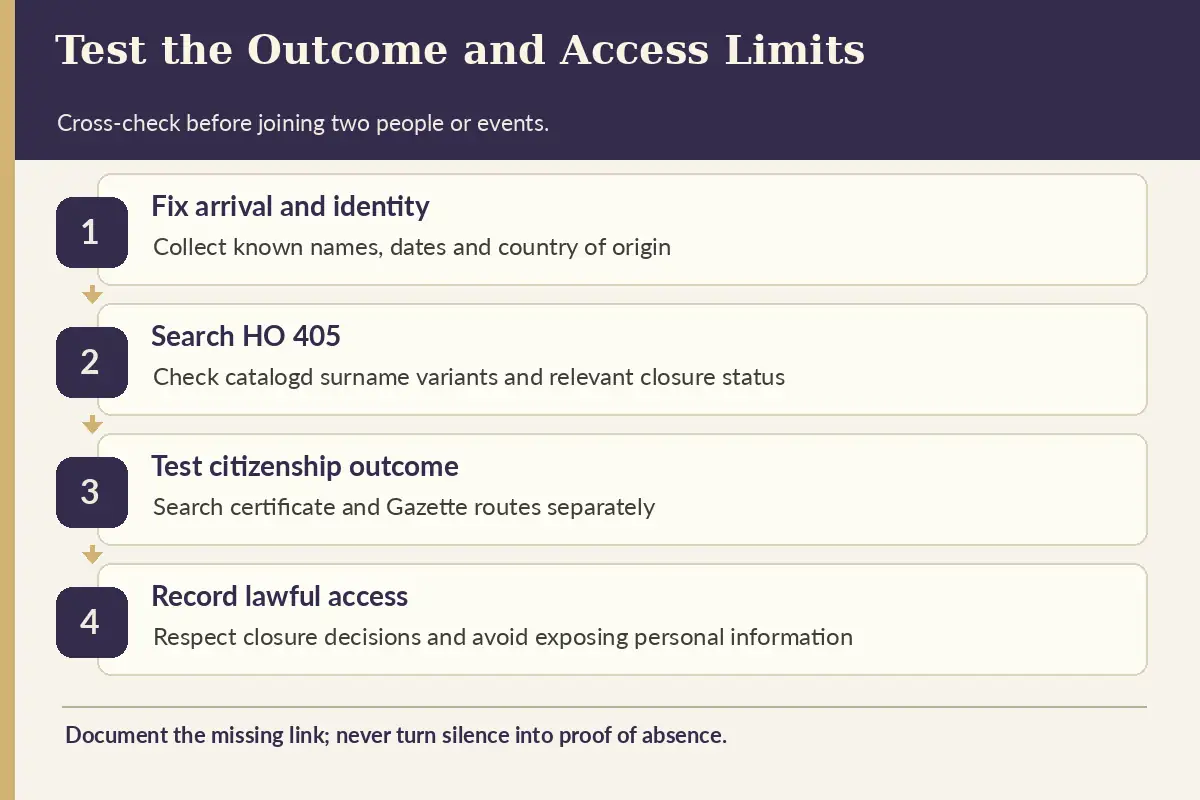
Start with a documented surname, variants and any earlier name, then search the HO 405 catalog as advised in the National Archives citizenship guide. Check the candidate’s year of arrival and other known identity anchors before claiming that a similarly named file belongs to a relative. A file can include application dates, correspondence dates and later administrative endorsements that are far removed from the migration event. Record each date with its meaning instead of combining them into one ‘naturalization date.’
A refugee or migrant might have used alternate spellings, a married name or an anglicized version of a name. Make a variant table showing the exact source for each form. If a name search fails, record the date and filters used and look for independent arrival or residence evidence. Discovery typically searches the words used in catalog descriptions, not every word in a closed or undigitized file. A failure to find a name in HO 405 is weak evidence given the archive’s acknowledged survival limits.
Distinguish Forms, Background Checks and Grants
Naturalization applications can contain information such as birthplace, occupation, family relationships, references and reports depending on the case and date. Those details are valuable but often come from an applicant or another informant and must be tested. Even a completed form or official recommendation does not necessarily mean the applicant received British nationality. Treat a signed declaration, an administrative memorandum and an issued certificate as distinct kinds of records. The citizenship question requires a successful outcome record, not merely evidence that a person wished to become a citizen.
For the grant, follow the appropriate British naturalization certificate and index routes described by The National Archives, including HO 334 for relevant periods and announcements in The Gazette where applicable. The official guide explains substantial legal changes before and after 1949, so do not transfer one period’s definitions to another. In family-history prose, prefer ‘applied for naturalization’ when that is all the file proves. If the certificate cannot be found, state the limits of your search rather than asserting the person remained a foreign national.
Understand the 100-Year Closure
Personal case files can contain sensitive information about people and their relatives. The National Archives notes a 100-year closure applying to HO 405 material, with possible Freedom of Information requests as an access route, and warns that not all documents can be publicly viewed. A publicly searchable catalog entry should never be mistaken for permission to reproduce the contents of a closed personal file. The relevant access status must be checked on the specific item at the time of the request.
If a file is closed, do not seek unofficial copies, hidden endpoints or another person’s private account. Make a legitimate archival enquiry or use the official access request process where appropriate. Preserve the archive’s response, its date and whether it concerns privacy, preservation or custody. A restriction is not evidence about the applicant’s moral standing, citizenship or medical history. For living people or potentially living family members, minimize identifying details in public notes and avoid drawing intimate conclusions from administrative snippets.

Deal Honestly With Incomplete Survival
The roughly 40 percent survival figure affects every conclusion drawn from a no-result search. A file not preserved or not catalogd by a searchable name cannot refute a family story on its own. Prepare an evidence status note: candidate found and accessible, candidate found but closed, no catalog result within an explicitly stated search, or candidate unlikely within the 1934–1948 arrival population. These categories are much more informative than a single ‘not found’ flag.
If the person arrived outside the HO 405 window, use the era-specific guides rather than stretching the series. Earlier naturalization case papers may be in HO 1, HO 45, HO 144 or HO 382 depending on date. A naturalization certificate and a case file can be held in different series and may have been created years apart. Build a two-track timeline: arrival and residence on one side, application and legal status on the other. This prevents a family migration story from inheriting invented dates.
Create a Privacy-Aware Proof Note
Write only what the source directly establishes: a name appearing in a catalog description, a permitted case paper listing a particular address, or a dated certificate confirming a successful grant. Cite the original HO 405 piece, the precise document and the method of access. For a disputed namesake, compare age, birthplace, spouse and address with at least one independent source. Do not call an applicant ‘naturalised’ unless a successful legal outcome is demonstrated by the right record for that period.
The Discovery explanation helps readers understand the limitations of name searches. Publication of sensitive material should follow lawful access and thoughtful minimization, even when a record is old. The GenHis affiliate disclosure does not change archival access rules. A useful report can end with a verified application and an explicit unanswered citizenship question, rather than a false certainty about a person’s status.
More Records and Archives Guides
How We Research This Historical Record Type
We begin with the repository’s own description of the series, then separate its administrative purpose from the reader’s family-history question. We review chronological coverage, name-search limitations, original-versus-index distinctions, survival, access restrictions and the actual wording of each proposed finding. The subject-specific official guide and a second independent archive source provide the initial route; an individual ancestor is not asserted without inspecting a relevant original item.
Our approach reports uncertainty openly. A missing index hit is a bounded search result, an application is not an approval, a payment decision is not necessarily a receipt, and a map or technical report is not person-level evidence. Whenever we cannot locate the source needed to prove the next assertion, the article states that gap and shows which separate record would resolve it. The affiliate disclosure is available for transparency; no paid relationship is implied.
No. HO 405 files concern applications and correspondence; verify the outcome through the correct certificate or official register.
Foreign nationals who arrived in Britain in 1934–1948 and later applied for naturalization, within the surviving part of the series.
It does not prove no application existed; only about 40% of applications in the series survived.
The series includes sensitive personal material subject to a 100-year closure and item-specific access rules.
Follow privacy law, archive terms and consent where relevant; avoid publishing sensitive personal details merely because metadata is discoverable.