
A U.S. homestead patent is evidence of a completed federal land conveyance, but the land-entry case file can reveal how the claim was pursued, and a cancelled claim may leave records without ever appearing in a patent index. Start with a known state and legal land description, search the Bureau of Land Management General Land Office database for completed patents, and request the matching original case file from the National Archives when appropriate. If no patent appears, do not conclude the ancestor never filed a claim. Search tract books and surviving cancelled or relinquished land-entry records instead.
First distinguish a federal patent from a complete homestead claim file
The National Archives explains that public-land transfers produced case files covering several entry systems, including homestead, cash purchase and military bounty land. The homestead program began under the 1862 act, but a modern family story that someone “homesteaded” does not establish which law governed the actual entry. The GLO patent search contains completed or patented transactions; it cannot show every claim that was rejected, cancelled or voluntarily relinquished. Keep those pathways separate from the beginning. Our guide “Historical Property Search” adds more detail on this.
A patent is a final federal title instrument. A case file is the administrative packet associated with the entry and can include statements, applications, land-office correspondence and other documents whose exact survival varies. The person who received a patent was not necessarily the first person ever to occupy a farm, and the patent date may be years after initial settlement. Later ownership changes require county deeds or other local title evidence rather than assuming federal records tell the whole parcel history.
Locate the patent and record the legal land description
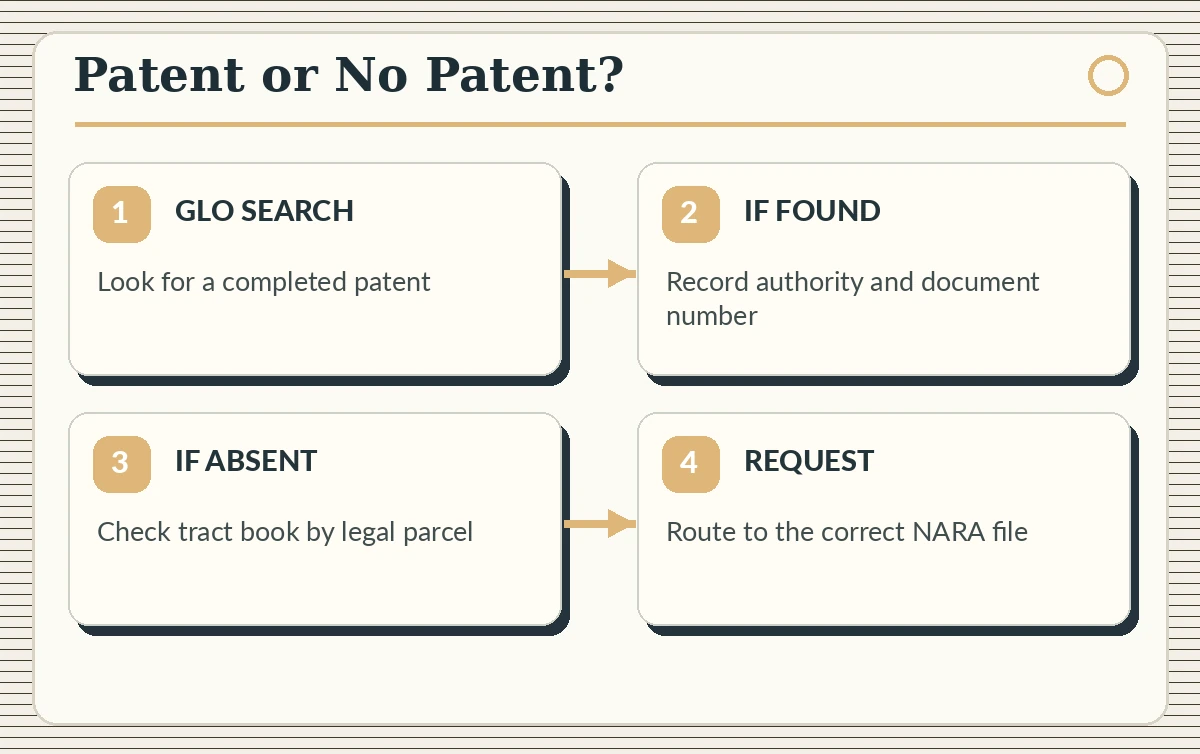
Use the GLO system with a documented name and state. Compare the patentee, issuing land office, date, authority, document number and township-range-section land description. A same-name patent in the wrong land office is not proof of your ancestor. Land sections can be subdivided and survey descriptions require the correct meridian; do not translate a township and range into a modern postal address without geographic validation. Record a source ID and save the patent image or citation when available.
For pre-1908 land entry requests, NARA lists key information such as state, land office, authority or patent type and document number. Its guidance also distinguishes the procedure for later serialized entries. Before paying for a copy, identify what the online patent actually supports and whether your research question requires the larger file. If a patent references an unexpected statute, investigate that law rather than forcing the record into the homestead category merely because a family tradition uses that word.
Use tract books when the name search finds no patent
Tract books are arranged by legal description and document actions affecting public land, including entries that did not result in a patent. They can reveal a land-office case number, a cancellation or relinquishment notation, or successive claims affecting the same tract. Begin with township, range and section identified from a map, tax roll, family deed or neighboring patents. A tract-book entry is an administrative transaction, not a definitive narrative of the claimant’s life.
BLM and NARA hold or describe tract-book material in different places, with eastern and western record arrangements. Use the agency’s jurisdiction guidance before requesting a volume or paying an intermediary. If a cancelled file is not located, distinguish a lost file, an unindexed collection, a different local land office and a genuinely absent application. NARA cautions that not all unpatented files survive; an archival no-result cannot be confidently converted into a statement that the family never tried to obtain land.
| Evidence step | What to record | What it cannot establish |
|---|---|---|
| GLO SEARCH | Look for a completed patent | A name alone establishes identity |
| LAND OFFICE | Locate the original office | The index replaces a source image |
| LOCAL DEED | Test later owners independently | An uncertain link is proven |
Request the original land entry file using the correct era route
NARA separates surrendered bounty land warrants, general pre-1908 land entry files and 1908-and-later case files. For many early patented entries the patent information can support a request using NATF Form 84 or the archives’ ordering procedures. For a cancelled entry, the office and case number may be more useful than a patent that does not exist. Some selected case files are digitized, but digitization depends on location and project, not a universal date rule.
Before requesting, capture every identifier, the desired record type and the question you hope the file will answer. If you receive a packet, inventory the pages and keep each affidavit or land-office action separately dated. A witness statement can be valuable for a residence hypothesis without proving its every statement true. Compare ages, citizenship assertions, described improvements and known family members against censuses, local tax records and court or vital records. Never assume every packet has the same documents. If you want the full process, read how to use historical land records to trace U.S. families.

Work a fictional cancelled-versus-patented claim test
Suppose a fictional Thomas Reed is associated with a particular Nebraska township in an 1880 household census, but a surname search finds a patent in another county. One hypothesis is that he moved and filed a completed claim elsewhere; another is that he made a local claim that was cancelled. Use the legal description of the known township, search the tract book and record any names and entry numbers without substituting the unrelated patent as evidence.
If the tract book identifies a cancelled Thomas Reed entry, use its land office and number to request any surviving file. Compare the claimant’s age, residence, family statements and dated witnesses with the known 1880 household. If the record does not survive or the identification remains ambiguous, mark the claim unresolved. A disciplined conclusion states whether you proved a patent, located an application or merely identified a candidate tract-book entry—three different levels of evidence.

How We Research Homestead Case Files
We checked NARA instructions for patented and cancelled land-entry records, pre- and post-1908 request paths and tract books, then cross-checked BLM guidance explaining why applications do not appear in the GLO patent index. Thomas Reed is fictional. We do not treat all public-land claims as homesteads or a patent date as a settlement date.
More Records and Archives Guides
Official archival research sources for homestead case files
National Archives: land-entry case files, patents, tract books and cancelled-claim limits (www.archives.gov).
National Archives: land-entry record requests, needed identifiers and Form 84 (www.archives.gov).
Bureau of Land Management: distinction between homestead patents and application files (edit.blm.gov).
This guide provides historical research information, not legal, medical or investment advice. Archive coverage, costs and access may change. These links are editorial references, not paid recommendations; see the GenHis affiliate disclosure. Interpret outdated historical classifications in context and protect details about living people.
No. It generally indexes completed patents, not all cancelled or relinquished entries.
Useful details include state, land office, authority, document or entry number, and legal land description.
Try tract books and NARA holdings for the relevant land office; survival is not guaranteed.
No. A patent ordinarily documents a later completed conveyance, not necessarily first occupation.
No. Contents vary; verify any relationship stated in affidavits with other records.