
PCOM 8 contains some surviving Prison Commission files about individual prisoners in England and Wales, broadly 1876–1958. It is not a complete personal case file series for all inmates. The National Archives cautions that most genealogists should start with the prison, conviction county and dates, because individual papers are exceptionally uneven and many later records have access restrictions. A file can document officials’ decisions and reports while still containing unverified claims about the person. This article explains how to search sensitively, distinguish a case file from a prison calendar, and respect a closed record rather than attempting to circumvent its restrictions.
Establish the Prison and Conviction Context
Begin with a documented prison name, county, conviction date and court when possible. A family story that someone was incarcerated may compress different prisons, stages of remand, a conviction and a later transfer. The National Archives’ prisoners and convicts guide recommends local archives for many prison registers, while records transferred to Kew include national prison administration. Treat a prisoner’s name alone as insufficient to identify a PCOM 8 file, especially for a common surname. Record every original source for the claimed prison and date.
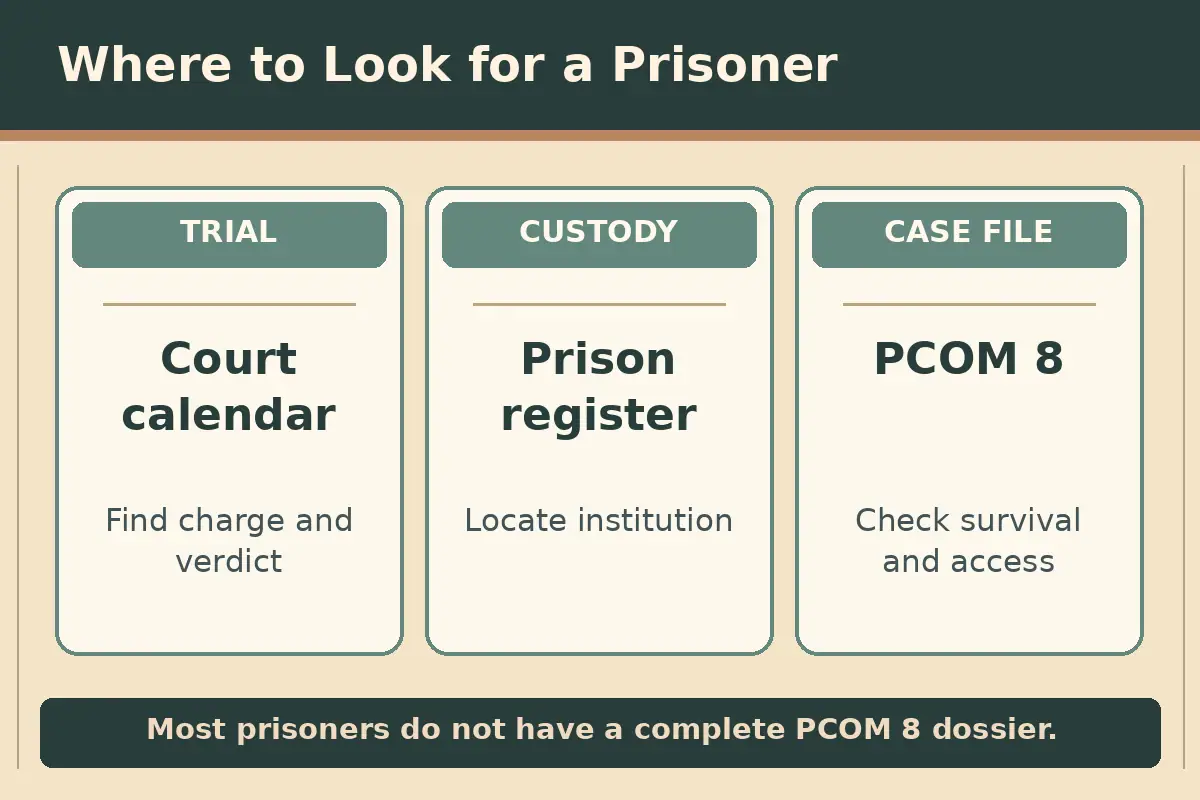
A trial calendar in HO 140, a prison register in PCOM 2 and a court decision answer different questions. A calendar may document a trial or sentence, while a prison register records custody at a particular institution and time. Neither guarantees that a separate Prison Commission personal file survives. When you are starting with a newspaper report, preserve its publication date and reported charge as a lead, not a legal verdict. Use court records where available to distinguish conviction from allegations and appeals.
Understand What PCOM 8 Actually Contains
The National Archives identifies PCOM 8 as containing some individual prisoners’ files created by the Prison Commission, covering 1876–1958. This is a limited set; its existence does not imply every prisoner held in the period had a surviving folder. Search the precise series in Discovery with a full name, dates and contextual place, then read each catalogue result’s title, piece reference and access status. A sparse description may not reveal the documents within or establish the file concerns the correct person.
If an item is open and available to consult, examine the actual documents to see which authorities prepared them and when. Notes may describe institutional conduct or proposed actions, but administrative opinion is not inherently independent proof of facts supplied by an informant. Quote names and dates carefully; do not ascribe statements from one officer to the court or to the prisoner without an attribution. A file spanning several years may refer to earlier convictions but should not be treated as a certified full criminal history unless the particular evidence supports it.
Check a File’s Access Status Before Ordering
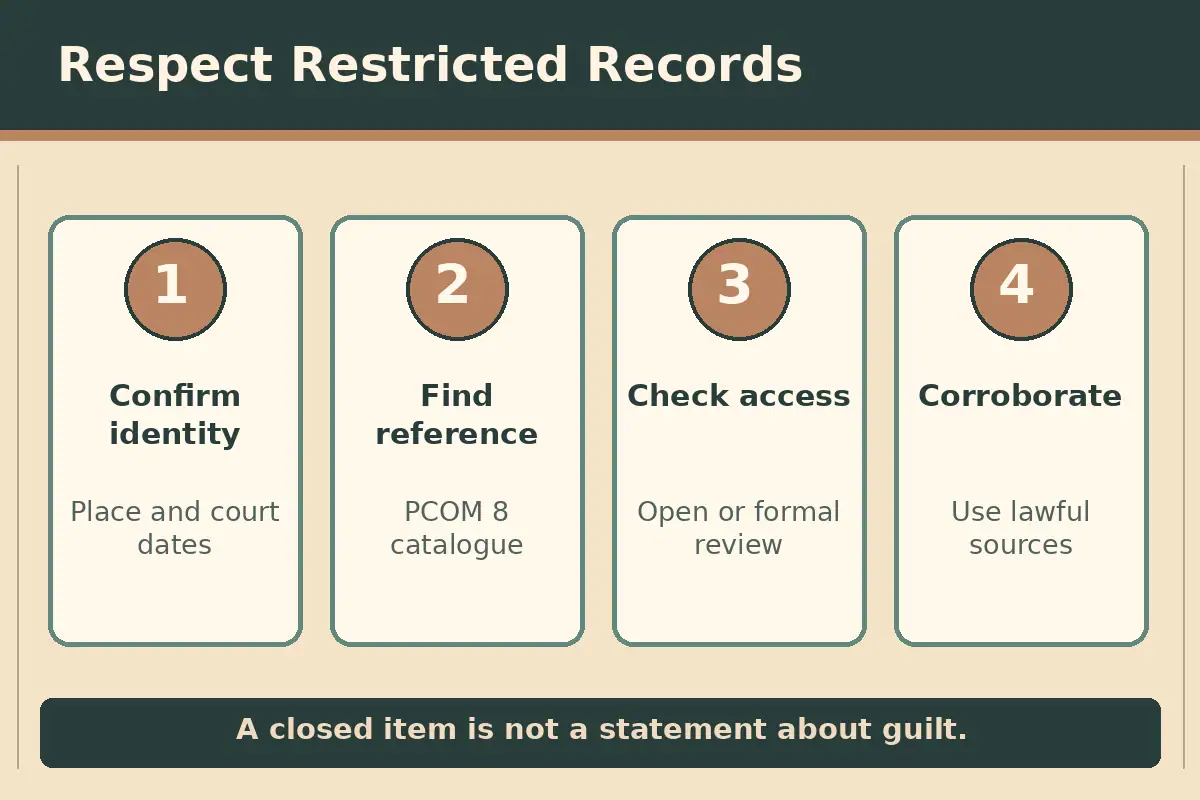
Recent criminal justice records can be closed for privacy and data protection. The archive says that a closed Discovery record may offer a ‘Submit FOI request’ option; this is a formal review route, not an entitlement to immediate disclosure. Do not advise searches designed to expose private medical details, names of protected individuals or personal identifiers from inaccessible materials. First establish a credible archival reference and find out which information is already lawfully open. A restriction is about access, not a judgment on a prisoner’s character.
A request under the Freedom of Information framework may need the full item reference and purpose; the archive decides any disclosure or redaction under applicable rules. Do not promise a successful release or an exact processing time. If an item remains closed, make a note of its catalogue description and access status, then move to lawful contemporary sources: local court orders, public trial notices or independently available civil records. Avoid implying that the closed file contains information the researcher has not seen.

Separate Official Reports from the Conviction
A Prison Commission case file and a court’s case papers have distinct administrative origins. A prison officer’s memorandum may concern custody conditions or behavior; a judge’s sentencing decision establishes a different event. Build an evidence matrix with DOCUMENT, AUTHOR, DATE, CLAIM and ORIGINAL-SOURCE STATUS. If a later official summary says the person had an earlier offence, locate the corresponding court record before treating the claim as a verified historical conviction. Many files will not contain a complete sequence of court proceedings.
Names can be re-used or misspelled; compare age, date of trial, prison, occupation and any lawful identifiers actually available. An offence label from a newspaper can differ from a formal charge or conviction; preserve both with provenance. Where two files mention the same person, a shared location and surname alone are insufficient to merge them. When reporting sensitive histories, minimize unnecessary personal information and refrain from turning institutional categories, diagnoses or accusations into conclusions about descendants.
Make a Documented Negative-Search Decision
Not finding a PCOM 8 item proves only that the search did not locate a surviving identifiable file under the examined criteria. Check whether the person was held in a local rather than a national institution and whether the relevant years or case type are represented. Search alternative variants and confirm that catalogue indexing could expose a name at item level. The archive explains that most prison records were not centrally preserved as individual dossiers. Some may remain with institutions or regional record offices.
Create a concise negative-search record: target identity, known court and dates, series examined, variant spellings, open items consulted and closed items not inspected. Then choose a different source class such as a prison register, county calendar or court paper. Do not read a lack of results as proof of innocence, absence of imprisonment, release date or erasure. Keep open-source findings separate from private family claims and leave living persons’ information out of published illustrative examples.
More Records and Archives Guides
How We Research Restricted Prisoner Papers
We route each claim from the relevant prison and court to its surviving record class. We first determine whether a PCOM 8 description exists, then check access conditions before reading an open file or considering an appropriate formal request. Our evidence ledger separates court outcome, reported allegation, prison administration and independent family identity. If the original cannot legally be consulted, we label the result ‘not accessible for this review’ rather than reporting invented contents or a blanket no-record conclusion.
The National Archives’ prisoners and convicts guide identifies PCOM 8 and explains the gaps, and its prisoner and staff guide describes the prison-first search method. Use a file’s current Discovery access notice for any actual request. Our affiliate disclosure explains site practices. We do not recommend circumventing archive restrictions to obtain sensitive genealogical records.
No. The series contains only some individual files and is not a nationwide register.
No. Closure is an access status and says nothing conclusive about guilt or the record’s exact contents.
Where the archive offers it, a formal FOI request may be considered; disclosure is not guaranteed.
Check original prison registers, county trial calendars and relevant court archives.
No. Attribute the allegation and corroborate the legal outcome from the proper court record.