
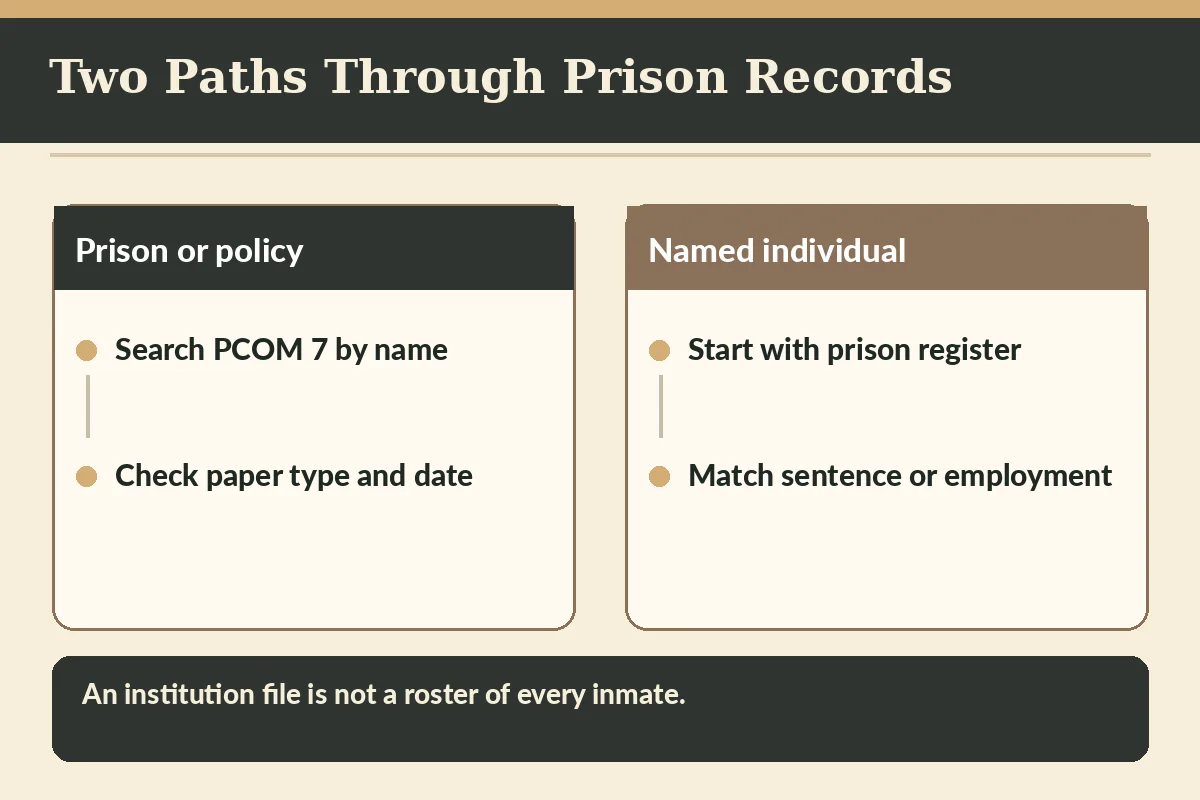
Prison Commission series PCOM 7 concerns the business of running prisons and borstals, including records about administration, treatment and staff. The National Archives describes its span as 1838–1938. It is valuable for reconstructing institutional decisions, but it is not a comprehensive index of everyone imprisoned in a named building. An instruction about food, labour, medical care or staffing does not prove that a specific inmate received that treatment. Start with the prison and document creator before making claims about a person.
Prisons had different authorities and recordkeeping arrangements. The Archives distinguishes centrally managed convict prisons from older local gaols, whose surviving records may be in local or county archives. The Prisons Act 1877 brought local prisons under a central Prison Commission, but an earlier file’s creator need not have been that body. Note the dates of the institution, its name changes, and who was accountable for it at the time. The name of a prison can also refer to a physical site, an administration and a changing inmate population.
Identify the prison and governing authority
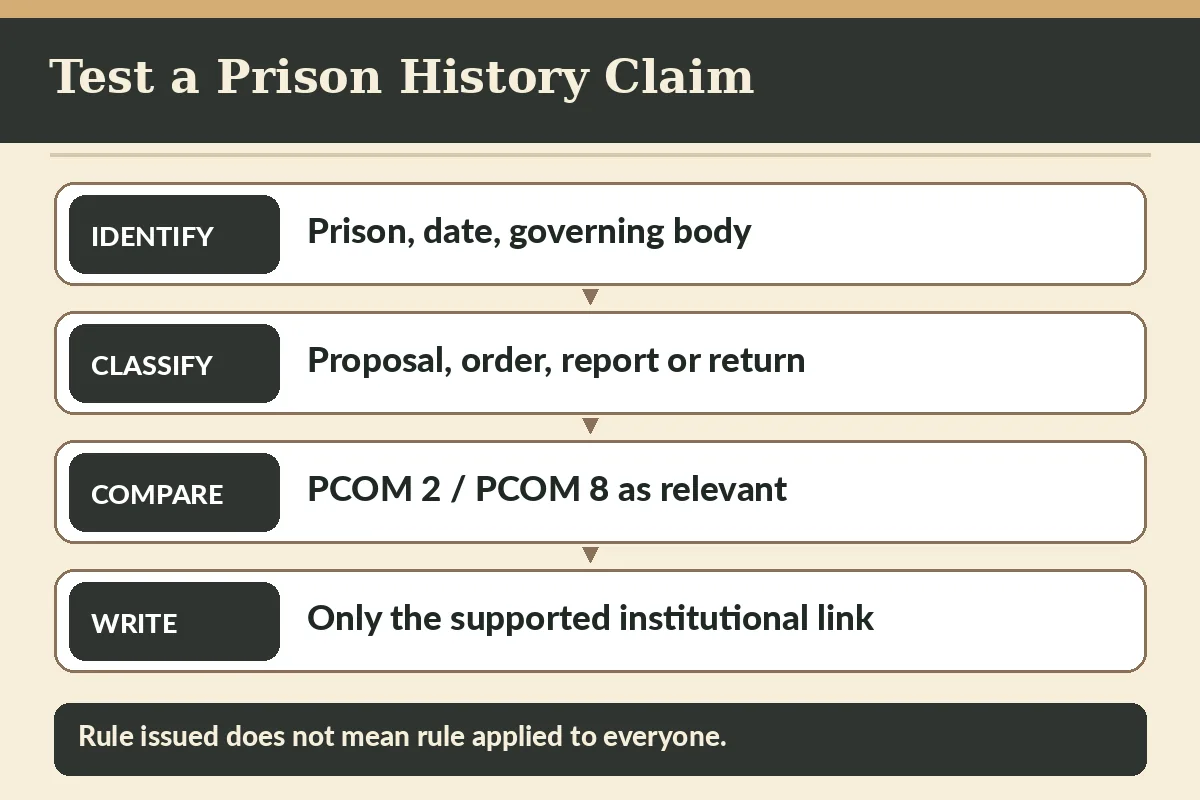
Search Discovery with a prison name, variants and practical management terms such as staff, discipline, clothing, health or buildings. Restrict to PCOM 7 only after testing a broader prison-name query. The Archives’ prison guide also points to PCOM 2 for minute books and journals, PCOM 9 for later administrative files, and PCOM 13 for expenses. Each series exists for a different documentary purpose. A correspondence reference and an expenditure entry should not be treated as successive steps in every case.
Copy the full catalogue reference and the description’s date range, then verify the actual documents. Much prison administration material is not digitized; the Archives describes visiting Kew or ordering copies as common routes. Search results can include records held by other archives, so check the ‘Held by’ field before requesting a file. If you only have a piece-level summary, avoid writing that a particular prisoner was disciplined, employed or medically treated on the basis of that summary.
Read policy documents as administrative evidence
Classify every item as a proposal, instruction, report, internal minute, inspection, financial record or record of an observed event. These categories answer different questions. A memorandum recommending a new diet establishes a recommendation; a circular may establish an instruction; a dated local return may provide evidence of practice. A later complaint could contradict an official statement. Preserve the exact speaker and date rather than blending several levels of authority into the sentence ‘the prison did this.’
Institution policy also has a geography. Identify whether a paper applies to all establishments, a named prison, a wing or a particular class of inmates. A national policy may have exceptions, implementation delays or local variation. Check whether the period covered by the file overlaps the dates relevant to a particular prisoner. Do not project a 1900 rule backward to an 1870 imprisonment merely because the same institution name appears in both records.

Test whether a rule was carried out
If a file concerns staff pay, welfare or pensions, its administrative coverage does not necessarily list the appointments of all officers. The prison guide identifies some separate staff sources, including appointment books in HO 160 for 1887–1898, limited registers within PCOM 2, and retirement allowance registers in PMG 28. These can help test an officer’s actual position. But a name in a policy dispute could be an applicant, correspondent, witness or officer in another service; check rank and workplace.
The physical building can change as policy is implemented. The Archives advises searching Office of Works records for some prison plans and alterations. A plan proves that someone drew or submitted a design, not that every wing was constructed, occupied or in use on a given night. Compare dated building records with inspection reports and independent maps if the issue is capacity, cell layout or relocation. A name in the heading of a building file is not an address for the inmates who later occupied it.
Follow a named prisoner or prison officer
A named prisoner’s path should be researched separately. The Archives’ prisoners and convicts guide points to registers, court calendars and individual prisoner files, including some PCOM 8 material. These sources may establish conviction, sentence, admission or transfer, depending on the document. They have their own gaps and closure rules. A person’s absence from PCOM 7 is normal, because the series is not designed as an individual roll. Do not fill that absence with invented inmate stories.
Keep a joined timeline with two columns: institutional policy dates and independently documented personal dates. Suppose a PCOM 7 file says a prison introduced a work program while a prisoner register records someone admitted in the same year. The juxtaposition creates a research question, not proof that the prisoner did that work. Seek rosters, registers, diaries or other direct records, and state when the link cannot be made.
An administrative document may also contain allegations about a member of staff or an inmate. An investigation request is not a disciplinary finding, and a finding is not necessarily evidence of every claimed incident. Read endorsements and later responses. For sensitive history, quote only what is documented, avoid needless repetition of allegations, and label uncorroborated statements as such. The goal is an accurate account of power and recordkeeping without turning archival gaps into a biographical judgment.
For a durable citation, save the piece reference, folio or page, date, institution, document kind and creator. Explain whether the words come from an original, a copied circular or a catalogue description. Maintain a separate search log for individual records and for institutional records. A negative search in one series says only what was searched. It does not establish that a prisoner was never there, an officer never served, or a rule was never used.
More Records and Archives Guides
How We Research Historical Prison Files
We checked The National Archives’ prisons and prison staff guide for PCOM 7’s role, dates and related management series. Its separate prisoners and convicts guide identifies person-oriented evidence and warns that some records may be closed. Those two guides support different routes; neither supplies an unnamed individual’s prison history.
Our method labels each source by institution, authority and intended purpose. We do not convert a proposed policy into observed practice or a case file into proof of criminal guilt. Every claimed person-level link requires its own citation. For transparency about the site, see the affiliate disclosure; no commercial prison database access or historical outcome is implied here.
A Prison Commission collection covering administration of convict and local prisons and borstals; the Archives dates its materials to 1838–1938.
No. Use prisoner registers, court records and, where appropriate, individual files such as PCOM 8.
No. Compare the dated rule with local implementation and direct personal records.
Some staff-related papers are present, but cross-check appointments or payments in appropriate staff records.
No. The Archives indicates that much of its prison administration material requires a reading-room visit or copy order.