
ADM 44 is a Royal Navy seamen’s effects series: records of claims concerning money or effects owed after a sailor’s death. The National Archives lists it separately from seamen’s wills in ADM 48 and officers’ effects papers in ADM 45. Claims can preserve useful names and family leads, but the existence of an applicant does not establish that the applicant was legally entitled, biologically related or resident with the deceased. The careful question is who claimed what, on what evidence, and what response the file actually records.
A naval effects record is not the same as a continuous-service record. It may include the deceased man’s identifying details, a ship connection, correspondence from an applicant, supporting certificates or administrative endorsements, depending on the surviving papers. Do not assume that every file holds all of these. Separate the sailor’s death from the claim date and from a payment date, if one is shown. Family memories often merge those events into one date, but the paperwork can span a considerable administrative interval.
Identify an effects claim before using a will
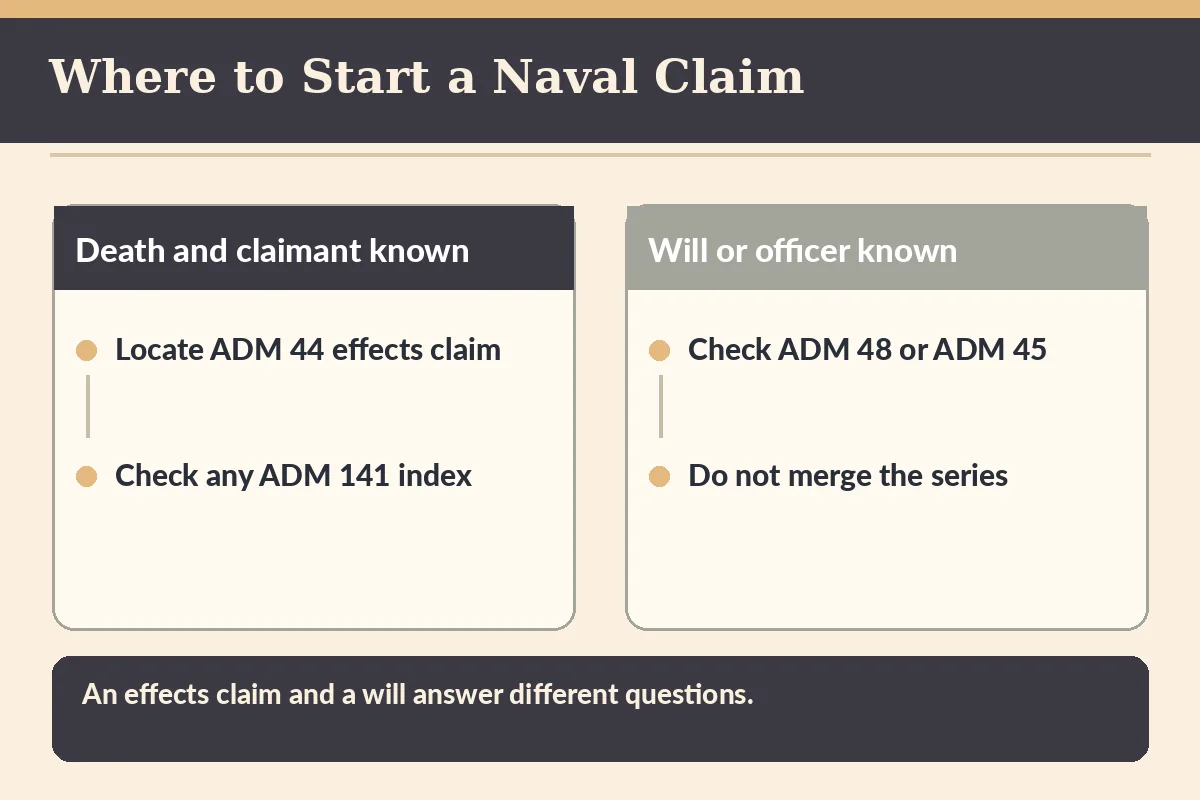
Begin with the seaman’s name, likely date of death, rank or rating and vessel if known. A specialist naval research source identifies ADM 141 as an index route to ADM 44; verify the reference against the actual entry and note how the index is arranged. The National Archives’ will guide points readers to ADM 44 among alternative holdings when looking beyond ADM 48. Neither an index entry nor a search result substitutes for the claim papers themselves. Keep variant initials and ship names as separate leads.
Distinguish ranks and record systems before choosing a file. The Archives names ADM 45 for officers’ effects and ADM 44 for seamen’s effects; a warrant officer’s original will may be found among ADM 48 material. A Royal Marine could appear in related Admiralty records, but a generic naval surname search cannot settle which service or rank applied at the relevant date. Record what the document itself calls the man and check that against a dated muster or service source when possible.
Distinguish an applicant from a proven heir
Read the applicant’s words closely. A person may describe herself as widow, mother, sister, executor, creditor or next of kin. That is an assertion in an application unless the file supplies independent evidence. A note showing that a document was received may verify submission, not legal acceptance of every relationship named on the form. Separate the claimant’s stated connection, the supporting certificates provided and the office’s decision. Do not turn a creditor into an heir merely because a payment was requested.
Some claims were supported by civil or ecclesiastical documents such as marriage or baptism certificates, as the naval records guide notes. Examine who those documents identify and whether they relate to the correct sailor. A certificate attached to one claim does not prove that the applicant described the entire family correctly, and a copy’s presence does not ensure that an inheritance dispute was resolved. Transcribe names, dates and parishes rather than silently assigning a family tree link based on a shared surname.

Compare ship and sailor identifiers
A will may give additional clues about intended beneficiaries, but an ADM 48 will and an ADM 44 effects claim answer different questions. A will shows an expressed testamentary instruction at the date it was made. An effects claim records later administrative efforts concerning wages or property after death. The beneficiary named in an older will might not be the person applying later. Cross-reference only when name, rank, ship and chronology are compatible; do not assume every man left an ADM 48 will.
Ship names can be reused, and ratings may move between vessels. If an ADM 44 file references a ship, check whether the named man served on that vessel at the relevant date. Distinguish a ship attached to a will signed years earlier from the ship associated with a later claim. An Admiralty record may identify the last ship known to an office rather than document every posting. A naval muster or separate service record can help test continuity, but there may be gaps, spelling variations or incomplete transfers.
Test the claim with independent family records
An administrative outcome needs its own column. A clerk’s note may acknowledge receipt, request further proof, reject an application or direct a payment. These actions differ. If a file contains only a claim and no final decision, do not assert that money was paid. Likewise a claim for unpaid wages does not establish the amount ultimately disbursed. Distinguish requested sum, assessed entitlement and documented payment, noting where no figure or recipient can be established.
Treat the named claimant’s address as a dated administrative address, not automatically the sailor’s last home. An applicant could have moved, acted through an agent or written from another household. Compare any attached civil record with local registers and household sources, using age, parish and family connections. A shared surname and same county are weak evidence when several sailors served over decades. Build the individual identity through multiple matching features, not an attractive but untested narrative.
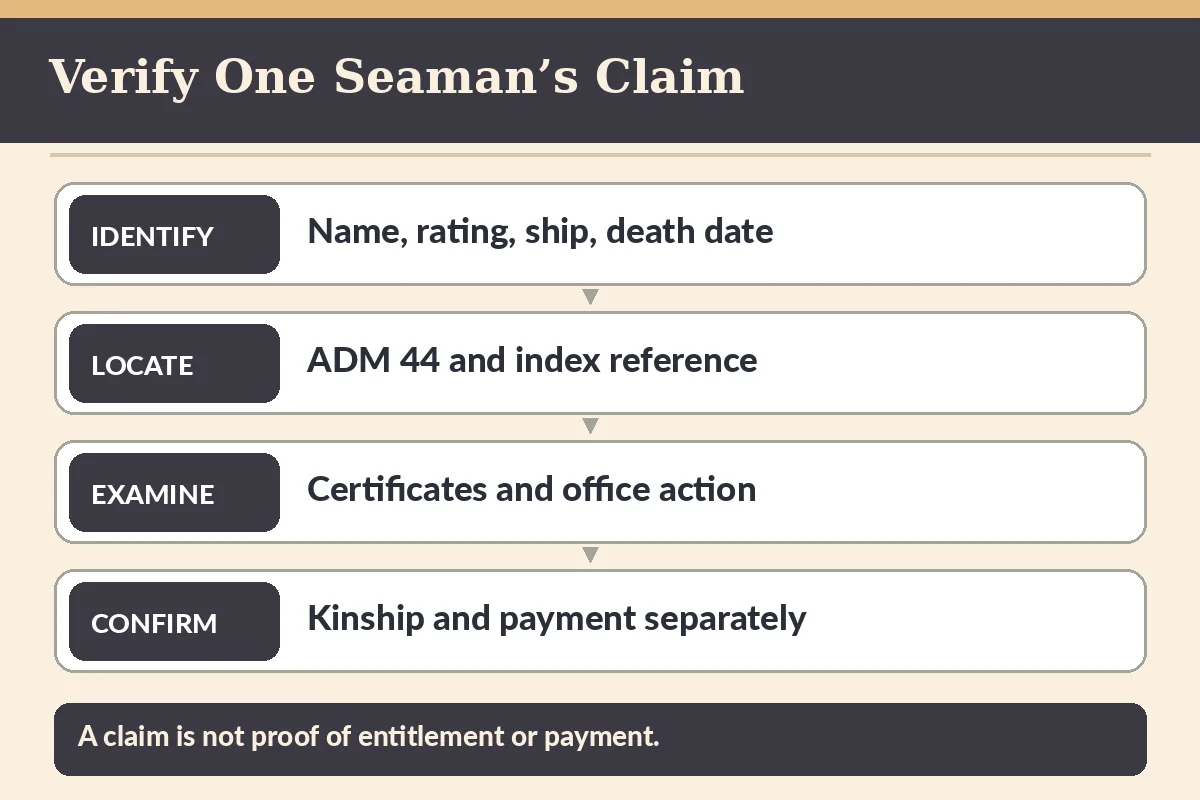
Imagine a widow’s application naming a man and a ship, with a marriage certificate enclosed. The application is evidence that she sought an effect or wage payment and made a stated relationship claim. The certificate may independently link a couple if the identities match, while an administrative note may establish the office’s response. None of those elements necessarily proves that the sailor served continuously aboard that ship or that every relative named in family tradition was an heir. Write each supported statement separately.
The final research log should list the ADM 44 reference and page, any ADM 141 index pointer, the man’s identifying details, each applicant and evidence supplied, and any documented decision. Add a separate line for the ADM 48 will only if one has actually been found, with its own date and reference. Keep failed searches and alternative spellings. A precise statement that a relative applied is valuable even when the applicant’s entitlement or the payment outcome remains unknown.
More Records and Archives Guides
How We Research Naval Effects Claims
We checked The National Archives’ Royal Navy and Royal Marines wills guide for the distinction between ADM 44, ADM 45 and ADM 48, and the Royal Marines other ranks guide for adjacent probate and service routes. A specialist naval-records reference describes ADM 141 and possible supporting certificates. These resources identify where to look; they do not establish an unseen claimant’s identity.
Our editorial approach keeps claims, submitted proof and administrative outcomes distinct. We do not infer biological kinship from the word ‘next of kin’ or successful payment from an application form. Any family link needs the source that actually proves it. The site’s affiliate disclosure explains relationship transparency; no historical result or paid record service is implied.
Seamen’s effects papers about claims for money or property following death, distinct from a full naval service record.
ADM 48 preserves original seamen’s wills; ADM 44 concerns later claims and administrative evidence about effects.
A specialist naval records guide identifies ADM 141 as an indexing route; verify every reference against the original papers.
Not without corroboration. Separate an applicant’s description from documentary evidence of the relationship.
No. Look for an explicit decision, account or payment notation rather than assuming the request was granted.