
FO 383 contains Foreign Office correspondence from the First World War’s Prisoners of War and Aliens Department, 1915–1919. It can preserve inquiries and reports concerning people held abroad, including British subjects and civilian internees. It is not a complete roll of everyone taken prisoner. Researchers should begin with a name and wartime context, read the exact file description, then separate a family’s request for news from any subsequent official statement about the person’s location or fate. The National Archives explains that some reports survive in FO 383 even where related WO 161 interview pages are missing. That makes FO 383 a distinct correspondence problem, not a replacement for every military service file.
Decide What Kind of Captivity You Are Investigating
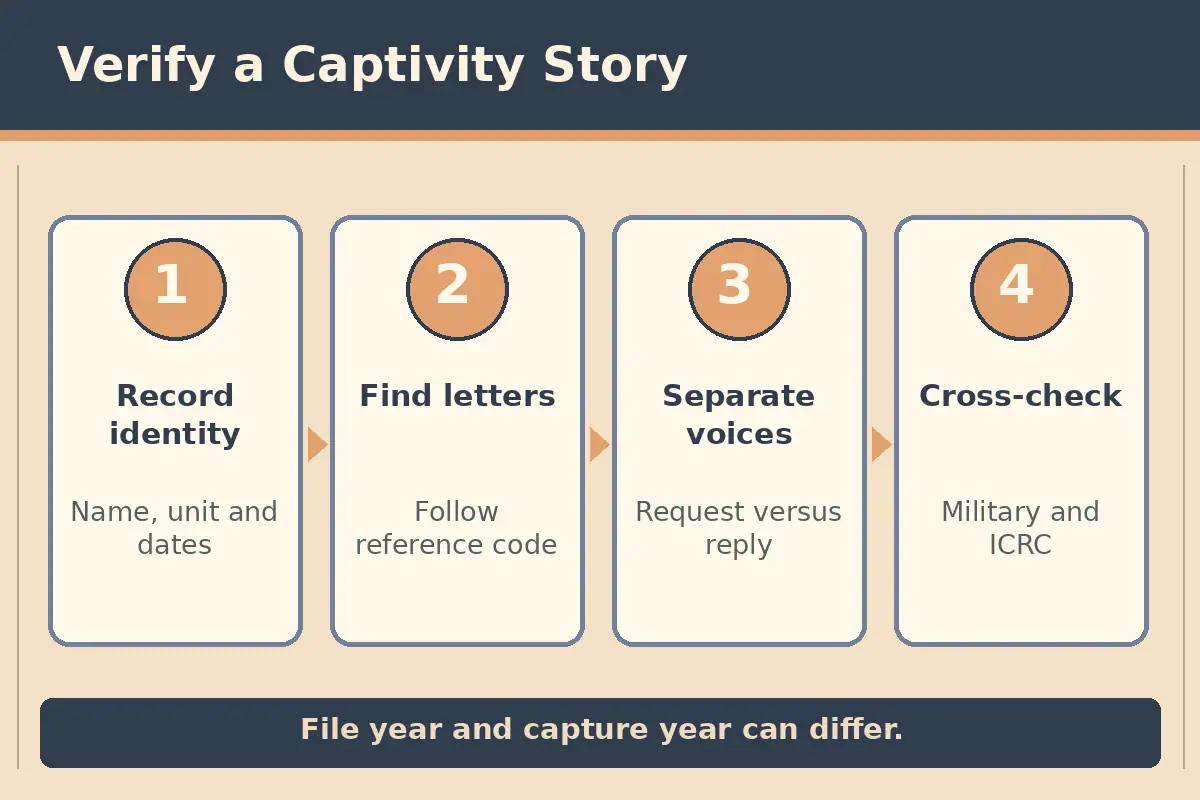
Begin with the original words used in a letter, Red Cross notice, local newspaper or family history: captured soldier, missing officer, civilian internee, or merchant seaman held abroad. Those are different circumstances and may have different record trails. FO 383 was created by a Foreign Office wartime department and covers correspondence, not a single military detention database. Make a dated factual summary with nationality, service or civilian status, last known location and reported captor. Do not replace ‘missing’ with ‘prisoner’ before the record provides that evidence.
The National Archives’ internees guide identifies FO 383 as a name-searchable series for correspondence concerning British subjects abroad during 1915–1919. Its British POW research guidance also points to FO 383 for surviving First World War reports. Search by full name in quotation marks, then try initials, spelling variants and relevant places. A result may be correspondence about an inquiry rather than an actual detention entry; read the title carefully and obtain the file where permitted.
Use the Foreign Office Card Index and Department Codes
The 1906–1919 Foreign Office correspondence system used distinctive departmental number prefixes. For prisoner correspondence the wartime code was introduced in 1915. The National Archives’ Foreign Office guide gives a worked scheme: a country’s political number could be prefixed to identify commercial, consular, treaty or prisoner papers; the prisoner code appears in its wartime table as 1218 for Germany. Numbers are filing keys, not dates of detention or military unit numbers. Copy the precise printed or handwritten card entry before seeking a file.
If a card directs you to FO 383, search that series for the original file or use the correct reference conversion; do not infer the content solely from the card. A card may mention a person once because the correspondence related to an inquiry, transit, an appeal or a change in legal status. Different people with similar names can appear across related records. Record the code, year, full FO reference, sender and recipient, and whether the document is a filed original or a catalogue abstract. This separates a finding aid from a primary source.

Read Requests, Reports and Replies as Different Claims
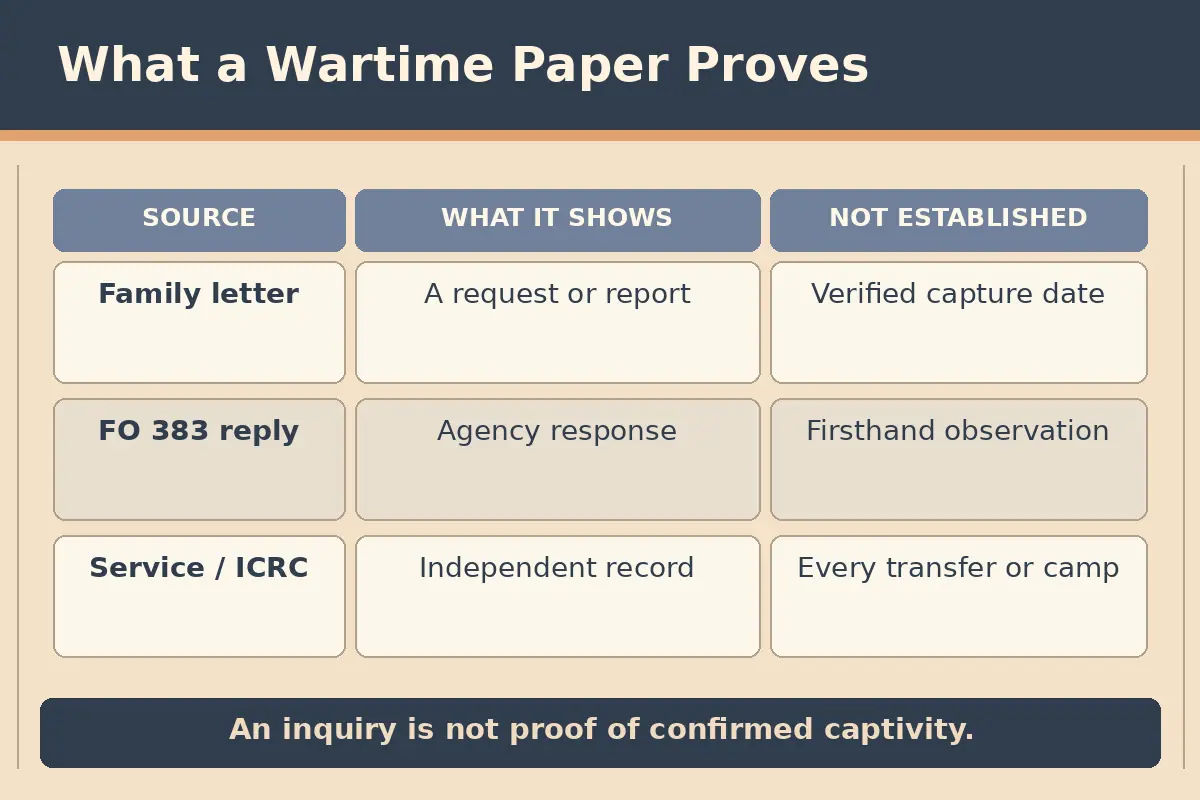
Open the correspondence in original order where possible. Label a letter from relatives as a request, an intelligence message as a report, and an official reply as a response. The existence of a request does not establish the truth of every statement in it. Look for date written, date received, references to earlier letters, the capacity of the author and any named camp or exchange destination. A government reply may relay information received from another agency rather than a firsthand observation of the prisoner.
Build three independent fields: WHAT WAS REPORTED, WHO REPORTED IT and WHAT IS CORROBORATED. An address in a letter may be a family contact and not where the captive lived at the time. If several letters disagree about a capture date, preserve the disagreement and seek unit records or Red Cross evidence. A document about repatriation arrangements may concern a group, not the completed return of a named individual. Even an official notification can require later verification where names or camp transfers were confused.
Compare the International Red Cross and Military Sources
The International Committee of the Red Cross holds substantial records on First World War prisoners; the National Archives cautions that no complete British and Commonwealth POW list survives at Kew. An ICRC card, a service record and Foreign Office correspondence were created for different purposes and have distinct coverage. Compare birth details, unit or rank, captivity location, dates and known relatives. If the names match but unit information does not, retain competing candidates instead of merging both files into one biography.
Officers were required to report the circumstances of capture on repatriation, and some reports survive within their military service records or WO 161; other ranks are far less fully documented. The archive notes that some missing pages of WO 161 are represented in FO 383. That does not mean every absent WO 161 item has a duplicate. Treat the three repositories as alternative evidence routes, not a guaranteed chain of documents. Keep a record of whether a source is an application, an external list, a personal recollection, or an independent military return.
Check Dates, Custody and Access Before Concluding
Search the actual year in which correspondence was filed; a 1917 letter may discuss a capture in 1916. Use the filed reference to request documents or consult them at Kew, since being searchable in Discovery does not guarantee digitized full text. Some related content may be on commercial websites, but the National Archives remains the custodian of the FO references. When a name cannot be found, widen to correspondent names, unit, country, camp and code. Save every variant and date interval searched.
For each candidate prepare a four-line conclusion: verified identity, reported captivity, source of confirmation, and unresolved dates or places. Avoid publishing private details of potentially living descendants mentioned in later correspondence. A search failure may reflect wartime loss, indexing limitations or an unfiled query, not a wartime claim proved false. A strong citation includes FO 383 piece, document date, correspondent and page or file item, followed by an explanation of what the particular line proves.
More Records and Archives Guides
How We Research a Wartime Inquiry
We start with a documented identity and distinguish civilian internment, military captivity and missing-person inquiry. We search FO 383 by person and year, use the Foreign Office correspondence code system where a card exists, and read all available letters in sequence. The evidence table labels each assertion as reported, officially relayed or independently verified. Military files and ICRC records are compared only when identifiers agree; they are not automatically the same person’s history.
Our principal guides are The National Archives’ Foreign Office correspondence key, its internee guide and the interview-report guide. They explain where to seek original documents, not the truth of a particular prisoner story. We record unreturned letters and lost files as unknowns. Our affiliate disclosure applies to outbound links; archive results must be assessed independently of any access provider.
No. A file may be an inquiry or a reported sighting. Examine the dated correspondence and independent confirmation.
It identifies a correspondence class in the wartime filing system, not a prisoner number or capture date.
No. The survival and indexing of wartime records are incomplete.
Yes. The correspondence includes certain civilian internment inquiries as well as military cases.
Record each reporter and date, then compare military or ICRC evidence without silently choosing one.