
PIN 26 holds a surviving sample of British First World War disability and dependents’ pension case files. The National Archives says only about two percent of these case files were kept permanently, including awards and refusals. The collection does not operate like a complete index to everyone wounded, bereaved or pensioned. A useful search starts by asking whether the claimant was a disabled service member, widow, dependent or another eligible person, then checks both the name and relevant medical or administrative terms. Each discovered file must be read as a sequence of claims and decisions, not as a single certificate of war service.
Understand the Two-Percent Survival Limit Before Searching
The archive’s official pensions guide identifies PIN 26 as a representative two-percent sample containing more than 22,000 case files across army, navy, air force and related claimant categories. The records may include applications from much later than the war, and some supporting documents from before 1920. Do not describe PIN 26 as a 1914–1918-only register. The date of an application, the date of service, the date of a medical examination and a decision or appeal may be separated by years or decades.
The survival rate changes the meaning of a negative search. A missing file tells you that the consulted retained sample produced no matching case, not that the person received no pension, suffered no disability or had no dependents. Make a search log stating which names, units, categories, date ranges and spelling variants were checked. A family might have several relevant claimants whose surnames or residences changed after a service member’s death. A spouse’s later marriage can create an additional index challenge, but the file should never be forced to fit an unsupported family story.
Search Names and Disability Terms in PIN 26
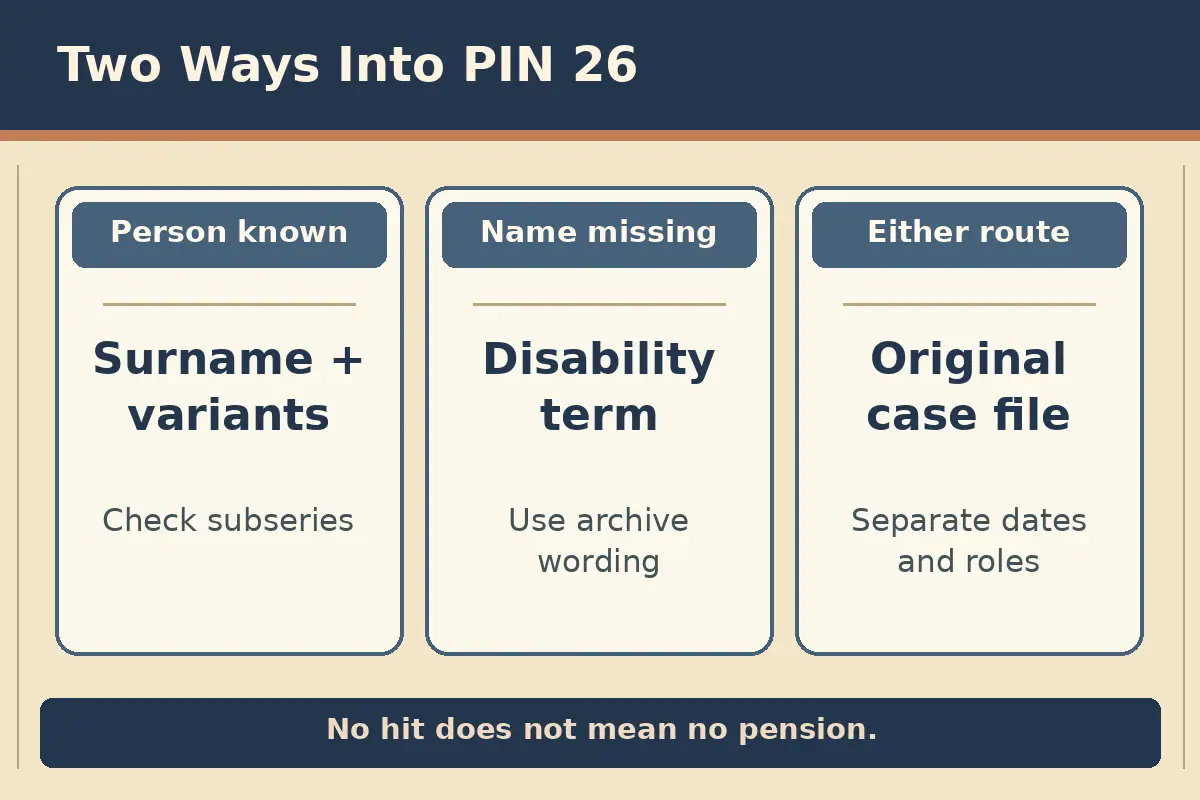
Begin in the PIN 26 catalogue using a soldier’s or claimant’s surname, alternate spelling, initials and any service number already verified elsewhere. The National Archives warns that not every description contains the claimant’s name. If the name search fails, search the disability or issue named in other evidence. The guide lists historical abbreviations such as GSW for gun-shot wound, TB for tuberculosis, POW for prisoner of war and DAH for disease of action of the heart. Use such terminology as a catalogue search aid, not as a medical diagnosis.
The hierarchical catalogue view groups some files into categories such as widows and Navy. Browsing a relevant subseries may find a case that an ordinary search missed. Some descriptions mention selection codes, for which a key is available in the printed PIN 26 binder in Kew’s reading rooms. Record the full PIN 26 piece reference and the words used in its catalogue description before trying to inspect the case. Access to a description or thumbnail is not the same as having seen all pages of the claim file.
Read Application, Evidence, Decision, and Review as Separate Events
A file may include a service member’s own statement, a doctor’s report, letters from employers or relatives, official assessments, award notices, refusals and later correspondence. For each page label its function and author. A statement that injury began in a particular battle may be testimony rather than independently confirmed operational history. A medical report can establish the opinion documented at examination, but it is not proof of an unexamined earlier event. A decision records what the pension authority decided, not necessarily the definitive truth about every allegation in the application.
A strong research table includes the date of the claim, claimant’s identity, reported disability or family relationship, supporting source, authority’s response, and any later review. Note a rejected application alongside an allowed one; do not quote an amount without identifying whether it was proposed, paid or altered. Some pensions changed as disability assessments or household circumstances were reevaluated. The mere presence of a widow or dependent classification should be tested with a marriage or birth record before a genealogical relationship becomes settled fact.

Compare Pension Testimony With Military and Civil Records
The First World War army guide points to other service and medical collections that may complement PIN 26. A pension reference may contain a verified regiment or service number worth following into the appropriate surviving service record, medal roll or unit diary. However, an army unit’s diary speaks primarily about the unit and cannot identify an individual at every event it describes. A pension medical assessment also has a different evidentiary function from a hospital sheet in MH 106; neither one automatically explains an injury’s cause without corroboration.
For a widow’s claim, compare reported marriage and death details against civil or church records; for a dependent, identify the claimed relationship before assuming legal entitlement establishes biological parentage. Use probate, census and contemporaneous addresses to distinguish people sharing a surname. Maintain a source column for each date so that a later recollection cannot displace a surviving contemporary entry without analysis. If multiple claimants appear in a case, note who supplied each statement and whether the pension authority was testing their identity or another eligibility criterion.
Know What Other Pension Sources Can and Cannot Replace
Pension index cards and ledgers may provide much wider clues than the rare surviving narrative files. The Western Front Association has explained how these collections relate to the retained PIN 26 files. They are complementary, not interchangeable. A card can indicate that a case existed while the detailed papers were destroyed; a retained case may give context missing from a brief card. Do not assume every card has a complete surviving file, nor that an unlocated card proves the claimant never existed. The archive system records administrative actions at different stages.
Create a cross-reference column containing any pension number, service number, regiment, claimant address and dated administrative notation. Every cross-reference should be copied literally; a similar number on a different type of record might refer to an entirely different system. A card’s indexed claimant name can differ from the person whose service generated the benefit. Record that relationship explicitly. When identifying a widow or dependent, keep a separate identity worksheet for the veteran and the claimant rather than merging them under one household profile.

More Records and Archives Guides
How We Research PIN 26 Without Treating Silence as Proof
We first decide whether the research question concerns service-related disability, a widow’s pension or a dependent’s pension, then consult the surviving PIN 26 hierarchy and the name or disability search. Next we inspect the original case where available, identify the applicant and all witnesses, and compare the recorded claim with independent wartime and civil evidence. We preserve both granted and refused outcomes and attach a date to every medical or administrative assertion. This method can reveal genuine contradictions without turning the archival sampling process into an imagined family event.
The army research guide is useful for deciding what military evidence to seek when PIN 26 is incomplete. Always verify current online access and catalogue descriptions with the repository; terminology and digitization may change. These records can discuss sensitive medical conditions, and historical language is quoted only with its source context. The GenHis affiliate disclosure explains our site policy; the archive route does not depend on buying a commercial product.
No. The National Archives retained a representative sample of roughly two percent of pension case files.
Yes. Cases could be reviewed or submitted years after the war; the retained papers may span decades.
Try variants and relevant disability terminology, then browse the appropriate PIN 26 subseries. The catalogue does not name every claimant.
It documents the application and its supporting evidence. Compare reports with independent service and medical records.
No. Sampling, cataloguing differences and loss of original files prevent that conclusion.