
To investigate a War of 1812 pension claim, locate the veteran in the National Archives M313 index, record the claim number and request or view the corresponding file. Many claims were made decades after 1812–1815, especially under the laws of 1871 and 1878. A pension affidavit can contain valuable marriage clues, but late recollections should not be treated as contemporaneous service records.
Know Why War of 1812 Pensions Were Filed Later
The War of 1812 took place from 1812 to 1815, but many surviving federal pension applications were filed much later. Earlier pensions chiefly related to disability or service-related death. Under 1871 legislation, many veterans of federalized state volunteer forces became eligible for pensions based on service, and a later 1878 law further broadened eligibility.
Widows could apply under the relevant conditions too. This time gap matters: a person submitting testimony in 1880 may have been recalling events from more than sixty years earlier. Keep separate dates for military service, marriage, petition, examination and final pension action. A declaration’s date is not automatically the date of the service it describes.
Start With the Alphabetical M313 Index Cards
NARA’s M313 pamphlet explains that the microfilm index reproduces faces of envelopes for pension applications and cross-reference cards. It is arranged alphabetically under veteran names and may show claim numbers, alternate spellings and occasional substitution references. Search surnames and initial variants before concluding no file exists.
Copy the entire recorded claim or certificate number and any cross-reference, not merely the soldier’s name. An M313 entry identifies a file route; it does not transcribe every affidavit inside the case. A single name may lead to several papers filed by a veteran or surviving family members.

Distinguish M313 From T316 and M848
NARA distinguishes several relevant index routes. M313 relates principally to War of 1812 pension application packets. T316, the Old War pension index, includes earlier death- or disability-based cases and Regular Army service; M848 is for War of 1812 military bounty-land warrants dated 1815–1858.
A veteran could appear in more than one stream, and bounty-land papers were sometimes consolidated into a later pension packet. Other bounty applications remained in distinct files. If M313 lacks a name, inspect T316 or bounty-land records where the person’s service type and research question justify it. Do not treat the three indexes as interchangeable evidence of pension approval.
Find the Original Claim Packet From an Index Lead
The National Archives pensions guide identifies War of 1812 pension and bounty-land claim files in RG 15, with selected applications available through its catalogue and other access channels. Once an index card gives a claim number, search the actual case and record which pages you inspected. The packet might include the applicant’s statement, service verification, marriage evidence, widow’s claim or correspondence about eligibility.
Some available online images are selections; an index hit is not the same as reviewing the full folder. Record the evidence source for every claimed relationship or date. If a file has several document types, cite each exhibit separately rather than attaching the index reference to a composite story.
Read the 1871 and 1878 Widow Eligibility Rules
The NARA historical research article explains that the 1871 law generally required longer service, and early widow eligibility depended on a qualifying marriage before the peace treaty was ratified in February 1815. In 1878 the legislation allowed shorter qualifying service and removed that marriage-date provision.
An unsuccessful 1871 claim followed by a later petition need not indicate the marriage was fictitious or service was false; the legal rules differed. When a file reports a marriage date, identify whether the source is a surviving certificate, third-party affidavit or claimant’s recollection. The law explains why particular facts were requested, not whether every answer was historically true.

Use Widow Evidence Without Presuming Kinship
A widow’s application may report her maiden surname, marriage place, husband’s death, residence and children; some cases hold letters or supporting family documents. Classify each statement by its author, date and directness. A widow is often knowledgeable about her own marriage, but events occurring long before the application can still be misremembered.
An affidavit from a neighbor about a ceremony has different evidentiary value from an original register made at the time. Also check whether names were changed by remarriage or spelling practices. If the file lists a person as a child or dependent, seek an independent birth or probate document before establishing that link permanently in the family tree.
Separate Military Evidence From Pension Entitlement
Pension examiners sometimes sought service information from the War Department, but later entitlement depended on legislation, length of service, discharge, marriage or survivor rules. An approved pension is evidence of an administrative decision, while testimony about a specific battle may still need a contemporary muster roll. A rejected application similarly does not prove a person never served.
The user’s earlier B130-era general service-record workflows and M602 military indexes serve different purposes from this page: here the starting issue is the M313 pension claim and its family evidence. Compare unit details from the case to wartime rolls, but cite the two separately. Do not translate a pension number into a particular military engagement.
Test Two Veterans With the Same Name
Suppose John Miller occurs twice in a War of 1812 pension index. Do not select the entry with the closest county solely because later descendants lived there. Record each claimant’s unit, state, spouse, filing location, claimed dates and pension reference.
Compare a wartime muster or compiled service record, postwar census household and a contemporaneous marriage record. If one application names a wife whose age or marriage date conflicts with the proposed family, retain that candidate separately. It is common for a pension file to contain a family history reconstructed from memory; compare that account with records created nearer the event and explain any conflict instead of forcing agreement.
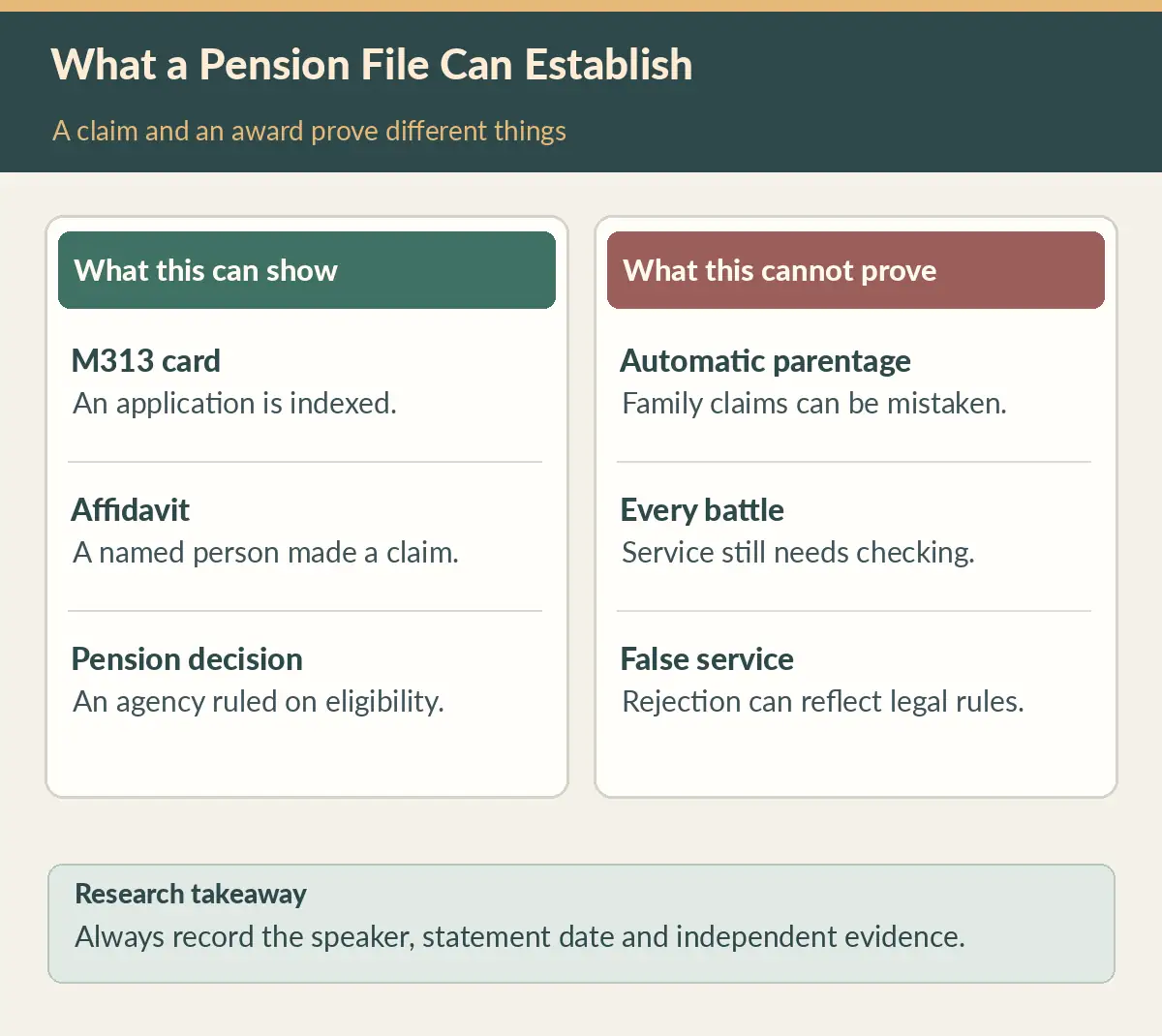
How We Research a War of 1812 Pension Claim
We record the person’s proposed wartime unit from independent evidence and search M313 under relevant name variants. We preserve every file number and cross-reference, retrieve available original claims, and classify each affidavit, examiner’s statement and ruling.
When relevant, we compare T316 and M848 rather than assuming those are duplicates of M313. We test marriage evidence against surviving civil or church registers and service details against military records before assigning the claimant to a family. Our affiliate disclosure documents editorial relationships; NARA catalog and microfilm identifiers remain the research anchors.
More Records and Archives Guides
Prepare a Source Citation and a Claim-Level Summary
For an M313 index entry, cite the National Archives, publication M313, veteran’s name, roll or image and indexed pension number. If the claim packet was viewed, cite RG 15, the specific case reference, applicant, document date and page or image, distinguishing it from the index. Create a table with four columns: statement, speaker, record date and corroborating source.
Record legal outcomes as administrative outcomes, not universal proof that each reported circumstance occurred. When a packet is unavailable or partly digitized, note that limitation. The finished finding should say exactly which spouse, service unit and claim number were verified and which family claims remain open.
It indexes War of 1812 pension application files and provides claim references.
Major federal service-based pension laws were enacted in 1871 and 1878.
No. T316 is the Old War pension index with a different claims scope.
Often, but each statement requires evidence appraisal and preferably corroboration.
No. Eligibility decisions and historical service evidence are different questions.