
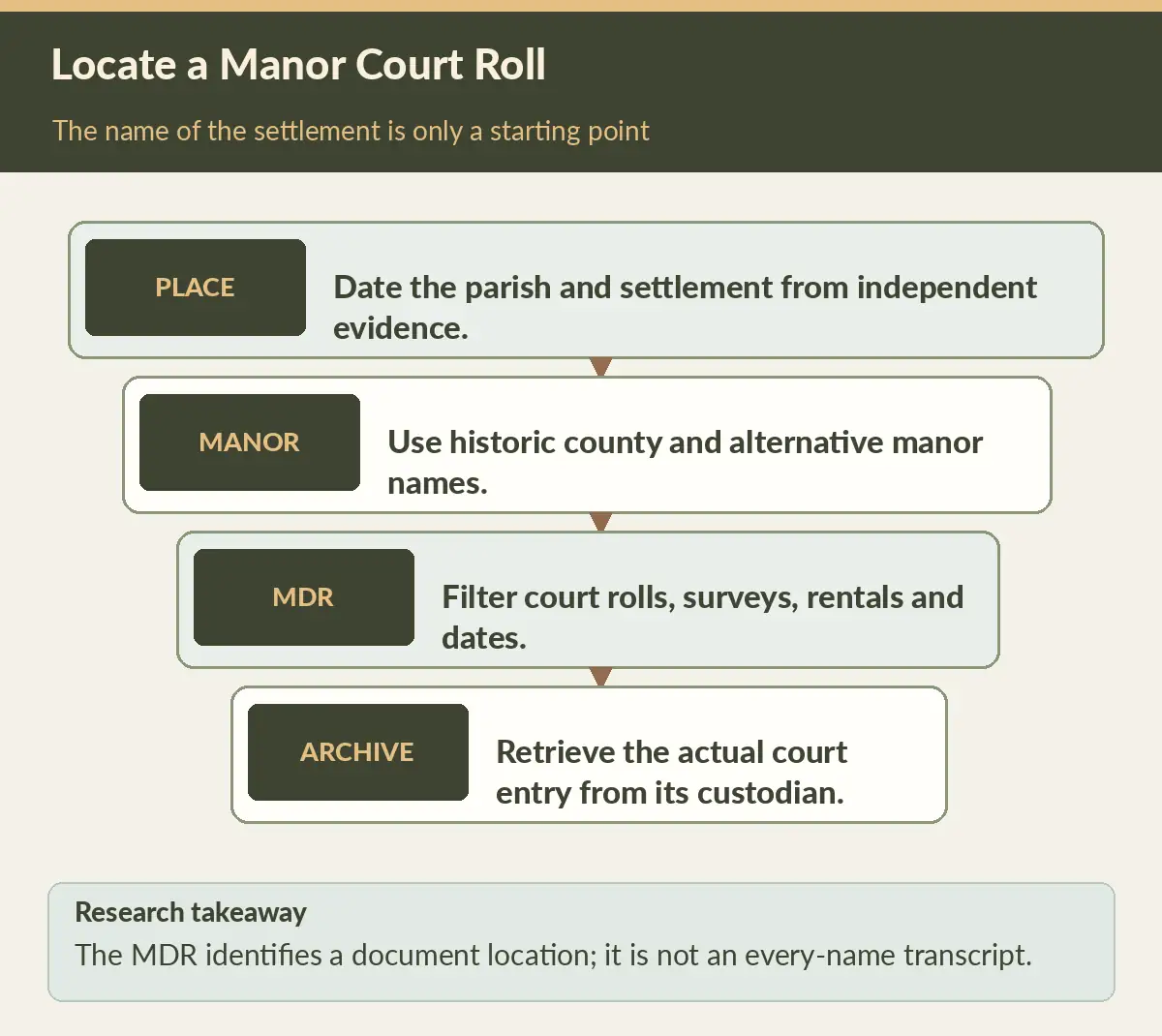
To find an English or Welsh manor court roll, start with a historically accurate parish and search the Manorial Documents Register (MDR) for the associated manor, document type and relevant dates. The MDR tells you where surviving records are held; it is not a transcript of everyone named in a manor and does not prove that an ancestor owned a particular home.
First Identify the Manor, Not Just the Parish
A parish is an ecclesiastical or civil locality, while a manor was a different historical administrative and property jurisdiction. The boundaries can overlap imperfectly, and a single parish might contain several manors. A manor may also encompass portions of multiple parishes.
Before searching, write down the settlement, parish, historic county and approximate date found in your earliest reliable family record. Compare contemporary spellings rather than starting with only the modern village spelling. An apparent failure under a parish name is not strong evidence that no manorial document survives. The MDR links parishes and associated manors, but each suggestion still requires checking the historical context.
Open the Official MDR and Choose the Search Mode
The official Manorial Documents Register offers searching by manor and by manorial document. Users can choose a historic county, standardized or alternate manor name, English parish, document type and year span. Start broadly enough to catch alternate naming conventions, then restrict once plausible results appear.
Record the exact form of the manor name and the location given by the result. The online index includes descriptions of material held not only at The National Archives but across thousands of archives. A search-result reference is a finding aid, not necessarily a link to a scanned parchment or an every-name index.
Find Court Rolls, Surveys and Other Record Types
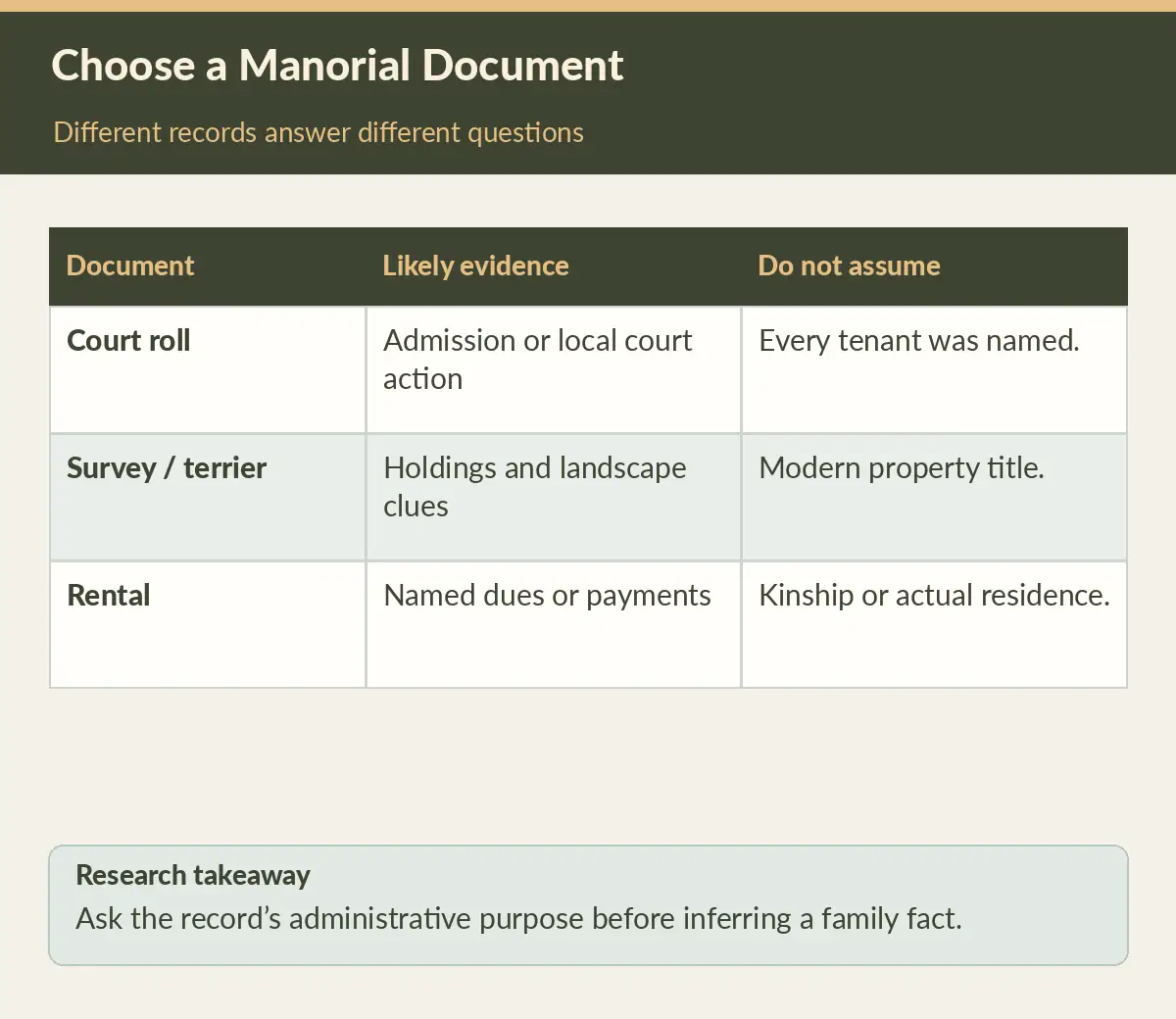
Court rolls record business transacted at a manorial court and can include admissions, surrenders, copyhold transfers, local regulations, disputes and fines. Surveys, rentals and terriers often record different aspects of holdings, tenants, boundaries or dues. Selecting only “court roll” in the MDR can miss a useful estate survey, just as a map cannot replace an entry confirming the legal event.
Build a record-type inventory with date ranges for the target manor and neighboring manors. Before searching for a person’s name, ask what the document was created to administer. The purpose of each record determines which family questions it could reasonably answer.
Follow the Holding Repository Rather Than Assuming Kew
The National Archives manors guide explains that manor records can be dispersed among county archives, estate collections, private holders and national repositories. The National Archives itself tends to hold material that entered Crown, duchy or central-government hands.
An MDR result gives a record location and sometimes a catalogue reference; inspect the custodian’s current finding aid for the precise item, condition and access options. Historic documents may require an appointment, on-site consultation or a copying request. Do not confuse “indexed by the national register” with “digitized by the national archive.” Capture the repository name and collection reference in full.
Account for Date Forms and Languages in Court Rolls
Older rolls may use Latin, abbreviations, legal formulas and dates expressed through regnal years or saints’ days. The court heading often identifies the type of meeting, date and presiding official. A year-only reference in a modern index may not resolve the exact meeting date.
Copy the original words and record a normalized date separately with an explanation of how it was derived. Look for entries about admission, surrender, heriot and successive holders, but do not treat every recurrence of a name as the same life event. A later copy of a roll is a different documentary witness from the original record.
Reconstruct a Holding Without Assuming Direct Descent
Suppose a series of court roll entries names John Carter, then another Carter, then a woman described as widow. These notices may concern a transferable holding or dues, but without explicit relational language they do not prove a father-son line. Make a chronology recording the manor, tenement description, event, court date and every named party.
Compare locations, neighboring holdings and any distinction between surrenderor, admittant and landlord. Use parish baptism, marriage and burial records to test potential family connections. Where multiple men share a name in the same decade, keep competing reconstructions rather than forcing an attractive succession into a proven pedigree.
Distinguish Copyhold, Occupation and Land Title
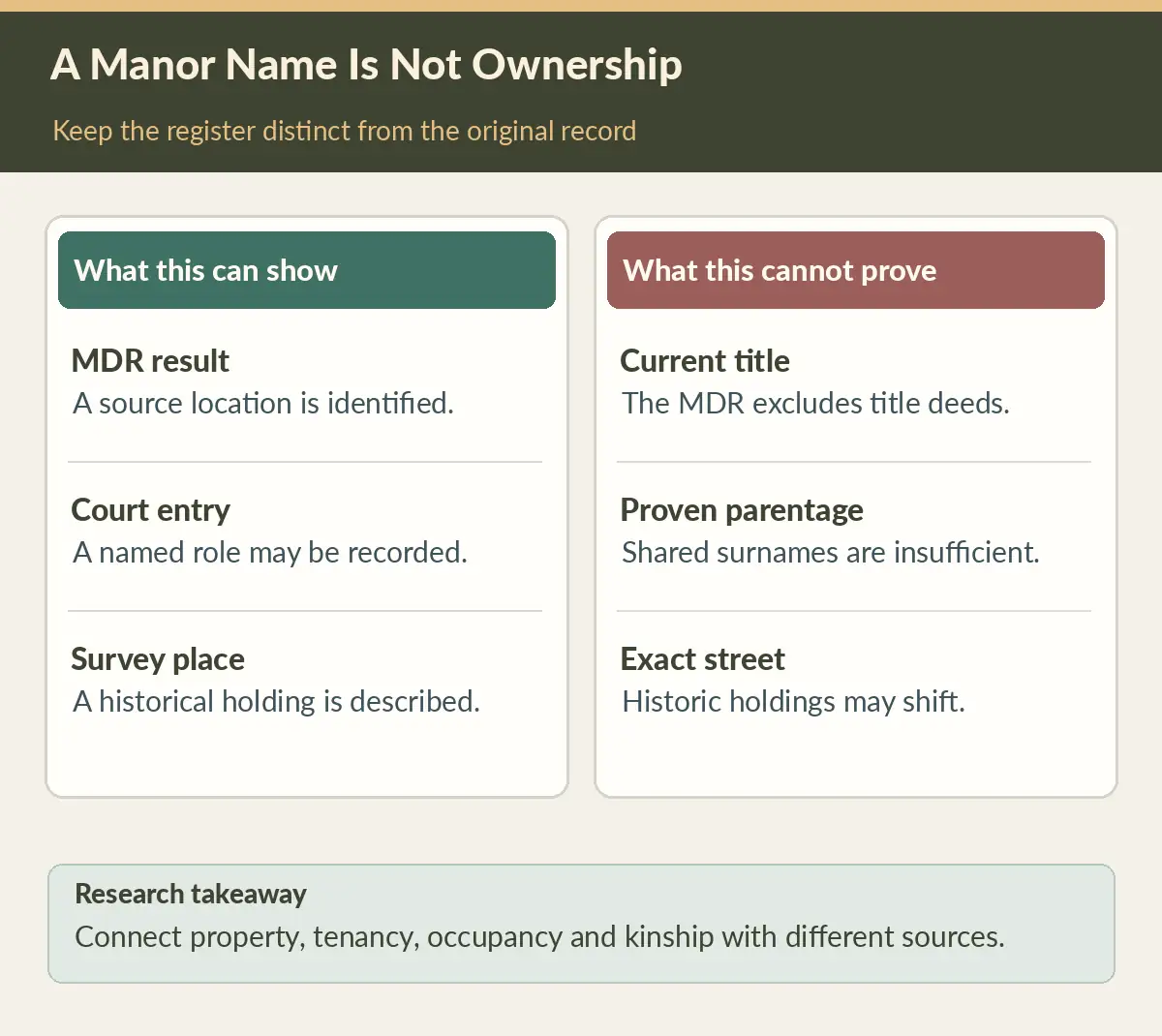
Manorial records may preserve evidence of customary rights or changes in copyhold tenancy, yet the MDR itself does not include title deeds and is not a register of ownership of lordships. The National Archives explicitly warns that the register lists historic documents and their locations, not current ownership of a manor or its lands.
A tenant named in a rent roll might not hold full freehold title or reside on the site in a given year. Separate four questions: who was recorded, what right or obligation was described, whether occupancy is evidenced, and where any title proof would be found. Avoid translating an historical manor name into a present-day street address without maps and corroboration.
Handle Gaps, Alternate Manors and Missing Originals
Some manor courts leave no surviving rolls for the period sought. Others preserve scattered years, fragments or later abstracts at a different repository from the main archive. Search alternate manor names and neighboring jurisdictions, then consult the custodian’s catalogue for additional unindexed estate papers.
A negative MDR result may mean missing metadata or historical documents rather than absence of the family. Record each name variant, county, date filter and record class tested. If access restrictions prevent examining an item, say “located but not inspected.” This is more useful than silently treating a catalogue title as a fully read record.
How We Research a Manor Court Record
Our method begins with an independently sourced historical place and date. We identify candidate manors through the MDR parish and manor indexes, inspect record-type coverage, and retrieve the archive reference from the holding repository.
We distinguish the finding aid from any transcript and seek a legible original or trustworthy scholarly edition before making a specific claim. We transcribe roles and tenement descriptions, compare independent parish evidence and preserve unresolved namesakes. The affiliate disclosure makes our editorial relationships clear; the National Archives MDR and each source repository provide the documentary backbone of the research.
More House and Local History Guides
Build a Manorial Citation That Others Can Follow
A useful citation names the manor, historic county, court or survey type, date, present custodian, collection and item reference, folio and the original entry. Include the MDR description only as the route to that document if you have actually consulted the underlying record.
If a county archive has digitized the manuscript, add its stable viewer identifier and the image or folio. Preserve variants in the place name without silently modernizing them. Conclude with a limited statement about a named person’s recorded customary right, fine or appearance at court, not a sweeping property-ownership or family descent conclusion unless another source supports it.
It chiefly identifies manorial documents and their locations, not every individual named in them.
Yes. Search the parish-to-manor connections and alternate manor names.
No. Records are held across many repositories with varied access.
No. The register identifies documents, and title deeds are outside its scope.
Cite the holding repository, manor, series, court date, item and folio or image.