
Answer the Research Question Before Searching Names
A historical Army post hospital may appear in building and repair registers even when no patient roster or nurse list is available. The National Archives describes registers of construction and repair of post hospitals dated 1875–1917 in Record Group 112, the Office of the Surgeon General (Army). It separately describes a register of hospital construction projects dated 1919–1926. The two categories offer a route to a facility’s development, not a shortcut to medical histories. Start with the post, a date range and a building question.
An entry referring to repairs, appropriations or construction can help establish what the Army was administering, but it may not demonstrate that the work was completed at the date mentioned. It is equally important to avoid treating hospital building records as evidence that a particular soldier was hospitalized there or a specific nurse was employed there. RG 112 lists personnel, hospital and fiscal categories separately. Your research method should keep the physical building timeline distinct from the independently documented lives of its staff and patients.
Route the Search Through the Correct Construction Era
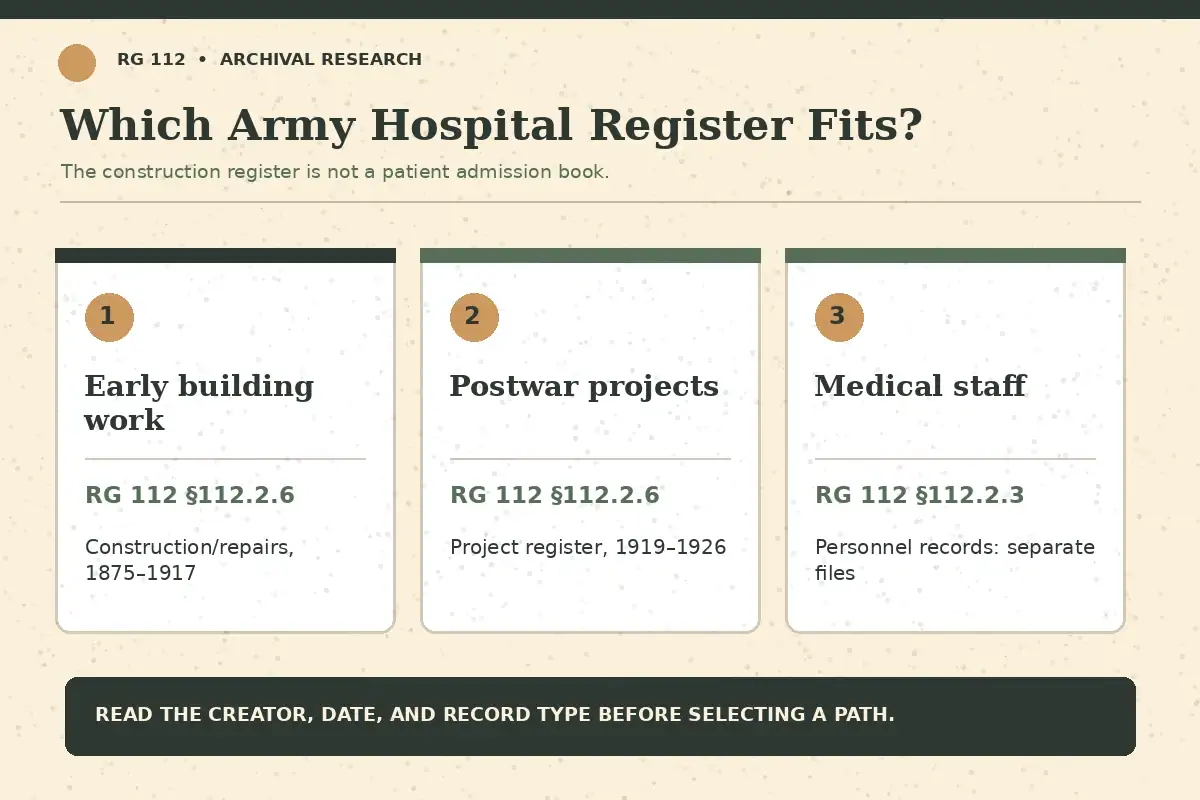
The date gate is clear in the NARA RG 112 guide. A post-hospital construction or repair question concerning 1875–1917 points toward the earlier registers. A question about an Army hospital building program in 1919–1926 may belong in the later construction-project register. The records might not use the same form, filing sequence or definition of a project. Ask for the finding aid and entry arrangement instead of assuming the two are successive volumes in one continuous register.
For a post whose name changed, establish the historically correct installation designation and jurisdiction at the relevant date. Avoid modern base names as the sole search term. A period newspaper can suggest a hospital inauguration, but it is not a replacement for the office’s register. Record the event date claimed in the newspaper separately from the document and from the engineering activity. Earlier entries may reflect planning while later entries reflect repair or an administrative inspection.
Distinguish Construction, Alteration, and Repair
An entry for construction is not identical to evidence of completed occupancy. A requisition, estimate or contractor authorization could precede a finished building by many months. A repair register may describe maintenance on a structure that was already standing, while a revised floor plan may depict intended changes that were never executed. Examine the actual record’s terminology and status column, where present, before writing that a hospital opened, expanded or moved.
Create a building ledger with columns for post, building name or number, nature of work, date of entry, creator and next corroborating source. Put “planned,” “authorized,” “in progress,” “inspected” and “completed” in separate categories only if the record genuinely uses such evidence. Do not invent a standard set of columns for all RG 112 registers. Photographs, annual reports or other federal plans may provide an independent test of what stood at a given date, but each needs its own citation.
Use Administrative and Fiscal Papers for a Second Check
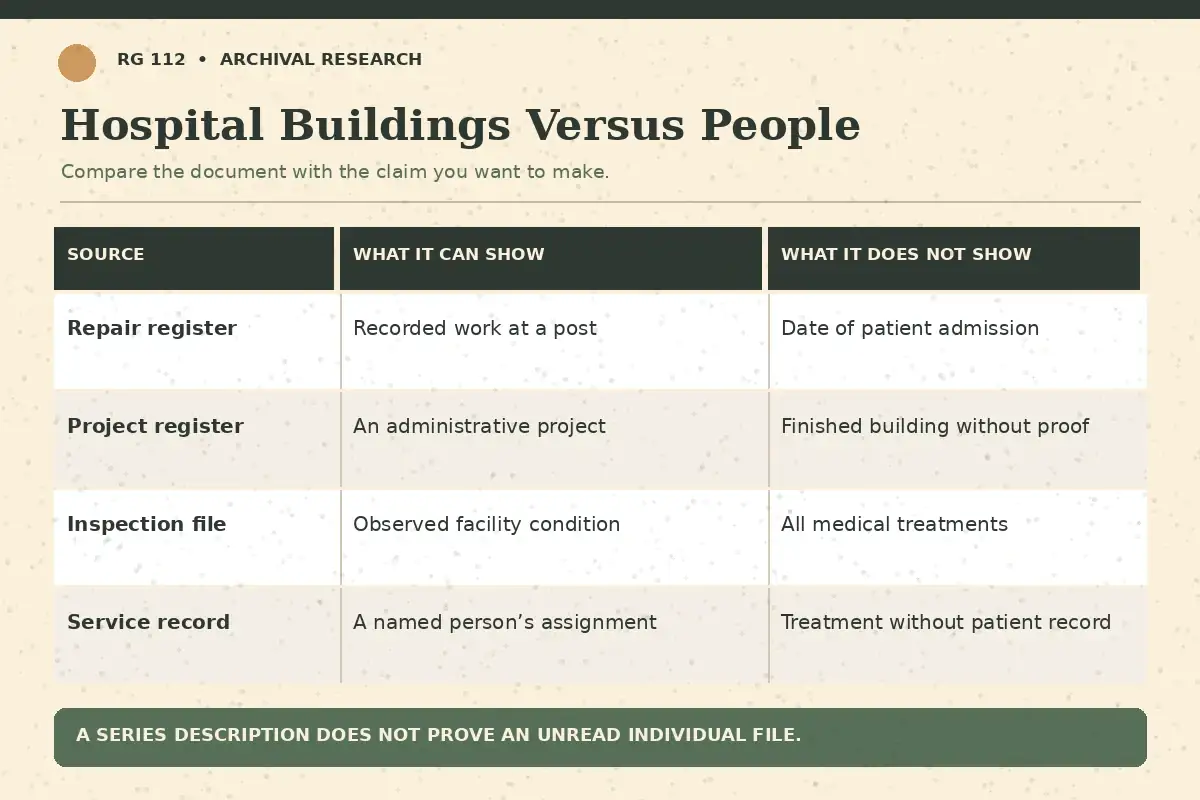
RG 112 also describes correspondence, estimates of funds, registers of contracts and various fiscal accounts. These can be useful when a building register provides only a short entry. For example, an inspection may name a facility while a payment abstract describes money disbursed. Yet an expense entry can concern supplies, salaries or preparation rather than proof that a new wing was physically completed. Confirm the purpose of the transaction before correlating it with a construction date.
The Office of the Surgeon General’s general correspondence changes over time, including a listed 1890–1917 sequence and later files. Some records may be filed under an Army installation, medical department office or contractor rather than the building itself. When requesting them, provide the post name, date interval and the administrative question. Do not silently merge a hospital at one fort with a similarly named institution in another state. Records for one post do not define nationwide access or preservation.
Keep Staff and Patient Research on a Different Track
NARA RG 112 §112.2.6 lists registers of hospital staffs and lists of hospitals from 1861–1870, a separate historical period. Section 112.2.3 describes other records of medical personnel, including service cards and registers of hospital stewards. Those categories cannot be substituted for the construction registers or treated as complete rosters at every later hospital. Start with the person’s rank, role and known service interval before searching a same-name staff entry.
Patient evidence is even more claim-specific. A hospital’s existence at a post does not mean every soldier stationed there received treatment, and a unit assignment alone does not establish a diagnosis. Medical files may have privacy, custody or survival limitations. If the question concerns a particular patient, consult appropriate service and medical record guidance and document what is open to research. Do not disclose living-person health details or infer illness from proximity to a military hospital.
Build a Credible Hospital Site Timeline

Create two timelines: one for the structure and one for the people named in independent records. On the building line list the hospital’s first documented mention, construction authorization if actually shown, dated repairs, inspection findings, photographs and any demolition or conversion evidence. On the people line enter only attributable service or residence dates. A source may prove that a hospital building existed in 1905, but cannot by itself connect a nurse listed on a later memorial to that location.
When writing up findings, cite RG 112, the specific series and register, post name, entry date, reference and repository. The NARA Catalog may provide only a series description rather than a scan, so seek the original record before asserting a particular entry. A careful conclusion might be that an 1898 register records repairs at the named post hospital; whether a relative worked or was treated there remains an open question pending individual-level evidence.
More House and Local History Guides
How We Research This Archival Record Group
We reviewed the official National Archives guide to RG 112 for the creating office, identified record categories, date ranges and the limits that make this search different from a broad keyword search. Its descriptions establish that particular materials are held or described, not that a proposed file, named person or unexamined document is already verified. We preserve distinctions between a series, a file unit and an item, and do not invent a catalog identifier where the source gives none.
We also cross-checked NARA guidance on using the Catalog and additional subject context from the sources documented for this page. Availability, digital access and processing arrangements can change; researchers should confirm the current custodian and request instructions. For reproducibility, cite the creator, RG number, series, file identification, exact date and where the original was consulted. If a link offers only an overview, say so instead of claiming to have read a specific manuscript page. See GenHis’s affiliate disclosure; this research route does not require a paid partner.
NARA lists post hospital construction and repair registers for 1875–1917 in RG 112 §112.2.6.
A separate hospital construction-project register covers 1919–1926; its format and scope should be verified.
Not automatically. Read the entry’s status and look for inspection, financial or photographic corroboration.
No. The named categories concern buildings; patient records are different and may have access restrictions.
Find a person-level medical personnel or service record matching the individual, post and date.