
CUST 130 contains London Port title registers and transfer books for registered vessels covering 1818–1994, according to The National Archives’ merchant ship registration guide. These records can help reconstruct documented changes in registered interests in a ship. They are not crew lists, voyage logs or a record of where an owner lived. Begin with the vessel’s historic name, approximate date and registration identifiers, then search the correct London Port volume and compare transfers with other registration material. A name written in a title book must be interpreted as the legal role shown by its heading, not automatically as captain, builder or passenger.
Confirm London Registration Before Choosing CUST 130
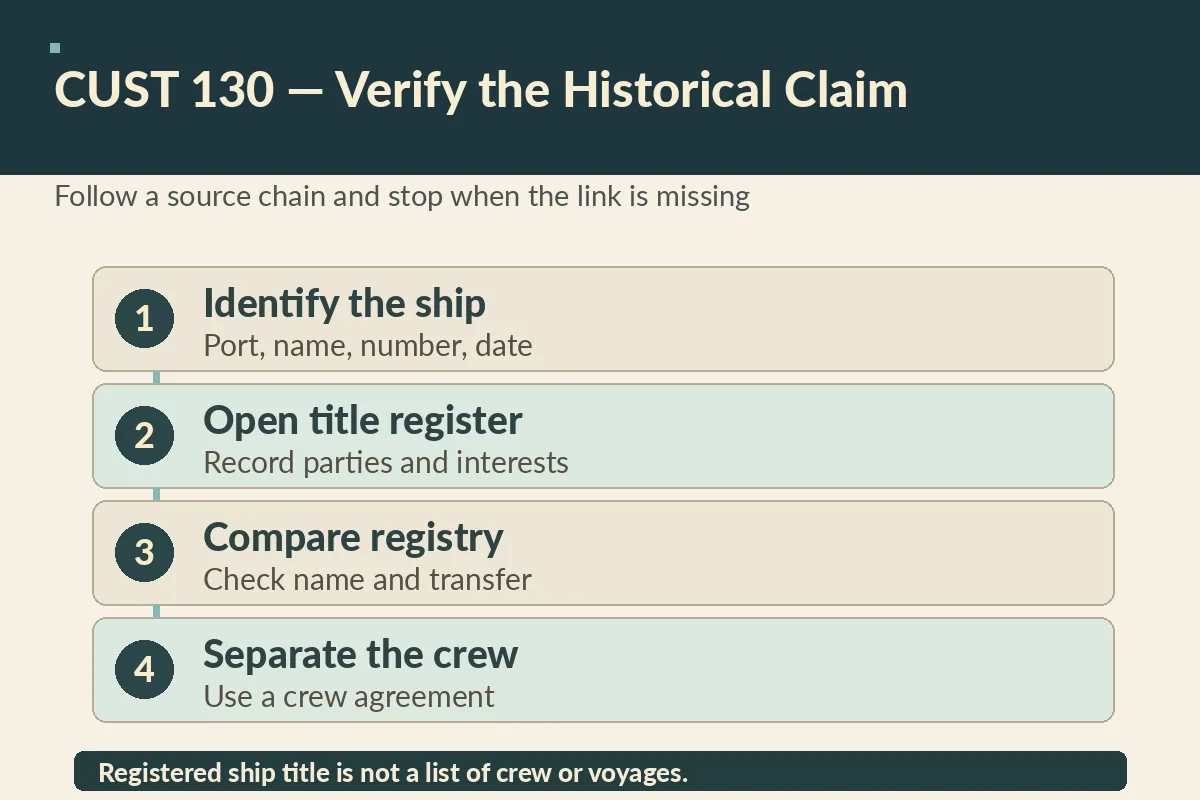
CUST 130 is specifically associated with the Port of London. A vessel seen in a London dock or named in a Thames newspaper was not necessarily registered at London. Begin with the port of registry and the ship’s name as it appears at the date in question. If the vessel was registered at another port, consult the registration books or related custody appropriate to that port rather than searching London title registers by habit. The National Archives registration guide distinguishes records grouped by place, historical date and registration system.
A ship could be built in one port, registered in a second and trading from a third. Those facts answer different questions. Keep four fields distinct: construction or origin, port of registry, home port if reported and port of actual movement. A newspaper saying a master sailed from London does not prove that the vessel belonged to a London owner. A historical map of warehouses near a dock establishes context for the port, not the ship’s registration number or owner’s land title.
Use Ship Identifiers to Control Changes of Name
Before later official numbering systems, research often requires careful use of a port registry number, vessel name, approximate date and construction details. From the mid-nineteenth century, an official number may help track a British registered vessel through name changes; always verify that the number belongs to the same ship rather than assuming identical names mean identical hulls. The registration guide describes changes in the governing records, including BT 107 for earlier registrations, BT 108 and BT 109 in the nineteenth century, and BT 110 for later closed registries.
Make a ship identity table containing vessel name as written, port, registration year, official or port number where available, rig or type and tonnage. A discrepancy in tonnage may reflect a new measurement, an alteration or a different ship; investigate before merging entries. When a title-book entry cites another book or volume, copy the original cross-reference and inspect the referenced item. A later register may summarize the earlier title but omit conditions or supporting signatures.

Read Transfers as Dated Interests, Not Family Relationships
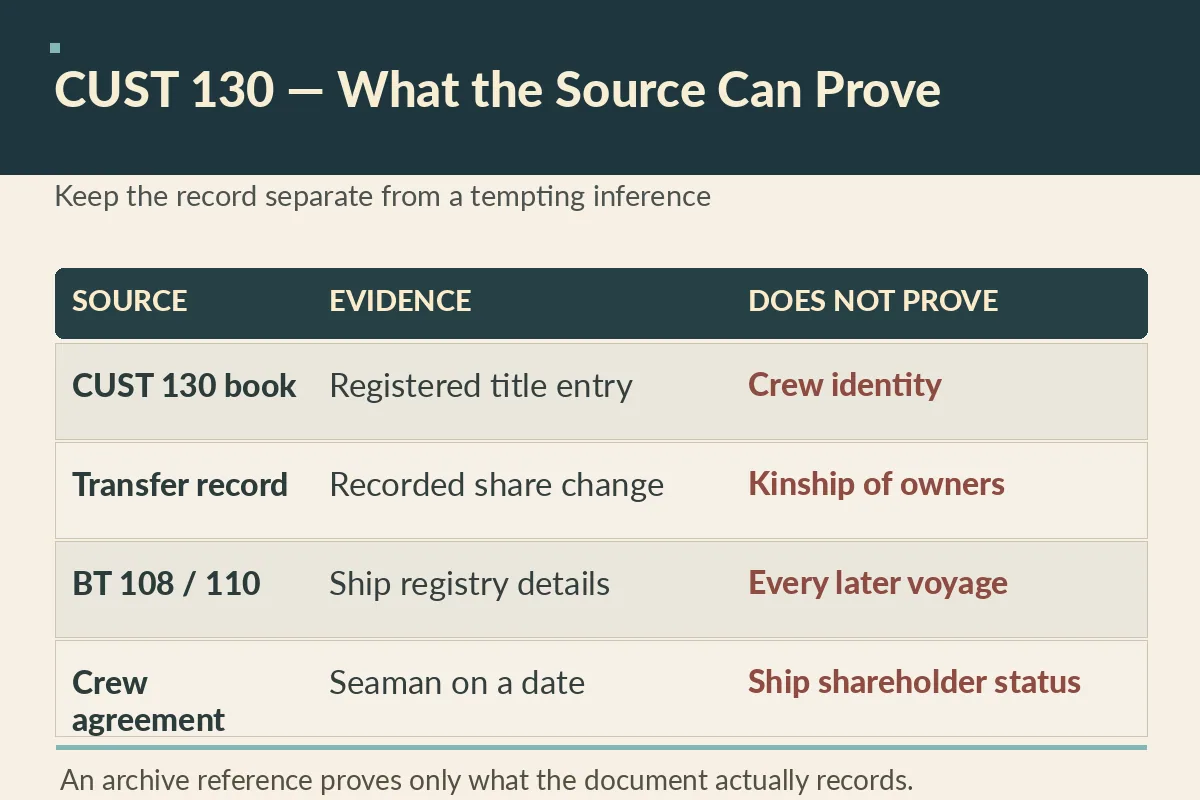
The key question for a title register is what interest was recorded, for whom, on what date and through which official procedure. Transferred shares or ownership entries should be transcribed as the book expresses them. A person whose name appears as a holder of an interest is not thereby shown to have captained the vessel. Shared surnames among owners do not prove kinship, and a registered address is not necessarily a household residence throughout the period. Distinguish the date of a deed or transfer from the date on which the registry recorded it.
If a title book records several successive transfers, do not collapse them into a single sale. Separate the outgoing holder, incoming holder, quantity of interest, recorded date and any explanatory references. A company name can identify the registered proprietor while leaving the beneficial ownership of the company a separate research question. An inheritance assertion requires independent probate or civil evidence. For a ship-owning family, combine the title entry with a probate, partnership document or newspaper notice only after confirming the persons and dates.
Compare London Title Books With National Registers
CUST 130 sits alongside other merchant ship registration material rather than replacing it. The National Archives guide explains the usefulness of BT 107 early registration books and the later BT 108 transcripts and BT 109 transactions, with the BT 111 indexes helping navigate selected groups. From 1889, BT 110 often keeps papers for a single ship together, but the arrangement follows historical closure and registry practices. Check which series is relevant to your vessel’s year and whether the London title register provides a complementary view of transfers.
Use a side-by-side comparison instead of treating one series as a master biography. A title book may help show a recorded interest at a date; a transcript can supply vessel particulars and named owners. If the two entries differ, check whether they refer to different dates, a name change or a later correction. Do not substitute an index description for the original registration document if the question depends on exact shares or identities. A blank in the online catalogue often reflects limited item-level indexing, not absent title transactions.
Do Not Turn Ownership Into Evidence of a Voyage
A ship’s registered owner, master and crew occupied different legal and practical roles. A registered shareholder could have remained ashore while a master operated the vessel, and a seaman could join or leave between ports. To research who sailed, use crew agreements, log books and personnel records, following the separate crew-list guide. A title record does not place the owner on the ship, and a crew list does not prove that a sailor owned shares.
Similarly, registration does not establish every trading journey, casualty or port visit. Search vessel movement cards, port clearances or maritime incident records as separate evidence. A transfer entered after a sinking or overseas sale may tell you about registry processing but not the ship’s precise location on the transfer date. If you are reconstructing the history of a named owner, keep legal ownership, occupation, residence and family relationships in distinct columns rather than presenting one record as proof of everything.
Make a Transfer Ledger With Precise Citations
For each CUST 130 entry, note the piece and page, register or transfer-book title, ship identifier, named parties, dated act and any linked document number. Preserve the spelling and capacity of each name as printed. If the relevant book is not digitized, plan a Kew visit or a copy request and avoid claiming that an online catalogue abstract confirms the transaction. Verify restrictions or reproduction rules for the particular document, not an imagined global rule for the series.
A concise final finding might say that a person was recorded as holding a specified registered interest in a London vessel on a given date, followed by the book reference. It should not say that the individual built the ship, lived at its port or commanded its crew unless distinct records establish those claims. An unresolved ambiguity in the ship’s identity should remain explicit. That caution makes the reconstruction useful to family historians, local historians and researchers of maritime businesses alike.
More House and Local History Guides
How We Research and Cite These Records
We read the National Archives ship-registration guide before searching CUST 130 and use the merchant crew guide as a separate check for person-level service claims. We track port of registration, name, number, recorded interest and transfer date independently. Catalogue references are treated as finding aids until the precise volume or copy is inspected. For commercial transparency see the GenHis affiliate disclosure.
London Port title registers and transfer books of ships, with covering dates 1818–1994.
No. Ownership and command are different roles.
Use the registration records and port-specific arrangements relevant to that port.
Compare official or port numbers and dated registration particulars.
Consult separate crew agreements, muster books and seamen records for the relevant date.