
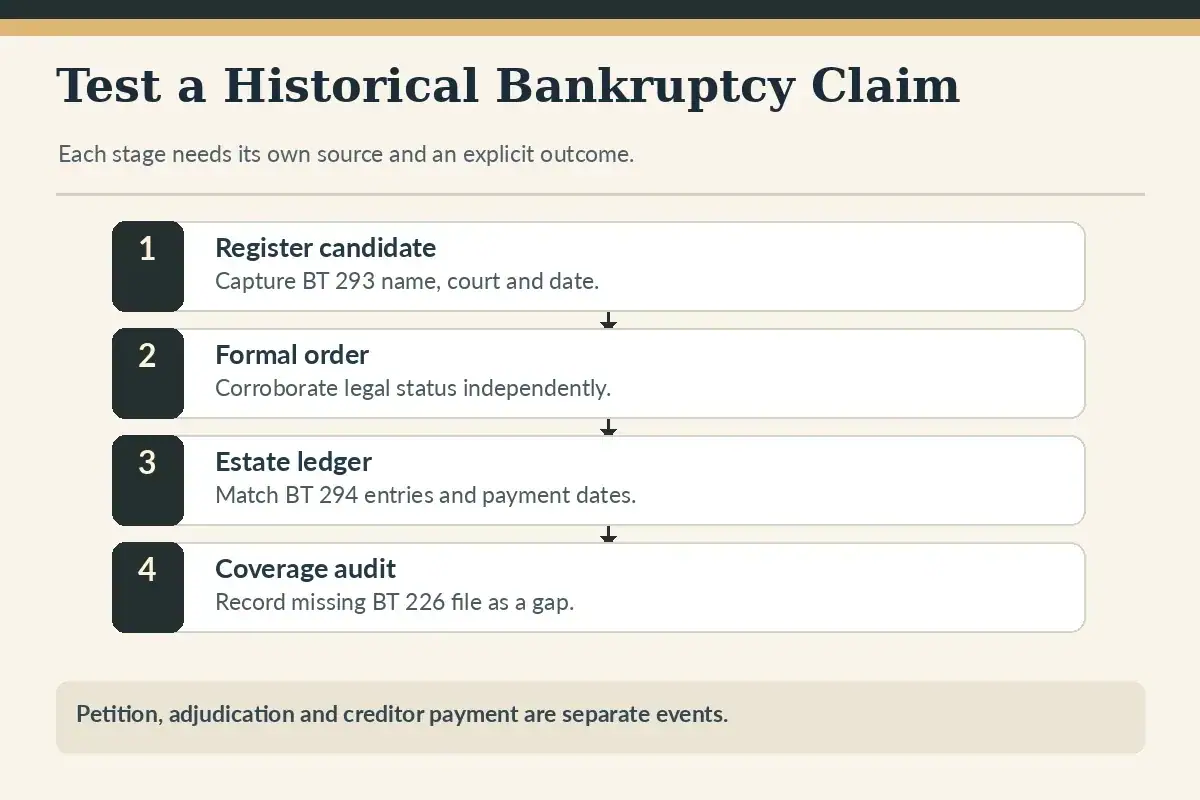
BT 293 and BT 294 document different parts of historical British bankruptcy administration. The National Archives says BT 293 contains official receivers’ registers of people served with bankruptcy petitions, while BT 294 comprises estate ledgers showing how assets of people declared bankrupt were distributed. A petition served on someone is not the same evidentiary event as an adjudication or a later payment to creditors.
These records can help investigate a shopkeeper, business owner or family enterprise after the late nineteenth-century changes in bankruptcy administration. They should not be presented as an automatic valuation of the family home or a complete statement of personal wealth. Start with a name, locality and year, and make three separate columns for the petition event, the legal status and any recorded distribution.
Follow the Post-1884 Official Receiver System by Record Type
According to The National Archives, after 1884 the Board of Trade supervised official receivers. These officials investigated circumstances, held creditor meetings and could administer estates on an interim basis. The records they generated therefore reflect both legal procedure and financial administration. A researcher should identify whether a volume is a petition register, an estate ledger or a separate case file before extracting information about a person or company.
The same guide lists BT 40 for London and county court bankruptcy registers, B 11 for High Court petition registers and B 12 for receiving orders from the later nineteenth century. Those are related but not interchangeable references. If your goal is to verify an order rather than a notice served, use the record type that can document the order. Do not summarize every file as “the bankruptcy record” without naming the component and its date.

Locate BT 293 by Date and Initial of the Surname
The National Archives recommends browsing official receivers’ registers in BT 293 by date and the initial letter of a surname. Before searching, write variants of names and trading styles. A person may appear under an individual name, partnership description or business name in related documents. Preserve the spelling used on the register entry; an index reference should not be silently replaced with the spelling on a later family tree.
Service of a petition may be an important clue to a financial dispute, but it is a procedural step. Never translate it automatically into “declared bankrupt.” Extract the date of service or petition, court, parties and any reference the page actually supplies. If the surname is common, include locality and occupation in a comparison table. Keep unresolved matches as alternatives rather than attach a stranger’s debts to the target family.
Read BT 294 as a Distribution Record, Not a Balance Sheet
The archive describes BT 294 as official receivers’ estate ledgers recording distributions of assets of people declared bankrupt. A ledger may help explain amounts paid to creditors and how an estate was administered. The sums it contains are not necessarily an appraisal of every possession, nor do they prove how much cash remained in a household after the proceedings. Record column headings, account dates and the recipient role before calculating totals.
A payment to a creditor cannot by itself establish a kinship relationship with the debtor. An estate ledger might use abbreviations or carryforward entries; those should be transcribed before interpreting any discrepancy. Distinguish the date of the initial court event from the dates on which assets were realized or dividends paid. If a payment is missing, it may be because that portion of the process is recorded elsewhere, not because no debt existed.

Understand Sampling, Gaps and the Role of BT 226 Files
The National Archives points to case files of the official receiver in BT 226, but explicitly warns that only samples of those files are included from 1914 onward, with indexes in BT 293. This matters for negative searches. A relevant BT 293 entry can survive even when no corresponding detailed case file is available. Failure to find a BT 226 file must not erase a properly cited petition or ledger entry.
There are also older payment books for the former insolvent debtors’ court within BT 294, covering 1875–1904, so avoid assuming every record found in the broader series concerns a post-1884 bankruptcy under the same administrative route. Check the catalogue’s piece title and institutional provenance. A series-level name is not a uniform description of every volume. Include a survival note whenever you report an unsuccessful case-file search.
Create a Three-Stage Case Ledger and Audit Namesakes
Consider a fictional grocer, Ellen Morris, whose name appears in a BT 293 search. A reliable account begins: “A person of this name was served with a petition according to the stated register,” provided the entry matches place and time. Next locate a dated receiving order or adjudication before writing that the individual was declared bankrupt. Only then should a linked BT 294 ledger be cited for distributions. A modern descendant’s recollection that the shop closed cannot fill the missing legal step.
Build a ledger with separate entries for documentary reference, record function, stated date, exact name, location, proven event, unresolved ambiguity and next corroborating source. Check Gazette notices as additional dated evidence, not as a replacement for estate accounts. If two Ellen Morrises operated businesses in neighboring towns, compare court, trade and addresses before combining any debts. Do not infer that creditors and partners must have been relatives.
More House and Local History Guides
How We Research Official Receiver Records and Financial Claims
The archive-series distinctions and access route follow The National Archives’ bankrupts and insolvent debtors guide. The catalogue search is available through Discovery advanced search, while The Gazette can offer dated notices of proceedings. The guide’s limitation on post-1914 BT 226 case files is particularly important to our interpretation of an absent file.
Ellen Morris is a fictional example; the text makes no allegation about a real person’s finances. Every factual financial claim should specify whether it comes from a petition register, court order, estate ledger or contemporary notice. External copy services may be paid; see our affiliate disclosure.
BT 293 records people served with petitions; BT 294 contains estate ledgers showing distributions of assets after bankruptcy.
No. Being served with a petition is distinct from a legal declaration or receiving order.
The National Archives recommends browsing by year/date and the initial of the surname.
No. The National Archives states that from 1914 only a sample was kept.
No. The accounts concern administration and distribution of recorded assets, not a complete household valuation.