
BT 253 at The National Archives preserves a sample of British Register of Business Names registration documents, not a continuous searchable list of every shop or partnership in the country. The Register was established in 1916 and abolished in 1981. A business name can differ from its legal owner’s name, and the existence of a registration does not itself prove who worked behind the counter, who held a lease, or when a shop actually opened.
The Archives identifies sampled material from 1916–1917 and every ten years from 1921 to 1981–1982. The approximately 1,300 pieces are arranged by registration-number batches and year. Search strategy must therefore begin with a likely date, a historical trading name and any known registration number, followed by explicit notes about selection gaps. A missing BT 253 entry does not prove an enterprise was unregistered.
Recognize what a registered business name means
The Register of Business Names chiefly captured businesses trading under names that differed from the owner’s name, or after later changes from a company’s official name. It was historically important because it brought partnerships and sole traders, as well as certain business entities, into a registration process. Do not translate “registered trading name” into “incorporated company”: incorporation creates a distinct legal entity, while a trading style may simply identify how a proprietor represented a business to customers.
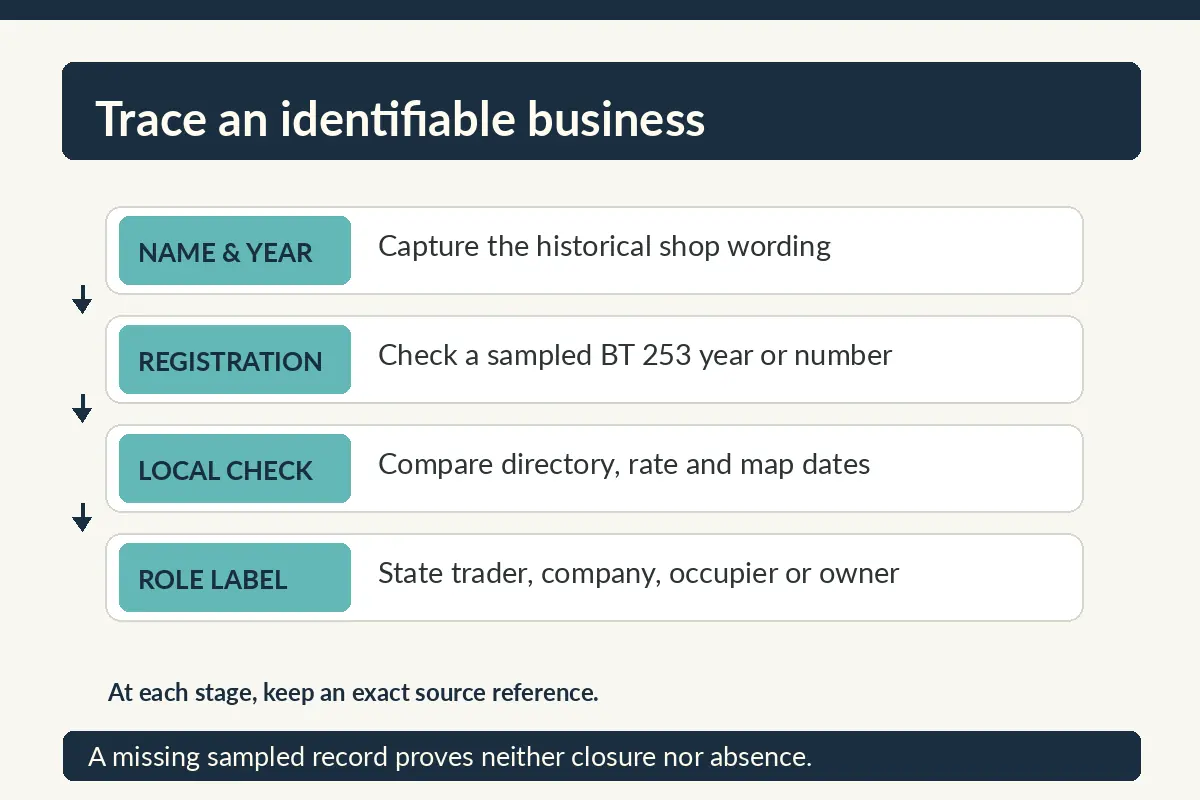
Start with the exact wording from the oldest advertisement, billhead, street directory, photograph or family document. Preserve punctuation, initials, possible abbreviations and successive name changes. A shop known informally by the proprietor’s surname could have a registered trading name that does not match the family’s oral memory. Conversely, two businesses in different places may have used similar public-facing names. Location and dates are necessary checks before combining records.

Use the sampled years as an explicit decision gate
The archive guide says BT 253 holds sampled registrations for 1916–1917 and every ten years from 1921 until 1981–1982. Work with those sample periods rather than assuming full annual coverage. A firm known to have traded in 1934, for example, may not have a directly corresponding BT 253 record from that year. Search a plausible sample and mark the result as a surviving selected registration, not as a universal register of all active businesses in that decade.
Browse the catalogue at series and piece level by year and the included ranges of registration numbers. The Archives warns that there is little chance of finding an individual registration without browsing the numbered batches. Do not claim that a search box will reliably retrieve every owner or shop name inside those batches. If a registration number appears in another document, keep it with the company address and date, then use it to narrow the records.
Separate registration from operating at an address
A registration entry may include useful declarations about a trading style, parties or business address, depending on the actual surviving form. Transcribe only the fields visible on that particular document. A recorded address could be a business or correspondence address; do not automatically call it a shopfront, warehouse, residence or freehold. The date of an application or registration is also not necessarily the first day goods were sold from that building.
To connect the enterprise to a physical premise, compare street directories, maps, local rate books and advertisements around the relevant date. An address renumbering or road-name change can make the same site appear different; verify with local records rather than guessing. For a claimed founder or long-term proprietor, seek dated evidence of the person’s role, not only a decorative sign. A registration is an administrative statement and may need independent confirmation of later business activity.

Do not confuse BT 253 with dissolved-company files
BT 31 holds a sample of legal and procedural records for companies dissolved since 1860 under later registration law, whereas BT 41 covers certain earlier joint-stock company records. These company files serve a different purpose from a business-name declaration. A trading name used by a partnership may have no incorporated company file at all. On the other hand, a registered company may operate under a public-facing name that differs from its legal title.
If you find an entity number or formal company title, decide whether a company-record search is warranted; do not send every family shop directly to BT 31. The National Archives also cautions that its central company records are selected and largely not day-to-day business books. Business ledgers, customer lists, payroll and photographs may survive with families, local repositories or a company archive, but they should not be presumed present in government registration papers.
Make a trading-name chronology with a confidence column
For each claimed business phase, record the trading name as printed, the source date, geographic area, named person and exact source reference. Add a separate column for what kind of relationship the paper supports: registration declarant, manager, advertised proprietor, ratepayer or building owner. Do not turn two roles into synonyms. If a family member appears in an advertisement without an address, note it as a lead until the location is independently connected.
The end result is a modest but useful statement such as, “A sampled BT 253 registration records this trading name at a specified date; independent directory evidence places a similarly named business at a stated street in another year.” If forms or directories conflict, record both. Flag missing sample years as archive coverage gaps rather than evidence of closure. This method preserves the distinction between a name, the people connected to it and the business premises.
More House and Local History Guides
How We Research and Verify These Records
This guide uses the record-series descriptions and the boundaries explained in The National Archives guide Secondary archival guidance. The sources identify the kinds of documents, their arrangements and possible access routes; they do not certify any particular ancestor, institution or map as independently inspected. Check each original item and the current catalogue access status before quoting a detail as a documentary finding.
We separate a catalogued lead from an original document, an administrative statement from an event, and a possible identity from a proven link. Historical names, jurisdictions and date ranges can be uncertain; missing entries are not negative proof. Reader information is editorial, not a claim of professional archival representation. Review our affiliate disclosure before following any commercial material on the site.
No. The preserved material is sampled, and its catalogue arrangement is by years and registration-number batches.
The Register of Business Names brought trading styles of such businesses into registration; eligibility depended on the rules in force.
No. A trading style and an incorporated legal company are different concepts.
Not by itself. Test lease, ratepayer and title questions through separate local records.
Use contemporaneous directories, trade advertisements and other evidence; do not infer absence from BT 253.