
A medieval name in King’s Bench indictment files, series KB 9 at The National Archives, records an accusation or a stage of criminal process—not proof that the named person committed the alleged act. KB 9 emerged between 1361 and 1385; its first surviving term indictment file dates from 1385, with good survival from 1391 onward. The practical research method is to find the correct term or special commission, transcribe the exact accusation, and then look separately for what happened to the proceeding.
This matters when an ancestor’s uncommon name appears alongside an offense and a locality. By the end of the fifteenth century, an indictment might identify an accused person, occupation, place and date of alleged offense, complainant or victim, and property involved. None of those descriptive details independently settles identity across generations, kinship, guilt, or sentence. Record each allegation as an allegation, and give the archive’s complete piece reference.
Choose the court period before searching for a name
Start with the approximate incident year and county, not a modern keyword search for a surname. The National Archives explains that KB 9 can be browsed by legal term until 1675. For later indictment files, London and Middlesex material falls under KB 10 and out-county material under KB 11, so a family account dated 1690 should not be placed automatically into a medieval KB 9 research route. Record the year, term if known, county, and all plausible spelling variants before selecting volumes.
A county reference requires care. King’s Bench was a central court that could exercise criminal jurisdiction during provincial sessions, and files could be returned by commissioned justices sitting locally. A document associated with a town does not mean every person named there was a resident of that town. Separate the alleged offense location, the jurisdiction or place of session, and the residence actually stated in the record. A modern county map is only an orientation aid, not a substitute for the historical label.
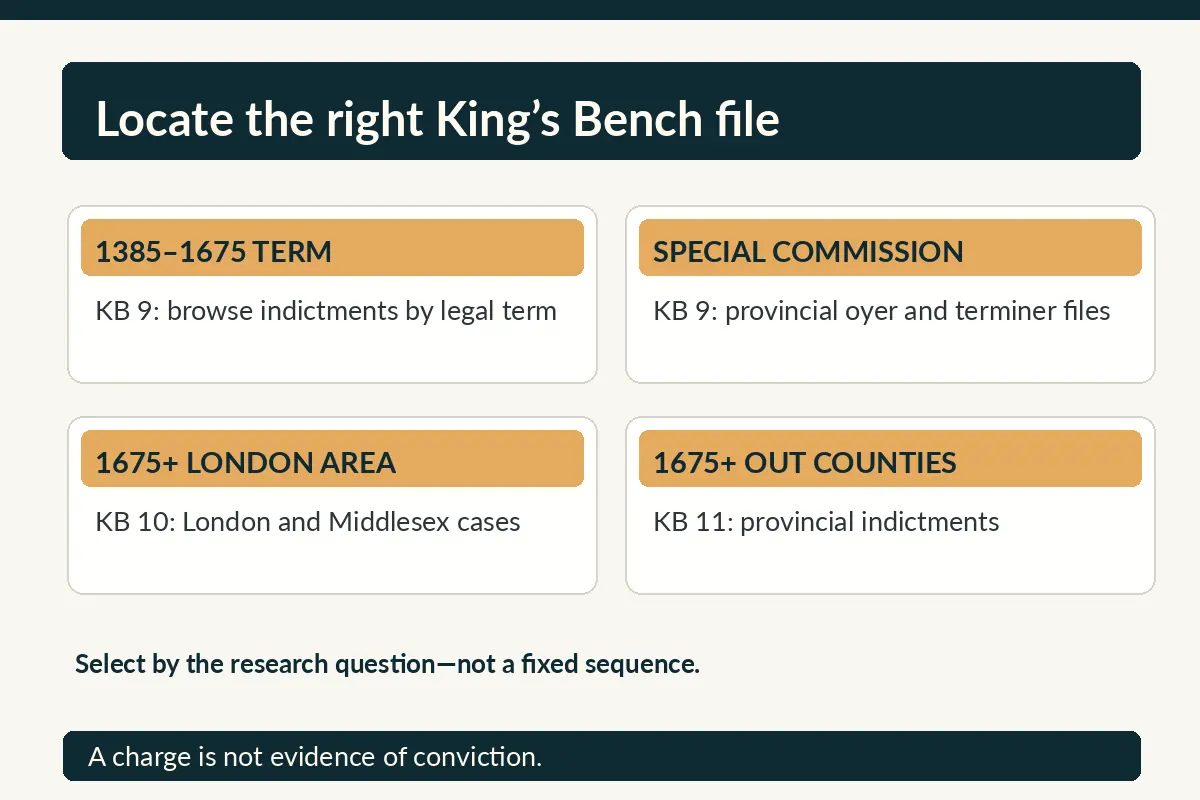
Distinguish ordinary term files from special commissions
The KB 9 collection includes main term indictments and separate files arising from provincial oyer and terminer commissions. Some special-commission documents were subsequently filed with ordinary term files, especially after 1430. If a known disturbance was investigated by a special commission, check whether the catalogued reference names that commission rather than assuming that all related papers belong to a single quarterly sequence. Make two candidate groups if the historical circumstances point to both routes.
Before ordering an item, save the exact Discovery description and its physical level: series, piece, file and any internal mark. Catalogued dates may describe the legal term or a file grouping, not the day of the alleged offense. Many early KB 9 files through 1562 are accessible online via the Anglo-American Legal Tradition project, but the Archives does not say every item has a searchable modern name index. Browsing images systematically may be more effective than expecting OCR to identify medieval Latin spellings.
Extract a charge as a bounded documentary statement
A useful transcription table has separate columns for the original wording, conservative translation, named role and inference. If an indictment alleges theft, capture the charge date, alleged place, defendant designation, victim and goods if present. Preserve abbreviations, uncertain readings and names that may be occupations rather than surnames. A clerk’s formula has a legal function; do not expand it into a narrative of what must have happened on the ground. Record whether the information comes from an actual file or an editorial calendar.
Next distinguish an accused party from witnesses, jurors, messengers and other people mentioned in process documents. The same name may recur because an individual served a legal role rather than because that person was indicted. KB 9 includes jury panels and procedural papers as well as charges. If a similar name appears twice, compare the occupational phrase, county, associated names and dates. Even a precise matching place is not conclusive without further identity evidence.

Look beyond indictment files for an outcome
An indictment begins a question; a separate record must answer whether the defendant pleaded, appeared, was acquitted, convicted, fined or otherwise proceeded against. The National Archives notes that controlment rolls can sometimes provide cross-references to indictment files, but ordinarily researchers may need to search files systematically. Treat a procedural return or jury panel as evidence of its own recorded stage, not a verdict. Do not convert an absent outcome reference into a presumed dismissal or conviction.
For later King’s Bench Crown Side material, the Archives describes KB 29 controlment rolls and their references to KB 10, KB 11 or, after 1845, KB 12; those references are period-dependent, not an automatic crosswalk for every medieval KB 9 file. If you use an index or modern summary, trace its citation to the original page before quoting the finding. Never say an execution or imprisonment followed a charge unless a separate reliable record supplies that fact.
Keep identity, language and uncertainty in a case ledger
Make one ledger row for each distinct action: alleged offense, filing, summons, appearance, disposition and later related notice. Record exactly where the action is documented. Medieval naming practices include bynames and variable spelling, and familiar modern surname forms can conceal multiple individuals. Use property transactions, tax lists, local court rolls or other independent records cautiously to test whether a defendant could be a person in your family history; none should be assumed from the indictment alone.
A defensible conclusion might say, “A KB 9 file for this legal term names a person of this designation in an indictment alleging a specified act; the outcome has not yet been established.” That statement is useful even if no verdict survives. Maintain a “not searched,” “searched but absent” and “unavailable” distinction in notes. The records you did not find are not evidence that no charge or proceeding existed, and an old editorial summary is not the same as inspecting the original parchment.

More Records and Archives Guides
How We Research and Verify These Records
This guide uses the record-series descriptions and the boundaries explained in The National Archives guide Secondary archival guidance. The sources identify the kinds of documents, their arrangements and possible access routes; they do not certify any particular ancestor, institution or map as independently inspected. Check each original item and the current catalogue access status before quoting a detail as a documentary finding.
We separate a catalogued lead from an original document, an administrative statement from an event, and a possible identity from a proven link. Historical names, jurisdictions and date ranges can be uncertain; missing entries are not negative proof. Reader information is editorial, not a claim of professional archival representation. Review our affiliate disclosure before following any commercial material on the site.
No. It is an allegation or part of criminal procedure; seek a separately documented outcome.
Often not reliably. Start with a likely legal term and county, then inspect relevant files and spelling variants.
London and Middlesex proceed in KB 10 and out counties in KB 11, according to the Archives guide.
No. Separate oyer-and-terminer files exist, and some papers were filed with ordinary term files.
No. Record each person’s explicit procedural role before identifying them with an ancestor.