
The National Archives identifies SUPP 9 aircraft data sheets and photographs as a useful Second World War technical resource. Its RAF research guide points to British aircraft in SUPP 9/1 and aircraft used by the United States Army Air Forces in SUPP 9/2. These records can help distinguish similar types and document a specification at a particular time. They are not flight logs and do not establish which pilot flew a specific airframe. Start by selecting the British or American collection, identify the type and model, then compare the sheet’s stated details with independent operational records only when you have a serial, unit or mission to test.
Choose SUPP 9/1 or SUPP 9/2 Before Searching
The official RAF research guide specifically separates SUPP 9/1 for British types and SUPP 9/2 for USAAF types. This is a practical division by collection, not a claim that an aircraft could never be used by another air force. Record which collection describes your target before interpreting national markings in a photograph. The wrong starting branch can create a misleading negative result when the aircraft’s origin, service operator and photographed location differ.
Search by the aircraft type’s contemporary designation, manufacturer and variant. Contemporary sources may use several names for a design or distinguish a model number from a later service name. Record the catalogue description and examine the actual data sheet when available. A type named in a file title is not evidence that every subvariant appears in full; the photographic guide warns that some data sheets have no photograph attached.

Read a Specification as a Dated Technical Statement
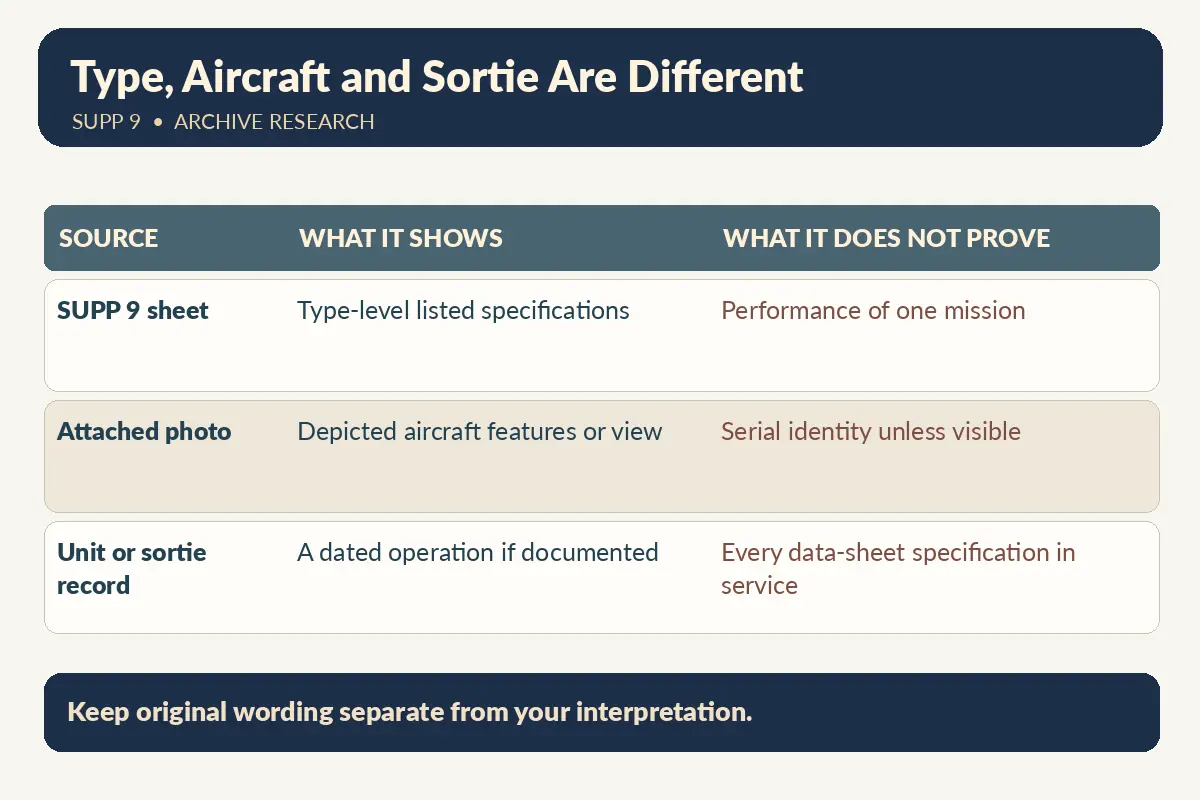
A sheet may supply dimensions, engines, performance figures, armament descriptions or other technical characteristics according to its format. Transcribe the date, amendment status and exact units. Do not combine figures from different revisions into one fictional “standard” aircraft. A listed maximum figure might reflect a controlled set of assumptions; operating conditions, equipment fit and wartime modifications can change what an aircraft actually achieved.
Make a type identification matrix with columns for version, source date, feature and confidence. Keep a photo observation apart from a number printed on a sheet. If the silhouette resembles another aircraft, check wing shape, tail, engines and visible fittings against a second source. Avoid filling invisible details by guessing. One side-view photograph rarely settles every equipment or production question.
Do Not Treat Type Photographs as Airframe Proof
A data sheet photograph may depict a representative example, an illustration supplied by a manufacturer or a selected publicity view. Unless a serial number or other unique identifier is legible and independently corroborated, the image identifies a type at best. Painted insignia may help with context, but alone cannot identify the exact unit, crew or mission date. Record visible markings as observations and separate anything supplied by a later caption.
For an individual service history, look for serial-number evidence, squadron operations records, maintenance books or an accident file. A type photograph cannot prove that an ancestor was aboard, that a photographed machine reached a combat theater or that it flew a specific sortie. The right statement is that a technical file describes the aircraft class. Any link to one person needs its own chain of records.
Compare Related AIR and AVIA Series Carefully
The National Archives aircraft research guide identifies AIR 10 publications such as pilot notes and maintenance instructions, AVIA files covering aircraft research, and operational command papers. These offer possible cross-checks, but they are not interchangeable with SUPP 9. AIR 10 may describe a procedure or approved equipment, while a squadron’s operation record can describe a dated flight. Neither should be cited for a detail it does not actually contain.
If an apparent specification conflict emerges, check source edition and model number before choosing the “correct” figure. A wartime technical type sheet might precede an upgrade described in a later manual. Likewise, a squadron log may use an abbreviated designation without identifying every factory modification. Keep multiple possibilities open until a serial-numbered record narrows the equipment fit.
Place Wartime Dates in the Right Documentary Layer
The photographic guidance dates the Ministry of Supply aircraft data-sheet collection to 1941–1945; that is collection scope, not a production certificate for every aircraft pictured. A sheet may discuss a type designed earlier or used after those years. Preserve at least four different dates where available: aircraft design, version or issue of the data sheet, photograph, and the specific operational event under study. Collapsing them into one date can create a false service timeline.
A positive identification is stronger when two independent features agree, such as a documented designation and a distinctive engine or wing arrangement. A negative identification requires care: a profile drawing may omit a hidden antenna, and photographs can be mirrored in reproductions. Do not claim a type never had a feature simply because the chosen image does not display it. The sheet and photo should be mutually checked, not treated as redundant confirmation.

Record an Exact Reference and a Testable Conclusion
A complete citation begins with SUPP 9/1 or SUPP 9/2, followed by any internal sheet identifier, page or image and its actual caption. If you saw only a catalog entry, note that. Do not cite a general aircraft guide as though it were the original data-sheet page. An image may need to be ordered or viewed at Kew, since the national photo holdings are not all digitized.
A defensible result might say: “The dated SUPP 9 sheet lists these characteristics for this named type and its accompanying image illustrates the visible configuration.” That does not establish a crew, a factory output quantity or one flight. Add a next-record column for the precise individual claim you want to test. This turns a specification into a research tool without turning technology history into invented family history.
More Records and Archives Guides
How We Research This Historical Record Series
We used the official The National Archives guide to photographic collections to establish SUPP 9 as an archive reference, its creator and what sorts of pictures the series may contain. The guide expressly warns that many photographs are hidden inside paper files, catalog descriptions may not name individual images, and not every record is online. Our method distinguishes a guide-level description from the unseen contents of any particular piece. Readers should use the archive’s Discovery search instructions, inspect the complete file when possible, and retain the difference between the file title, any original caption and their interpretation.
The illustrations are original explanatory artwork rather than facsimiles of any named archival record. The three research aids show alternative starting routes, an evidence-limits table and a conditional corroboration path, not a claim that each pictured item survives. A further research source supports this specific limit: identifies SUPP 9/1 British RAF aircraft types and SUPP 9/2 USAAF aircraft technical sheets, with related AIR 10 and AVIA records. The National Archives citation guide describes how to retain department, series and piece identifiers. If a record was not accessible, report the exact catalogue level reached; never claim an unviewed photo reveals an unnamed person or an unrecorded event.
We also reviewed the supplied GenHis topic inventory for existing SUPP 9 coverage and separated this article’s question from related guide pages. The recommended cross-check depends on what the reader actually has: a date, address, individual name, event or design. A missing photograph, a closed piece and an unindexed file are not evidence that an event never happened. Disclose missing evidence, document future checks and do not infer legal, professional, engineering or biographical outcomes from one picture. See the affiliate disclosure for site transparency; no archive source here represents a commercial endorsement.
They are separate divisions: the official RAF guide identifies British type sheets in /1 and USAAF types in /2.
No. The National Archives cautions that photographs are not attached to every sheet.
No. A person-level claim requires independent named flight, personnel or squadron evidence.
No. They report type-level technical information within stated conditions, not the results of every operational flight.
Type designation, variant, sheet date, photo caption, visible features and the exact SUPP 9 reference.