
MH 9 contains registers of paid Poor Law officers, not an inmate census. Start with the correct union and read appointments, pay and resignations in context. Begin at the official research guide, and review the GenHis affiliate disclosure before using outside access providers.
Find the Poor Law Union Before the Individual
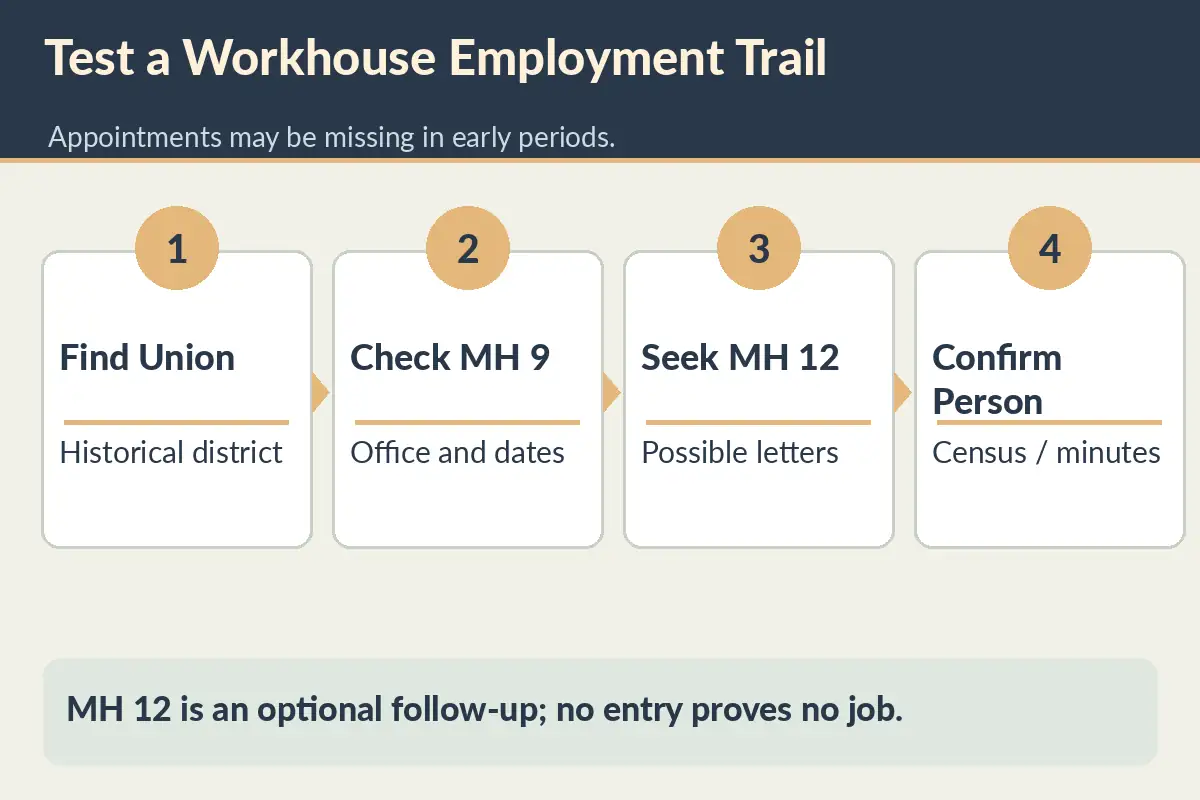
The National Archives identifies MH 9 as registers of paid officers of Poor Law authorities and successors, broadly 1837–1921. They are arranged geographically rather than catalogued under every employee surname. Begin with a dated census address, trade directory, letter, or appointment notice to establish the Poor Law Union. A modern town label is not necessarily the historical union’s name. Keep a worksheet for union, district, approximate dates and staff role before opening a volume.
A person living beside a workhouse was not automatically its employee. Census occupation “porter” or “matron” may refer to another institution. Confirm whether the identified establishment was a union workhouse, school or infirmary, then locate the appropriate officer class. Note neighboring unions for border settlements, and do not assume an official serving one union stayed there throughout an entire decade.
Read the Appointment and Salary Columns
The registers may record officers’ names, service dates, pay, allowances such as rations or light, and reasons for resignation. Masters, matrons, chaplains, medical officers, teachers and porters appear among the possible occupations. Read the original heading and surrounding entries: an amount may be a salary or an allowance, while an appointment date need not be the first day work was performed. A brief surviving line is not a complete employment history.
Make a transcription grid with name as written, office held, district or union, entry date, money field, annotation, and exact MH 9 reference. Distinguish resignation, dismissal, transfer and a death only when the text explicitly supports the label. If an index supplies a name without the original page, keep the claim at candidate level and do not advertise a specific wage until you inspect its column.

Account for the First Decades of Missing Appointments
Although MH 9 spans 1837–1921, The National Archives cautions that registers were compiled only from the 1840s and 1850s onward. Early staff and very short appointments can therefore be absent. A blank name search does not prove that an ancestor never worked for the Poor Law. Separate catalogue coverage, physical volume survival and whether an individual entry ought to have been recorded.
Use a dated search log rather than a single negative finding. Include the geographic district used in the original register, the officer type, the surviving periods, and whether you read an index or image. If the expected appointment predates surviving detail, search the Poor Law Union’s own minutes, guardians’ accounts and local newspaper notices for pay votes or contracts.
Link MH 9 to MH 12 Without Treating the Series as Twins
MH 12 contains correspondence between unions and central Poor Law authorities. It is not a duplicate personnel register, but it sometimes mentions appointment forms, disputes, salaries, staff removals and questions requiring central approval. The archive advises searching MH 12 by union and period. A useful MH 9 entry provides a date and precise office from which to frame a correspondence search.
The MH 12 catalogue is uneven: some letters have detailed digitised descriptions while most are described only by union and date. MH 15 contains subject indexes that may help route a topic, but it is not a comprehensive employee-name index. If an MH 9 resignation looks unexplained, examine correspondence without assuming a scandal; mundane administrative changes are equally possible.

Separate Staff Evidence From Inmate Evidence
MH 9 is a staff source, not a list of families admitted to the workhouse. For residents, check surviving local admission and discharge registers, births and deaths records and institutional population census pages. The National Archives emphasizes that the everyday records of workhouses generally belong in local or county archives. A workhouse manager’s name in MH 9 does not identify any particular inmate under that person’s supervision.
For relatives described as both an employee and a resident, build independent evidence lines. An institution schedule in the population census may list staff and residents together, but the census role does not tell you when employment began. Match age, birthplace, family and occupation against independent sources, especially when common surnames recur among several Poor Law officers.
State the Narrow Finding and Choose a Next Record
A defensible statement reads: “The MH 9 register records a person with this name appointed to this office in this union on the recorded date.” Adding that this was a particular ancestor requires a census, address, civil event or other identity link. Include the piece, folio or page, the label of each column and any later correction. Treat contradictions between salary books and census descriptions as evidence to investigate, not errors to erase.
If identity remains uncertain, use a local directory or family document; if dates are uncertain, consult successive MH 9 entries and guardians’ minutes; if the reason for leaving is ambiguous, search MH 12. The result is a repeatable employment trail with a clear line between administrative appointment and personal biography.
How We Research Mh 9 Workhouse Staff Registers
Our research begins with the original administrative purpose and the custodian’s description of the series. We record precise date and geographic limits, examine images or original pages before relying on a transcription, and attribute claims to their actual authors. Every identity link is tested against an independently created record. Search failures are recorded with the series, piece and available coverage; a missing item is not treated as proof of an event that never happened. The recommended next step follows the specific claim still unverified.
More Records and Archives Guides
Official Sources and Research Limits
For custody and scope consult the main archive guide (Confirms MH 9 officers register arrangement, 1837–1921, and local custody for inmate lists.). Check the second authoritative source (Documents MH 9 staff roles, fields, missing early appointments, and MH 12 correspondence.). Where the guides describe selected date ranges or copy sets, the original document-level catalogue reference controls the claim. Reading about an archival series does not mean an individual item has been inspected.
No. It concerns paid officers; inmate admission registers usually survive, if at all, in local archives.
The catalogue is arranged geographically, not indexed by each staff member’s name.
Examples include masters, matrons, chaplains, medical officers, teachers and porters.
Detailed registers began only in the 1840s and 1850s; some short service was missed.
Look for union correspondence in MH 12 and contemporary local records, where surviving.